


Local SEO services for small business help a company appear more prominently when nearby customers search for its products or services. Depending on your needs, they can include Google Business Profile management, location-page improvements, review processes, local content, citations, and reporting. Choose a provider based on the work you need done, the time your team can contribute, and whether success will be measured in qualified calls, enquiries, bookings, or sales—not rankings alone.
What local SEO services include—and who each is for
Local SEO is the work of making a business easier to find in geographically relevant searches, then making its website or profile more useful to the people who find it. A service may focus on one part of that process or coordinate several. The right scope depends on the business model: a single-location tradesperson has different needs from a retailer with several branches or an online store targeting local delivery areas.
Google says local results are mainly shaped by relevance, distance, and prominence; distance is not something an agency can directly change. A provider can improve the accuracy and relevance of business information and build signals that help customers and search engines understand the business, but no provider can guarantee a position for every searcher. See Google’s guidance on improving local ranking.
Common service categories
- Profile and listings management: Set up or improve the Google Business Profile, check key directories, and establish a process for updates and reviews. Useful for a new business, a profile with incorrect details, or an owner who lacks time to maintain listings.
- Local technical SEO: Diagnose indexing, mobile usability, site structure, and location-page issues. This suits a business whose pages are missing from search or whose site changes have caused visibility loss.
- Location content and on-page SEO: Improve service and location pages so each explains what is offered, where, and how to take the next step. This is relevant to multi-location firms and businesses competing for specific service-area searches.
- Reviews and reputation workflows: Help the business request genuine feedback and respond consistently. The business must supply the customer interactions; a provider should not promise to manufacture reviews.
- Measurement and consulting: Set up useful reporting, investigate changes, and advise an in-house team or agency. This can be a better fit than full execution when staff can implement recommendations.
Profile information should reflect the real business, not be changed to chase keywords. Google’s Business Profile representation guidelines explain how eligible businesses should represent themselves. For a service-area business, ask a provider to explain how it will handle the profile and location pages without implying a storefront exists where it does not.
Why the work matters—and what it can realistically change
Local visibility matters when a search is part of a nearby customer’s decision: choosing a dentist, finding a repair service, checking store hours, or comparing a local supplier. A useful result reduces friction between discovery and action. For a shop, that may mean a correct address and stock-related information; for a consultant, it may mean a clear service page and an easy enquiry route.
Local SEO does not control every factor that affects demand. A competitor may be closer to the searcher; a location may have limited search volume; and a profile can attract views without generating qualified enquiries. Set expectations around the customer action you want and the factors the work can influence, rather than treating a map position as a sales guarantee.
Choose outcomes that connect visibility to business value
Agree on a baseline before work starts. Separate visibility measures, such as impressions and clicks, from actions and business outcomes. Search Console can show how a site appears in Google Search, while a business should separately track whether calls, forms, bookings, or purchases are relevant and completed. Google describes the available search-performance measures in its Search Console Performance report documentation.
- For a local service firm: Track qualified calls and form enquiries by landing page, then note whether they match the service area and job type.
- For a clinic: Track appointment requests and completed bookings, not just profile views or calls that go unanswered.
- For a retailer: Track direction requests alongside store visits or in-store sales where the business can measure them reliably.
- For a multi-location brand: Compare each location’s visibility and leads while accounting for different markets, opening dates, and capacity.
These are measurement examples, not promised results. An illustrative starting policy is to review early implementation progress monthly and assess business outcomes over a period that reflects the sales cycle. Agree the review period and attribution method in advance; do not present every branded search or existing customer as a new SEO-generated lead.
How a provider diagnoses, prioritizes, and delivers the work
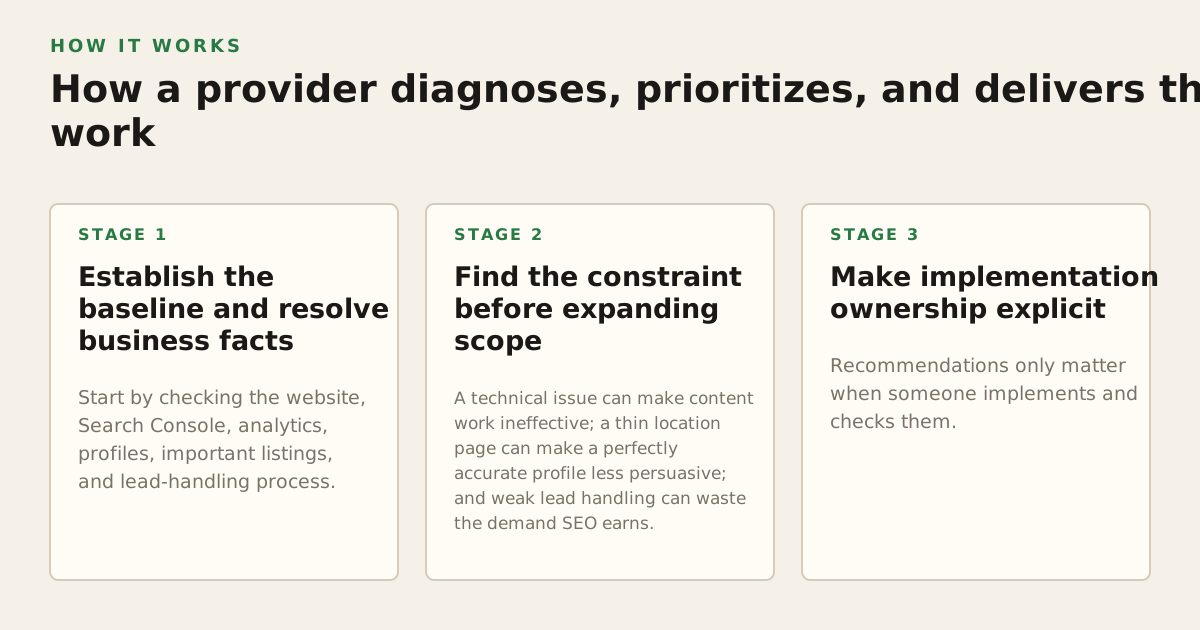
A sound engagement starts with access, evidence, and constraints—not a prewritten package presented before anyone has looked at the business. The provider should understand which locations are eligible, what the business sells, which customers it wants, what has already been attempted, and who will make changes. For an international company targeting Bangladesh, that also means clarifying language, location intent, and whether local pages serve distinct customer needs.
1. Establish the baseline and resolve business facts
Start by checking the website, Search Console, analytics, profiles, important listings, and lead-handling process. Confirm the business name, address or service area, phone, hours, categories, and location ownership with the client. Record major site changes, ranking losses, suspensions, and duplicate profiles. If access is missing, the first deliverable may be a documented access plan rather than immediate optimization.
2. Find the constraint before expanding scope
A technical issue can make content work ineffective; a thin location page can make a perfectly accurate profile less persuasive; and weak lead handling can waste the demand SEO earns. Prioritize tasks by likely customer impact, confidence in the diagnosis, implementation effort, and dependencies. For example, fix a broken enquiry form before commissioning more pages to send visitors to it.
Structured data can help search engines interpret page information, but it does not guarantee a special search display. Google’s Local Business structured data documentation explains the supported markup and its requirements. A provider should treat it as one technical aid, not a substitute for visible, accurate page content.
3. Make implementation ownership explicit
Recommendations only matter when someone implements and checks them. Before signing, identify who edits the site, who owns profile access, who approves copy, and who responds to reviews or enquiries. Ask for a prioritized work plan that distinguishes provider-delivered work from client tasks and includes a way to verify completion.
- Illustrative example: A plumber has one service area and an accurate profile but an outdated website. Start by fixing the contact path and improving the core service page before proposing many area pages.
- Illustrative example: A retailer has three branches with inconsistent hours. Correct location data and establish change ownership before investing in new local content.
- Illustrative example: A multi-location clinic has strong pages but unclear lead attribution. Define booking tracking and reporting before judging a content expansion.
Google’s SEO Starter Guide is useful context for discussing crawlability, page organization, and helpful content. It is not an audit or a substitute for examining the business’s own site and customer journeys.
Where local SEO engagements break down
The most common failure is a mismatch between the service sold and the work the business can support. A consultant may deliver technically sound recommendations, but a small team with no developer or copywriter may not implement them. Conversely, a business paying for ongoing execution may still need to provide approvals, service details, location access, and prompt lead follow-up.
Another failure is confusing activity with progress. A long report, a large citation count, or frequent rank screenshots do not establish that the right customers can find the business or complete a useful action. Ask how the provider handles tracking gaps, seasonality, and changes in lead quality. If calls are not recorded or sales are offline, the report should state those limits rather than imply precise attribution.
Pricing models and workload to clarify
Providers may propose a fixed-scope audit or project, a recurring retainer, consulting time, or a combination. The model should follow the work: a defined cleanup may suit a project, while ongoing content, profile changes, and analysis may require continuing support. Do not compare fees without comparing deliverables, revision limits, meeting time, access requirements, and who implements recommendations.
Ask what the quoted scope excludes, what could trigger additional work, and whether the business needs separate development, writing, photography, or call-tracking support. There is no useful universal budget figure without knowing the number of locations, site condition, competition, and implementation burden. Treat any proposed budget as a scope-specific plan with assumptions, not a guaranteed route to rankings.
Red flags worth checking before commitment
- A guaranteed map position or a promise to rank across an entire service area, regardless of distance or competition.
- Requests to share passwords instead of granting appropriate account access, or reluctance to explain who owns profiles and work products.
- Keyword-stuffed business names, fabricated locations, bought reviews, or location pages that add no distinct value for customers.
- Reports that show rankings but omit leads, implementation status, measurement limits, or the actions needed from the client.
Google advises businesses to represent eligible locations accurately and follow its profile policies. If an agency proposes a shortcut that depends on misleading business details, ask how that complies with the official representation rules and decline work that puts the profile at risk.
Choose a service type, then interview the provider
Use the table to narrow the scope before comparing proposals. A smaller engagement is not automatically better: it is a poor fit if the business cannot implement the work or if the central problem sits outside that scope.
| Buyer need | Service type to consider | Main trade-off |
|---|---|---|
| One location with inaccurate profile details | Profile and listings cleanup | Focused and manageable, but it will not resolve deeper website or lead-conversion problems. |
| Organic traffic dropped after a site change | Technical SEO audit and implementation support | Can address crawl and page issues, but requires access and often developer time. |
| Several branches need distinct search visibility | Multi-location strategy, local pages, and profile governance | More coordination and approvals; thin, duplicated pages can undermine the effort. |
| Leads arrive but are hard to attribute | Analytics and conversion measurement consulting | Improves decision-making, but does not itself create demand or fix every tracking limitation. |
| In-house team needs direction, not full execution | SEO consulting or a prioritized roadmap | Lower delivery burden for the provider, but the client must assign capable implementers. |
| Agency needs specialist strategy and reporting support | White-label consulting or scoped delivery | Can extend capacity, but responsibilities, client communication, and quality control must be explicit. |
Vendor interview checklist
Use these questions to test whether a proposal is specific enough to evaluate:
- What evidence would make you prioritize one issue over another for our locations and services?
- Which tasks will you complete, which will our team complete, and what access or approvals will you need?
- How will you measure qualified calls, bookings, or sales, and what will you report if attribution is incomplete?
- What is included in the proposed pricing model, what is excluded, and what conditions could change the scope?
- How do you prevent duplicate or low-value location pages and handle profile ownership, policy changes, and review requests?
- Can you show a sample deliverable with sensitive information removed, and explain how we would verify implementation?
For a location-page program, also ask how each page will answer a real customer question rather than swap a place name into a template. If your team is planning broader site improvements, the internal link opportunity tool can help surface relevant pages to connect; editorial review is still needed to decide whether a link is useful. For description drafts, the meta description length checker can support a final editing check, but relevance and accuracy matter more than hitting a character target.
Practical recommendation: Start with the smallest scope that addresses the verified constraint, includes an implementation owner, and defines a business outcome to review. If you need an independent roadmap or help connecting local search work to technical SEO and measurement, Mr Haq offers SEO strategy and consulting for local and international businesses.
Authored with NotFair SEO