


Local seo packages are scoped services for improving how a business appears in local search and turning that visibility into enquiries, visits, or sales. Choose one by matching its deliverables to your locations, website condition, and team capacity—not by comparing a list of tasks alone. A useful package may cover Google Business Profile, local landing pages, reputation, technical fixes, and measurement, with the mix adjusted for a single-location clinic, a multi-location retailer, or an ecommerce brand targeting regional customers.
The decision is not simply whether to hire an SEO consultant. It is whether a defined scope can address your actual bottleneck, and whether your team can provide the access, approvals, and operational information needed to do the work. Use the framework below to assess what belongs in a package, what to ask a provider, and what to prioritize first.
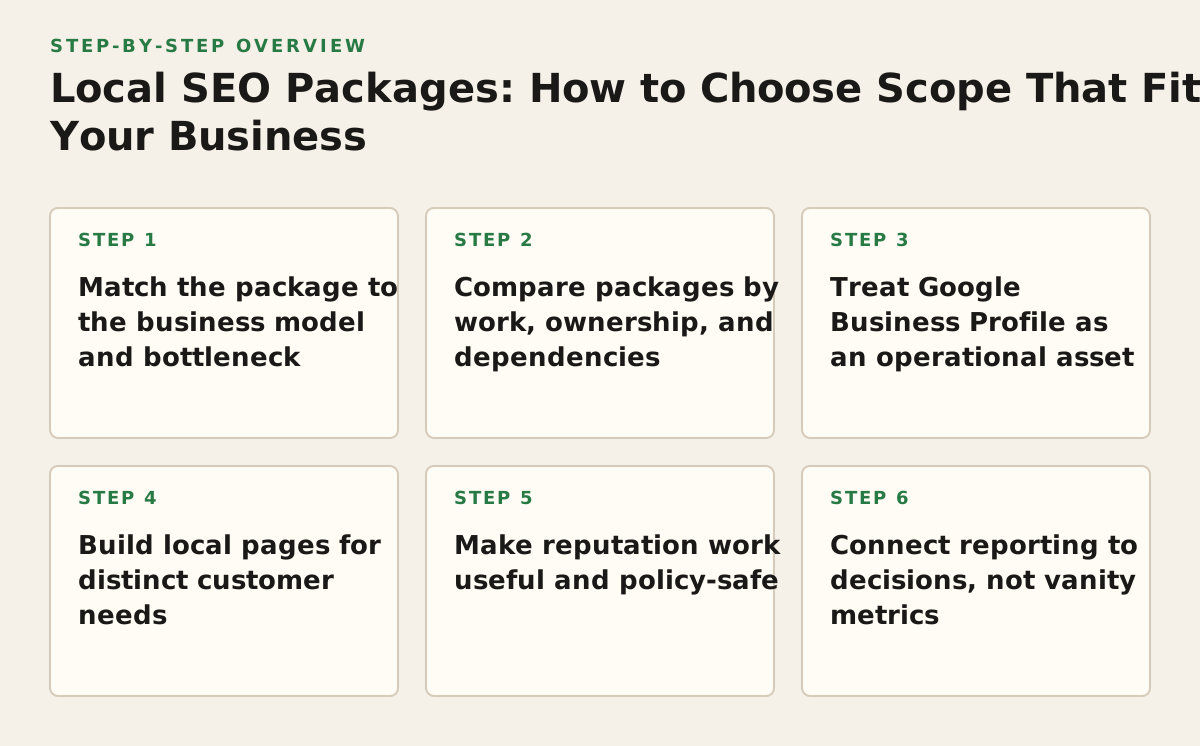
1. Match the package to the business model and bottleneck
Start with the customer journey the package is expected to support. A local service business often needs calls and qualified enquiries from nearby searchers. A retailer may need directions, product discovery, and accurate store details. An ecommerce brand usually needs non-location product and category pages as well as a credible local strategy where it has genuine physical operations.
This distinction matters because local optimization is not a universal checklist. Google says local results are primarily based on relevance, distance, and prominence; a provider cannot change a searcher’s distance from a business, and no package can guarantee a position for every query. See Google’s guidance on improving local ranking. A practical scope improves the factors the business can influence and identifies where location limits remain.
Translate the job into deliverables
- Single location: prioritize profile accuracy, service pages, conversion paths, and local reputation.
- Multiple locations: add location data governance, unique location pages, and a repeatable process for updates and reporting.
- Regional ecommerce: distinguish genuine stores or service areas from places the brand merely wants to rank; prioritize product and category visibility where there is no real local presence.
- Agency or international team: agree on ownership, approval steps, reporting format, market terminology, and who implements recommendations.
A package fails when the scope assumes a different business model. For example, paying for a large set of city pages does not solve a service firm’s weak enquiry form or an ecommerce site’s poorly organized product categories. Ask the consultant to name the main constraint, the work that addresses it, and the result that would indicate progress. A good answer connects tasks to a customer action, not just to a monthly activity count.
2. Compare packages by work, ownership, and dependencies
A scope list is only useful if you can tell what the provider will actually do. Clarify whether a deliverable is an audit, a recommendation, implementation, or ongoing maintenance. Then record the dependencies on your business: access to the website, profile ownership, location information, legal review, product data, and approval time.
Use this selection framework when comparing proposals. The “priority” column is an illustrative starting policy, not a universal ranking; move a workstream up or down after reviewing the site and business constraints.
| Workstream | Prioritize when | Confirm in the scope | Failure mode to watch for |
|---|---|---|---|
| Business profile and location data | Hours, categories, addresses, or service details are incomplete or inconsistent | Who verifies information and makes changes; how updates are approved | Changes are made without confirming real-world details or ownership |
| Local landing pages | Distinct locations or services need useful, searchable destinations | Page plan, content inputs, implementation responsibility, and conversion action | Near-identical pages are published for places the business does not serve |
| Technical SEO | Important pages are hard to crawl, index, use, or connect internally | Which issues will be fixed, who deploys them, and how they will be checked | Audit findings accumulate without a developer or release plan |
| Reviews and reputation | Customers are not consistently asked for honest feedback or responses are unmanaged | Request process, response ownership, and policy safeguards | Incentives or selective requests create policy and trust risks |
| Measurement and reporting | Leads, calls, or sales are not connected to organic landing pages | Metrics, reporting cadence, access, and limitations in attribution | Rankings are reported without showing whether qualified actions changed |
For each proposal, ask the provider to label the work as diagnose, recommend, implement, or maintain. For example, “technical SEO” might mean a one-time crawl and issue list—or it might include fixes, developer coordination, and post-release checks. Those are different scopes. If your team has a developer but limited SEO capacity, strategy and acceptance criteria may be more valuable than outsourced implementation; if no one can deploy fixes, recommendations alone may leave the core problem untouched.
3. Treat Google Business Profile as an operational asset
This workstream applies when a business serves customers in person or travels to them. A profile is not a substitute for a useful website, but accurate business details make it easier for customers to assess whether the business is relevant and how to contact it. Google’s local ranking guidance recommends completing and keeping Business Profile information current. Its Business Profile guidelines also set requirements for representing a business, including how names and locations should be presented.
Accuracy depends on business operations, not just SEO settings. The person managing the profile needs confirmed hours, service areas, contact details, categories, and the correct approach to any location changes. A consultant can organize and advise, but should not invent an address, add unsupported service locations, or make a business appear to have a staffed storefront where it does not.
Build a controlled update process
- Assign one business owner to verify location and service information before profile edits.
- Keep a shared record of approved business name, phone, hours, categories, and destination pages.
- Agree on who has access and who must approve changes that affect customer expectations.
- Check key details after operational changes, such as a move, a new service, or seasonal hours.
A common failure is treating profile management as posting frequency. Regular updates do not repair inaccurate hours or a poorly chosen category. As an implementation example, a clinic adding a new appointment type should first confirm that it is actually offered at the location, update the relevant page and customer information, and then review whether the profile’s available details accurately reflect the service. The package should specify who coordinates those steps and what requires clinic approval.
4. Build local pages for distinct customer needs
Local landing pages are most useful when customers need location-specific information: a service available at one branch, different opening hours, a local team, parking details, or a clear route to book. They work by giving both searchers and search engines a relevant destination rather than forcing every location query to a generic homepage.
Uniqueness should come from real differences, not swapped place names. Before creating a page, identify the local customer question it answers and the evidence the business can provide. A home services company might explain which work a branch handles, its service process, and how to request an estimate. A retailer could show location-specific contact details and store services. If those details do not differ, a separate page may add little value.
Check the technical foundations
Ensure the intended page can be discovered, indexed, and reached from relevant parts of the site. Use descriptive internal links, a clear title and heading, a working conversion path, and accurate page information. Structured data can help describe a business and its location, but it does not make thin content useful or guarantee a special search presentation. Google documents supported LocalBusiness structured data, while Schema.org’s LocalBusiness vocabulary defines the broader type and its properties.
Do not scale a weak page template across dozens of cities. That failure creates pages with little beyond a changed location name, and it can waste editorial and engineering time. As an illustrative workflow, draft one representative location page, validate its facts and conversion path with the local team, and use the approved structure only for locations that have meaningful information to contribute. To find relevant pages that could link to a new location resource, use the internal link opportunity tool.
5. Make reputation work useful and policy-safe
Review support applies when genuine customer feedback is an important part of how people evaluate the business. A package can help establish a consistent request and response process, identify recurring service issues, and ensure that review feedback reaches the people responsible for operations. It cannot guarantee that customers will leave positive reviews or that reviews will produce a particular ranking.
Ask for honest feedback without filtering for sentiment. Build the request into a normal customer follow-up process, and make it easy for customers to share their experience without pressure. Google’s Maps user-generated content policy prohibits fake engagement and describes restrictions on incentives and other attempts to manipulate contributions. Treat those rules as a constraint on campaign design, not fine print to review after launch.
- Choose a neutral point in the customer journey for a review request.
- Use the same opportunity for customers regardless of whether staff expect a positive response.
- Give the team a response process for both praise and complaints, with escalation for sensitive cases.
- Review recurring feedback with operations so the business can address service problems behind the comments.
The failure mode is optimizing for review volume instead of customer trust. For example, a multi-location retailer could define a consistent post-purchase request and let each store manager handle replies under shared guidance. The consultant’s role is to design the compliant process and reporting; the business remains responsible for the customer experience and factual responses.
6. Connect reporting to decisions, not vanity metrics
Measurement matters when owners need to decide whether to fix technical barriers, improve a page, expand a location strategy, or adjust lead handling. Agree on a small set of measures that reflect the business model: relevant organic landing-page visits, calls or form submissions where trackable, ecommerce transactions, and the search queries or pages that are gaining or losing visibility. Rankings can help diagnose changes, but a single position check does not describe the full customer journey.
Google Search Console’s Performance report provides search results data such as clicks, impressions, click-through rate, and average position. Those measures describe search visibility and visits from Google Search; they do not, on their own, prove that an enquiry became a customer. Pair search reporting with the business’s lead or sales records, and state clearly where attribution is incomplete.
Set a baseline before work begins, then compare like with like. For example, an agency supporting a client’s local campaign can report which location pages received organic impressions and clicks, which pages generated tracked enquiries, and what technical or content work was completed. If call tracking or CRM data is unavailable, report that limitation rather than presenting clicks as sales.
The report should prompt a decision, not just document activity. A useful format includes:
- What changed: pages, profile details, technical fixes, or content delivered.
- What moved: relevant visibility and customer actions, with the comparison period and data limitations.
- What happens next: the next prioritized task, its owner, and any approval or development dependency.
If you are preparing search snippets as part of page work, the meta description length checker can help review descriptions; treat the tool as an editing aid, not a promise that Google will show a particular snippet.
7. Implement in a sequence that removes blockers first
Use a sequence that moves from diagnosis to changes customers can use, then to measurement and expansion. The schedule below is an illustrative starting policy, not a universal timeline; legal review, engineering capacity, location count, and access delays can change the order or pace.
- Confirm the business facts and goals. Identify locations, services, target markets, conversion actions, profile ownership, and the pages that matter. Record whether the priority is calls, bookings, store visits, or ecommerce sales.
- Audit constraints before adding new work. Review crawl and indexation issues, existing location pages, profile accuracy, conversion paths, and available reporting. Separate urgent fixes from opportunities that depend on new content or development.
- Choose a focused initial scope. Assign each task an owner, approval need, and completion check. If a release requires a developer, agree on the handoff and validation rather than leaving the fix as an open-ended recommendation.
- Implement and verify. Check that profile information is accurate, pages are accessible and useful, links work, and tracked actions reach the right team. For multi-location businesses, validate the process on a representative location before applying it more broadly.
- Review evidence and re-prioritize. Compare search visibility with qualified actions and operational feedback. Expand the package only when the initial work is understood and the next constraint is clear.
Choose the smallest scope that can resolve the current bottleneck, but make sure it includes the access, implementation, and measurement needed to complete the work. If your team needs help defining that scope, Mr Haq offers SEO strategy and consulting across local SEO, technical SEO, content, analytics, and AI search optimization. Explore the options at Mr Haq and bring your locations, goals, and current constraints into the first discussion.
Authored with NotFair SEO