


A local seo checklist is most useful when it helps you decide what to fix first—not when it becomes a long inventory of platform settings. For a Dhaka retailer, a multi-location service company, an e-commerce brand with local pickup, or an agency reporting on behalf of clients, the job is to connect local search visibility with a measurable business action: a call, direction request, booking, store visit, quote request, or sale.
This guide gives you a sequence for making that decision. It separates the assets you control directly, such as your website and Google Business Profile, from signals you can only influence, such as reviews and third-party directory data. It also shows where local SEO stops being a technical problem. If your profile is accurate but customers cannot understand your offer, or if traffic arrives but calls are not tracked, more citations will not solve the underlying issue.
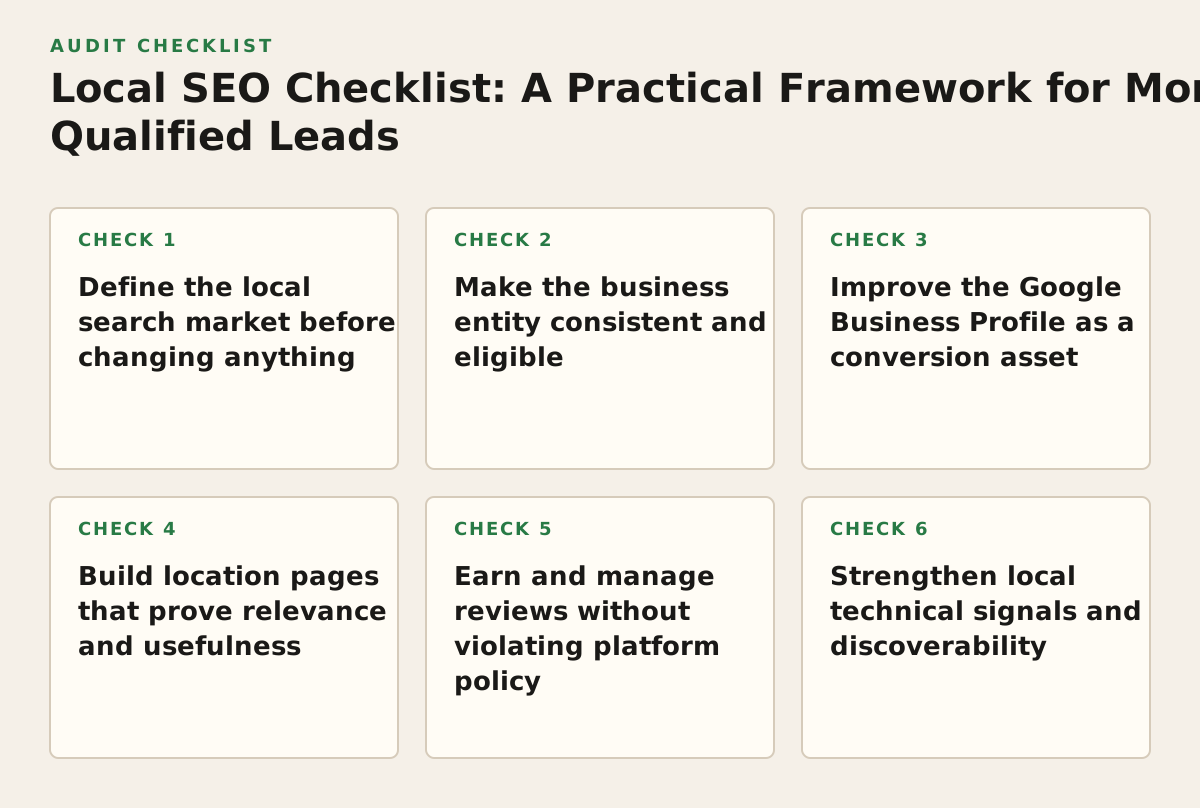
1. Define the local search market before changing anything
When it applies: Start here when a business serves several neighborhoods, has a service area rather than a storefront, or is expanding into Bangladesh or another market. A location name in a keyword does not automatically represent a viable market. You need to define the customer, service, geography, and conversion action together.
Why it works: Local optimization is constrained by operational reality. A company that serves only central Dhaka should not present itself as having branches across Bangladesh. An international company may need separate local experiences for Dhaka, Chattogram, Singapore, and London rather than one page that lists every city. Clear boundaries make your content, profile, and measurement more credible.
Build a service-area and intent map
- Core location: the city, district, or neighborhood where the business is physically based.
- Service area: locations the company can actually serve within its delivery, travel, or licensing constraints.
- Commercial intent: searches that imply a request for a product, appointment, quote, delivery, or visit.
- Research intent: searches for prices, comparisons, eligibility, opening times, or process details.
- Conversion proof: the evidence a visitor needs before contacting the company, such as qualifications, stock availability, turnaround time, or delivery coverage.
For example, a Dhaka-based air-conditioning installer could map “AC repair in Gulshan,” “split AC installation in Dhanmondi,” and “commercial HVAC maintenance in Dhaka” as separate intents. The first may need rapid emergency contact information, the second may need installation details and an estimate request, and the third may need service-level information and a facilities-manager contact path.
Failure mode: Creating a page for every neighborhood without a distinct service explanation. This produces thin doorway-style pages that differ only by place name and give users no reason to trust the business. A location page should exist because the service, logistics, proof, or customer questions materially differ there.
Implementation example: Put the target locations in a spreadsheet with columns for service, location, customer type, intent, landing page, profile coverage, and tracked conversion. Mark “not served” locations explicitly. That prevents sales teams, writers, and agencies from optimizing for areas the business cannot fulfill.
2. Make the business entity consistent and eligible
When it applies: Use this step for every local business, especially after a rebrand, address change, merger, domain migration, or move from a staffed office to a service-area model.
Why it works: Search engines and users need to reconcile the business name, address, phone number, hours, category, and website across places. Consistency reduces avoidable confusion, but it does not mean copying one description into every directory. The important principle is that the underlying facts must be accurate and the business must meet each platform’s eligibility rules.
Audit the identity fields that create the most friction
- Legal or publicly used business name and the name shown on signage.
- Primary phone number, including country code for international customers.
- Street address, suite information, map pin, and service-area configuration.
- Opening hours, holiday hours, appointment requirements, and temporary closures.
- Primary and secondary categories that describe the actual business.
- Website URL, preferred landing page, booking link, and contact route.
- Brand spelling and local-language variants used by customers.
Google explains how businesses can add or claim a Business Profile and manage information such as address, hours, phone number, and website in its official guidance: Google Business Profile help. Treat that documentation as the source of truth for the interface and eligibility process, because platform fields and verification requirements can change.
Failure mode: Changing a business name or category to include extra keywords. That can create a mismatch with real-world branding and make verification or user trust harder. Use the actual business identity, then make the website and supporting content explain the services and locations.
Implementation example: For a company with a staffed office in Banani and mobile service across Dhaka, use the real office details if customers can visit there. If customers cannot visit a staffed location, document the service-area model and avoid publishing a residential address merely to obtain a map presence.
3. Improve the Google Business Profile as a conversion asset
When it applies: Prioritize this section when the business receives calls, direction requests, appointment inquiries, or walk-ins from local customers. It matters less for a purely national e-commerce company with no local service or collection experience, although the company may still need accurate brand information.
Why it works: A profile is often the customer’s first practical interaction with a business. The decision is not simply “How do I rank?” It is “Can the searcher quickly confirm that this is the right business, open now, reachable, and relevant to the need?” Accurate information can prevent wasted calls and mismatched leads.
Configure the profile around the customer’s next action
- Select the category that best describes the core business rather than a high-volume adjacent service.
- Write a concise description that explains who you serve, what you do, and where you operate.
- Use current photos that show the entrance, interior, staff, products, equipment, or completed work.
- List services or products with names that match the website and the language customers use.
- Publish hours that the team can honor, including special or holiday hours where available.
- Use a booking, ordering, or contact URL that works on a mobile device and records the source.
- Review questions and answers for recurring objections, but never use them to publish misleading claims.
Google’s official Business Profile guidance covers editing profile information, adding photos, and managing customer interactions; use the relevant help center rather than relying on screenshots from older tutorials: Google Business Profile Help. The profile should support the website, not substitute for service details that require a full page.
Failure mode: Treating profile activity as a publishing contest. Frequent low-value posts do not compensate for an incorrect phone number, weak photos, or a broken booking path. Fix the customer journey before adding more updates.
Implementation example: A Dhaka dental clinic can make the first conversion path “call for an appointment,” while a furniture showroom may prioritize directions and a product catalog. Use separate tracked URLs or campaign parameters where appropriate, then compare qualified inquiries rather than counting every profile interaction as a sale.
4. Build location pages that prove relevance and usefulness
When it applies: Create or improve a dedicated page when a location has a meaningful customer base, distinct service logistics, a physical branch, or genuinely different local proof. A single service page may be enough when the business serves one compact area and the experience is not meaningfully different by neighborhood.
Why it works: A strong local page answers the practical questions behind the query. It explains what is offered, who it is for, how service works in that area, and what the customer should do next. It also gives search engines a clear relationship between the business, service, and place without forcing awkward repetition.
Use a page brief that requires evidence
- State the service and location in the title, introduction, and page structure naturally.
- Explain local availability, delivery boundaries, appointment procedures, or travel fees if relevant.
- Add a real address or service-area explanation; do not imply a branch that does not exist.
- Include locally relevant proof such as completed work, staff expertise, customer questions, or delivery examples.
- Show a clear contact action, expected response process, and any information the customer should prepare.
- Link to related service, product, pricing, policy, and contact pages so the page is part of a usable site.
- Review the page for duplicate paragraphs across cities and replace them with genuinely local information.
Google’s SEO documentation recommends creating helpful, reliable, people-first content and making important pages discoverable through logical site navigation: Google Search documentation. That is more useful than setting an arbitrary word count. A page should earn its existence by reducing uncertainty for the local customer.
Failure mode: Publishing dozens of near-identical city pages with swapped place names. This creates maintenance debt and can dilute internal linking and editorial quality. Consolidate overlapping pages when the offer and customer experience are the same.
Implementation example: An international B2B software company targeting Bangladesh could create a Bangladesh page only if it can explain local sales support, billing or procurement considerations, relevant customer requirements, and a real contact route. It should not create “Dhaka software company” copy that suggests a local office if none exists.
5. Earn and manage reviews without violating platform policy
When it applies: Use this process when reputation affects conversion, especially for healthcare, hospitality, home services, professional services, restaurants, and local retailers. Reviews are an operational feedback channel as much as a search asset.
Why it works: A review program creates a repeatable moment for customers to describe their experience. The durable benefit comes from better service and a larger body of honest feedback—not from manipulating sentiment. Ask every eligible customer through a neutral process and make it easy to leave feedback on the platform where the business is present.
Use a compliant review workflow
- Define the completed transaction or service event that makes a customer eligible to give feedback.
- Send one clear request through an appropriate channel, with a direct review link where available.
- Ask for an honest review without requesting a particular star rating or positive wording.
- Route service recovery through support as well, but do not block dissatisfied customers from reviewing.
- Respond calmly and specifically, avoiding private customer information in public replies.
- Record recurring complaints and assign them to an operational owner.
Google’s prohibited and restricted content policy identifies fake engagement and content influenced by incentives as violations, and its guidance should govern your review process: Google Maps user-contributed content policy. Businesses must not offer discounts, gifts, refunds, loyalty points, or other incentives in exchange for leaving reviews, regardless of whether positive sentiment is requested. A discount for future business can be a legitimate promotion only when it is not conditioned on submitting a review.
Failure mode: Sending review requests only to customers who report being happy. This creates selection bias and can undermine trust. A consistent trigger—such as delivery completion or appointment closure—makes the process fairer and gives management more representative feedback.
Implementation example: After a local appliance repair is completed, send a message thanking the customer, linking to the review form, and providing a separate support contact for unresolved issues. Do not say “leave five stars for 10% off.” If a review contains a factual error, respond with a concise correction and invite the customer to continue the conversation privately.
6. Strengthen local technical signals and discoverability
When it applies: Prioritize technical work when pages are not indexed, mobile users encounter broken layouts, important location pages are orphaned, redirects are inconsistent, or a migration has caused ranking loss. Technical fixes should follow a diagnosis, not a checklist ritual.
Why it works: Search engines need to access, interpret, and select the correct version of a page. Customers need the same page to load, understand, and use it. Improving crawl paths, canonical signals, structured data, and page experience reduces ambiguity, but no technical markup can compensate for an inaccurate business or unhelpful content.
Run a local technical audit
- Confirm each priority location page returns the intended status and is linked from relevant navigation or service pages.
- Check indexability, canonical URLs, robots directives, XML sitemaps, and redirect chains.
- Test phone links, forms, maps, booking flows, and WhatsApp or messaging links on mobile devices.
- Use one preferred URL for each location and redirect retired duplicates appropriately.
- Validate organization and local business structured data against the visible page content.
- Check language and country targeting when separate international versions exist.
- Inspect Search Console for indexing, manual action, security, and performance signals.
Google documents LocalBusiness structured data properties and examples here: Local business structured data. Schema markup can help machines interpret details, but it must describe visible, accurate information; it is not a method for adding hidden keywords or fictional branches. The Schema.org vocabulary also provides the broader definition of LocalBusiness types: Schema.org LocalBusiness.
Failure mode: Adding structured data while leaving a noindex directive, broken internal links, or contradictory address details in place. Markup is not a repair for access and consistency problems.
Implementation example: After migrating a multi-branch site, crawl the old and new URL lists, map every retired location page to its closest valid replacement, inspect representative URLs in Search Console, and test each contact path. If organic traffic drops, compare indexing and query data before rewriting every page.
7. Build authority through relevant local relationships
When it applies: Use local link building when the business has something useful to contribute to communities, suppliers, associations, events, media, or professional networks. It is especially valuable for newer sites and competitive service categories, but it should not become a directory-submission quota.
Why it works: A relevant mention can introduce the business to a real audience and provide context about its expertise or local involvement. The strongest opportunities usually come from something that already exists: a useful guide, original data, a community event, a partnership, a scholarship with legitimate eligibility, or a resource created for customers.
Choose relationships before link targets
- List local organizations, suppliers, chambers, universities, publications, and community groups connected to the business.
- Identify a genuine contribution: an expert interview, educational session, case study, event, or public resource.
- Check whether the audience matches the target customer and whether the organization is legitimate.
- Pitch the usefulness of the contribution rather than asking for an artificial keyword-rich link.
- Record the relationship, page, anchor context, audience, and outcome in a simple outreach log.
Failure mode: Buying packages of exact-match local links or publishing the same guest article across many sites. That approach creates artificial patterns and often produces irrelevant traffic. It also consumes time that could have gone into partnerships capable of generating referrals.
Implementation example: A Bangladeshi accounting firm could publish a plain-language guide for small exporters, collaborate with a trade association on a workshop, and offer an expert explanation for a business publication. The resulting mentions are stronger when they reflect a real contribution and send qualified prospects, not merely when they contain a target phrase.
8. Measure qualified local demand, not vanity activity
When it applies: Put measurement in place before an agency, franchise team, or internal marketing group changes pages at scale. It is essential when the business receives leads offline, because rankings and clicks alone cannot show whether local SEO is producing commercial value.
Why it works: Measurement connects an optimization decision to a business outcome. It also prevents teams from celebrating more impressions when calls are unqualified or service areas are wrong. Use a small set of reliable events and annotate major changes so performance can be interpreted rather than merely displayed.
| Business situation | Primary local asset | Priority action | Useful success signal |
|---|---|---|---|
| One storefront with walk-in demand | Business Profile and store page | Correct hours, directions, photos, and local inventory or service information | Qualified direction requests, calls, and in-store conversions |
| Service-area company | Service page plus coverage explanation | Clarify eligible locations, response area, and booking process | Completed bookings and leads within the service boundary |
| Multi-location brand | Branch pages and profile governance | Assign an owner for each location’s facts, reviews, and updates | Location-level leads, missed-call rate, and profile accuracy |
| International company entering Bangladesh | Country or market landing page | Explain local support, commercial process, language, and contact route | Qualified Bangladesh inquiries and assisted conversions |
| Penalty or ranking-loss recovery | Technical and content audit | Separate manual-action, indexing, quality, and demand problems | Recovery of eligible queries and lead quality after documented fixes |
Use Search Console for search performance and indexing diagnostics, and connect analytics or CRM data for downstream outcomes. Google describes Search Console as a service for monitoring and troubleshooting a site’s presence in Google Search: Google Search Console. For a reporting workflow, the meta description length checker can support page QA, while an analytics system should remain the source for calls, forms, bookings, and revenue.
Set a prioritization rule
- Fix issues that prevent customers from contacting or finding the correct business.
- Fix indexability, redirect, canonical, and migration problems affecting important pages.
- Improve the profile and pages with high commercial intent but weak conversion paths.
- Address repeated review and service complaints that reduce trust.
- Invest in local relationships and new content only after the foundation is reliable.
Failure mode: Reporting rank position without location, device, intent, or conversion context. Local results vary by searcher and place, so a single rank number can hide both opportunity and failure. Compare defined query groups with qualified leads and operational capacity.
Implementation example: If a clinic receives many profile calls but few completed appointments, inspect call handling, availability, pricing clarity, and booking friction before publishing another location page. SEO may have generated demand; the conversion problem may sit with the business process.
Implement this Local SEO Checklist in a controlled sequence
Use the following sequence as a starting policy for a small or medium-sized business. The order is more important than trying to complete every task at once.
- Document the market. List services, real locations, service boundaries, customer types, languages, and the conversion action for each priority area.
- Capture a baseline. Export current landing pages, profile details, review themes, indexed URLs, organic queries, calls, forms, and booking data. Record major site or business changes in 2026.
- Repair identity conflicts. Correct the business name, address, phone, hours, categories, map information, and website paths. Remove or redirect obsolete branch information.
- Fix conversion blockers. Test every phone number, form, booking link, direction path, and mobile page. Assign an owner and response standard for incoming local leads.
- Improve the highest-value pages. Start with pages tied to real services and locations. Add local proof, operational details, internal links, and a clear next action rather than thin city variations.
- Validate technical access. Check indexability, canonicals, redirects, sitemaps, structured data, language targeting, and Search Console diagnostics on representative pages.
- Establish the review process. Ask eligible customers neutrally, never offer incentives for reviews, respond professionally, and send recurring service problems to the operational team.
- Build relevant relationships. Choose a few credible local partnerships or useful resources that can earn attention, referrals, and legitimate mentions.
- Report business outcomes. Review qualified calls, bookings, forms, store actions, and revenue alongside visibility metrics. Keep changes annotated so future decisions are evidence-based.
For internal architecture work, the internal link opportunity tool can help identify relevant connections between existing pages. If the business has conflicting locations, a ranking loss, or a reporting requirement across markets, Mr Haq offers technical SEO, local SEO, content strategy, analytics, and AI search optimization consulting to turn this checklist into a documented operating plan. Mr Haq
Authored with NotFair SEO