


A link building agency helps a business earn or manage links from other websites through activities such as editorial outreach, digital PR, or link reclamation. To choose one, match its methods to your audience and pages, understand the work your team must contribute, and agree how outcomes will be assessed. No agency controls whether publishers link to you or can guarantee that a link will improve rankings.
What a Link Building Agency does—and what it cannot control
Link building is the process of getting relevant external websites to link to pages on your site. An agency may research publishers, develop a story or resource worth citing, conduct outreach, recover unlinked brand mentions, or report on placements. Some providers focus on one activity; others combine link building with digital PR, content strategy, or broader SEO.
The important distinction is how a placement is obtained. A publisher independently choosing to cite a useful resource is different from a placement arranged mainly to pass ranking credit. Google’s spam policies identify buying or selling links for ranking purposes, excessive link exchanges, and certain automated schemes as link spam. Review the Google link spam guidance when assessing a proposed method; in 2026, it remains a useful reference for separating editorial work from manipulative tactics.
A link may bring referral visitors or help people discover a resource, but it is not a substitute for a useful, accessible page. A provider can control its research and outreach process; it cannot compel an editor to publish, guarantee search visibility, or establish that a ranking change was caused by one link. Treat guaranteed rankings and fixed link quotas as reasons to ask more questions, not as proof of likely value.
Match the service to the business problem
Hiring may make sense when your business has pages worth citing but lacks the time, relationships, or specialist capacity to pursue relevant mentions. The best starting point is the job to be done: an e-commerce team may want qualified referral visitors to a buying guide, while a business entering another market may need relevant publishers in that language. A site with a ranking loss should first investigate the cause; buying links is not a general recovery plan.
Common service categories
- Editorial outreach: The agency pitches a relevant resource, expert contribution, or data-led story to publishers. It suits businesses with useful material and subject experts available for input. Editors can decline, and the client may need to review claims.
- Digital PR: The agency develops a campaign around research, news, or expert commentary to seek editorial coverage. It suits brands with a credible story and the capacity to approve it. Coverage depends on publisher interest, not outreach volume alone.
- Link reclamation: The agency finds existing brand mentions without links or broken references to your site, then asks publishers to correct them. This can be a focused task, but its scope depends on the mentions and broken links that already exist.
- Guest contributions or partnerships: Content or a collaboration is offered to another site. This can serve an audience when the editorial fit is genuine. If payment or an arrangement is primarily intended to manipulate ranking credit, it creates policy risk.
- Link audits and recovery support: The provider reviews link-related concerns and may advise on next steps. This is most relevant when there is a specific concern to investigate; an audit alone does not remove a manual action or restore rankings.
For paid links, Google recommends qualifying outbound links with attributes such as rel="sponsored" or rel="nofollow". That technical treatment does not make a paid ranking scheme a sound strategy. Separately, in the United States, the FTC explains when material connections in endorsements should be disclosed; obligations depend on the arrangement and jurisdiction. Consult the Google link qualification guidance and the FTC endorsement guidance when reviewing paid or endorsed placements in 2026.
Use the buyer need to narrow the brief
| Buyer need | Service to consider | Main trade-off |
|---|---|---|
| A useful page exists, but relevant publishers do not know about it | Targeted editorial outreach | Your team must help make the page and pitch useful; publishers can decline. |
| You have credible research, news, or expert commentary | Digital PR | Campaign development and approvals take time; coverage is an editorial decision. |
| Your brand is mentioned without a link, or a reference points to a dead URL | Link reclamation | Opportunities depend on existing mentions and broken references. |
| You need visibility with a particular language or market audience | Market-specific outreach or PR | Local relevance and language quality matter; a country-code domain alone does not establish audience fit. |
| You suspect a prior vendor used manipulative tactics or received a manual action | Link audit and recovery support | Diagnosis may need internal access and careful review; no provider can promise reinstatement. |
| Your team has a strategy but lacks execution capacity | Outreach or white-label execution support | Agree who owns quality checks, publisher communication, and client-facing claims. |
A defined project can suit a specific page, campaign, or audit. Ongoing support may suit a team with several priorities and the capacity to review work regularly. Either way, account for the client-side workload: subject experts may need to answer questions, legal or compliance teams may review claims, and developers may need to fix pages or redirects.
How a responsible campaign works
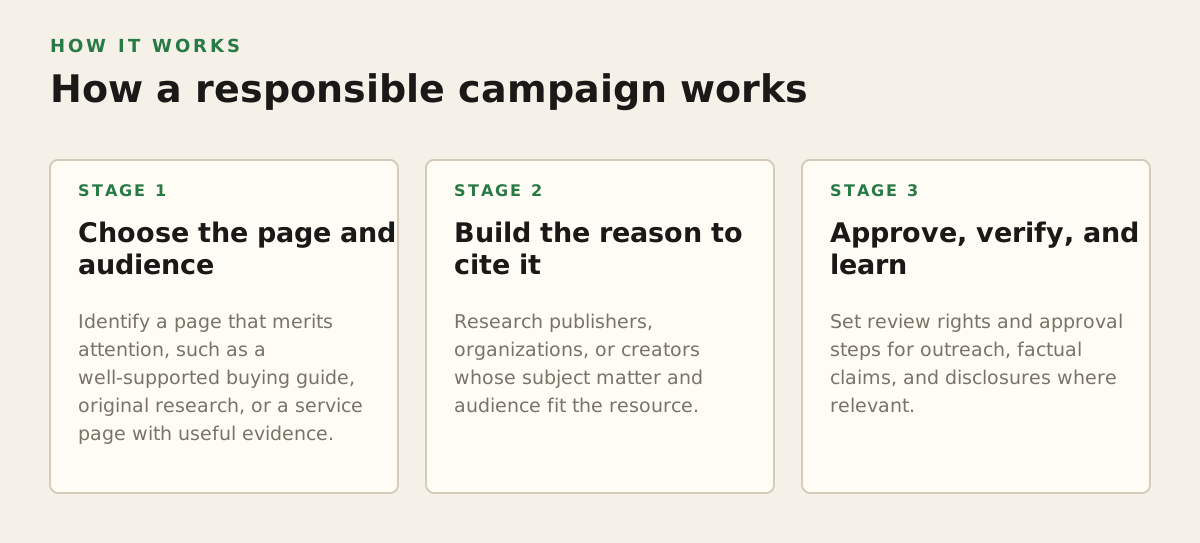
A sound campaign connects a business objective to a page and a plausible reason another site would cite it. It does not begin with a quota of links followed by a search for any publisher willing to sell placements.
1. Choose the page and audience
Identify a page that merits attention, such as a well-supported buying guide, original research, or a service page with useful evidence. Check that it loads, can be indexed, answers its intended audience’s need, and gives visitors a clear next step. A link cannot make an irrelevant or unusable page valuable.
2. Build the reason to cite it
Research publishers, organizations, or creators whose subject matter and audience fit the resource. The pitch should explain why their audience might benefit, not just request a link. Where content is needed, agree who supplies research, expert input, writing, and fact-checking before outreach begins.
Links also need to be technically accessible to crawlers. Google’s documentation describes crawlable links and the use of standard anchor elements, but a technically crawlable link is not a guarantee that it will be indexed or affect rankings. See the Google guidance on crawlable links when reviewing implementation.
3. Approve, verify, and learn
Set review rights and approval steps for outreach, factual claims, and disclosures where relevant. When a placement appears, check the live page, link destination, and surrounding context. Report what happened against the original objective rather than treating a spreadsheet of domain scores as proof of success.
These illustrative scenarios show how to make a brief testable; they are not universal benchmarks or guarantees:
- An online shop asks an agency to pitch a buying guide to 3 relevant publishers. The review looks at referral relevance and whether the guide earns genuine editorial citations, not just the number of placements.
- A software firm entering a second market requests outreach in 2 languages. The review checks language and audience fit rather than treating a publisher’s country-code domain as sufficient evidence.
- A local business has 5 unlinked brand mentions identified in an audit. The agency records which publishers added a link and whether each link points to the appropriate page.
Consider internal navigation alongside external links: visitors and crawlers need a clear route from an earned-link landing page to related content. The internal link opportunity tool is relevant to that separate internal-link task. If you also review how a page’s search snippet is presented, the meta description length checker is a related resource; it does not assess link quality.
Compare pricing models, budget inputs, and success measures
Agencies may charge by project, retainer, deliverable, or placement. Each model changes incentives: a placement-based fee may reward quantity or easy-to-obtain links, while a retainer needs clear ongoing outputs. No model is automatically safe or effective, and there is no reliable universal price for a campaign without knowing its scope, market, content needs, and review burden. Ask for a proposal tied to the work rather than an unsupported price-per-link benchmark.
To set a practical budget, list the costs and internal time the proposed scope could involve. Ask the provider to separate its fee from any content production, interviews, translation, research, or publisher payments. Then agree a spending cap and what happens if the work requires additional approval or production. Budget the whole workflow, not only outreach: a low agency fee may exclude work your team must still complete.
Before signing, ask:
- What is included, excluded, or billed separately, including content, interviews, translation, and publisher fees?
- Are payments made to publishers? If so, how will placements be qualified, disclosed, and approved?
- What happens if outreach earns no placement, or a link is later removed or changed?
- Who owns content, prospect records, and reporting if the agreement ends?
- What expertise, approval turnaround, and implementation time will you need from our team?
Agree on measurable success criteria that fit the goal. Depending on the campaign, these may include the relevance and context of referring pages, qualified referral visits, referral conversions, or visibility for the linked page over an appropriate period. Google Search Console’s Performance report includes search measures such as clicks, impressions, and queries. It does not prove that a specific link caused a change: search visibility has multiple influences. Use rankings and organic traffic as outcomes to monitor, not as a link-by-link causal ledger.
As an illustrative starting policy, a business could review a small pilot after the agreed deliverables or review period, checking placement quality, referral relevance, and staff time. Choose the scope and review point for your own constraints; there is no universal campaign duration or link target.
Spot failure modes and vet the provider
Warning signs often appear before a campaign delivers useful evidence: the provider cannot name the intended audience, uses the same pitch for every publisher, treats third-party authority scores as Google metrics, or will not explain how placements are obtained. Other risks include irrelevant sites, low-value guest content, undisclosed paid placements, and links to pages unrelated to the business goal.
If your site has a manual action, inspect Search Console rather than assuming a third-party toxicity score represents a Google penalty. Google explains how to review a manual action report. Its disavow guidance says most sites do not need the tool and describes specific cases involving considerable unnatural links and a manual action or likely manual action. Read the Google disavow links guidance before acting; a routine monthly disavow submission is not a sensible default.
Use this vendor interview checklist to test whether the provider can make its process clear:
- Which pages and audience would you prioritize, and why would another site cite them?
- How do you assess editorial relevance, and can you explain your outreach process?
- How do you handle paid placements, disclosures, and links intended for advertising rather than ranking?
- What must our team supply, approve, or implement, and when?
- How will you report live placements, removals, referral outcomes, and limitations without implying guaranteed ranking gains?
- Can we change or stop the work if evidence shows it is not serving the agreed objective?
Prefer a provider that makes methods inspectable, names the client workload, and accepts that publishers control editorial decisions. For a small or midsize business, start with a defined page, a specific audience, and a scoped test—not an open-ended link quota. Mr Haq offers SEO consulting that includes link building; review the approach at Mr Haq and verify that any proposed scope fits your goals and capacity.
Authored with NotFair SEO