
Useful content marketing examples do more than attract attention: they help a specific buyer make a decision, solve a problem, or take a next step. For an ecommerce brand, that might mean a product comparison that reduces uncertainty; for a local business, a service guide that answers practical questions; for a B2B team, a diagnostic checklist that helps a prospect recognize a problem. The examples below show what each format demonstrates, when it fits, where it can fail, and how to adapt it without copying another brand’s content.
Choose a format by starting with the customer’s unanswered question—not with a channel or a publishing quota. Google’s people-first guidance similarly emphasizes creating content for an intended audience and a useful purpose, rather than producing pages primarily to attract search visits (Google Search Central’s helpful-content guidance). The formats here are practical patterns, not guarantees of rankings or leads.
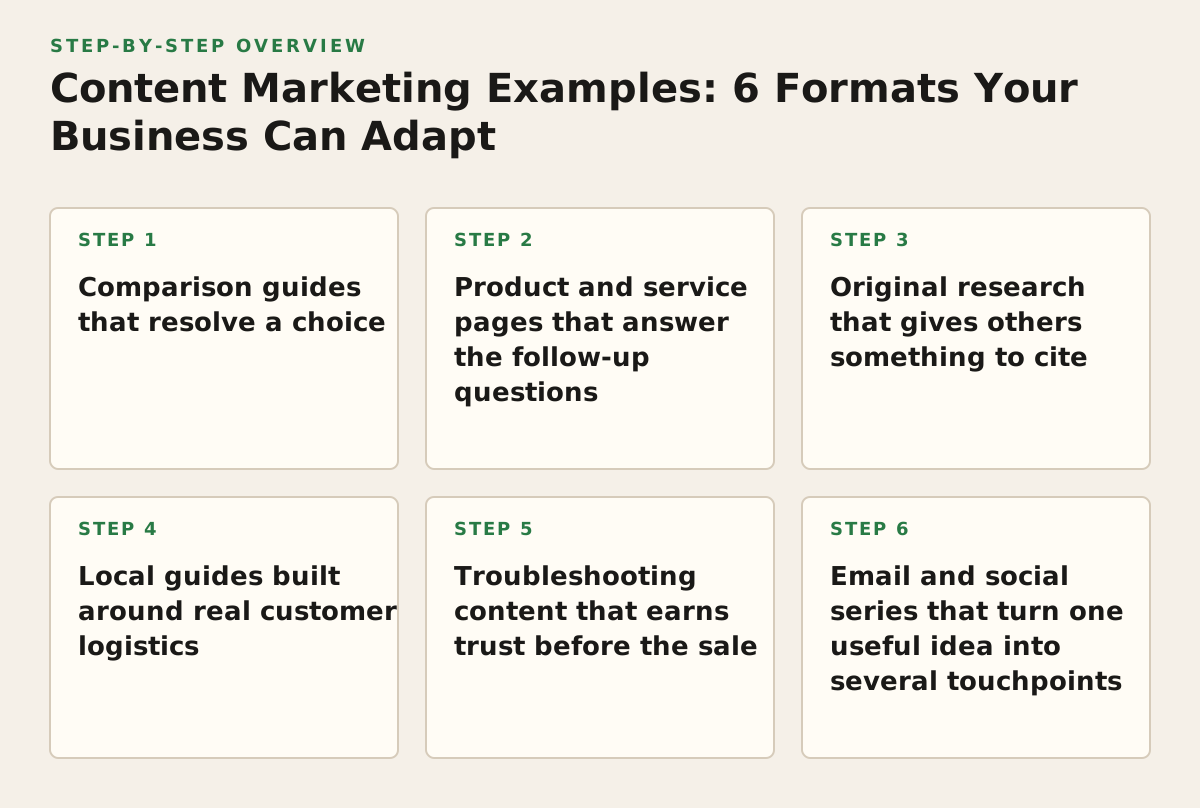
1. Comparison guides that resolve a choice
Use this when buyers are weighing alternatives, such as product types, service approaches, or in-house versus outsourced work. A comparison guide is useful because it makes the decision criteria visible. Instead of saying “our option is best,” it helps a reader determine which option fits their constraints.
Example pattern: “Option A vs. Option B for [specific need]”
Imagine an online shop selling both compact and full-size air purifiers. A helpful comparison would explain room-size suitability, filter replacement considerations, noise trade-offs, and the type of buyer each model suits. It demonstrates decision support through relevant criteria, not a disguised product pitch. A B2B version might compare a self-managed audit with an external technical review, explaining what each can and cannot uncover.
- State who the comparison is for and what decision it helps them make.
- Use the same criteria for each option; disclose meaningful limitations.
- Link to the relevant product or service page only where the next step is genuinely useful.
Failure mode: an “A vs. B” page that repeats feature lists but avoids trade-offs. Readers can tell when every criterion has been chosen to make one option win. Adapt the format by asking sales or support teams which two choices customers most often confuse, then build the comparison around those questions.
2. Product and service pages that answer the follow-up questions
Use this when interest already exists but shoppers or prospects still need details before acting. The content example is not simply “a product page”; it is a page that anticipates practical questions about fit, use, compatibility, or limitations. That specificity helps a visitor assess the offer without having to infer important details from broad marketing claims.
Example pattern: “Will this work for my situation?”
For a hypothetical kitchenware store, a page for a pan could explain which cooktops it suits, how to care for its coating, what comes in the box, and what it is not designed to do. A service-business version could explain what a consultation covers, what information a prospective client should prepare, and which problems fall outside the engagement. Shopify’s guidance on product descriptions discusses presenting details that help shoppers understand a product; use that as a prompt to make the page specific, rather than as a reason to copy a template (Shopify’s product description guide).
For products, structured data can make eligible pages available for Google product search appearances, but eligibility is not a promise that a particular display will show. Check Google’s requirements before implementing it (Google’s product structured data documentation).
- List real specifications, compatibility details, and exclusions.
- Answer the top questions near the decision point, not only in a separate FAQ.
- Make the next action clear without implying a guarantee the business cannot support.
Failure mode: using vague benefits such as “premium quality” where the buyer needs a measurable detail or a clear limitation. Adapt by reviewing the questions received before purchase and turning each recurring, answerable question into a page element.
3. Original research that gives others something to cite
Use this when your team can gather or analyze information that answers a question your audience cares about. A small, carefully described analysis can be more useful than a large “industry report” with unclear methods. Its value is the evidence and interpretation—not an impressive-looking chart by itself.
Example pattern: a transparent mini-study
A marketing agency might analyze a defined sample of public product pages to categorize which page elements are present, such as size guidance or returns information. It should state the sample, collection date, definitions, and limits. This demonstrates how to turn a repeatable observation into evidence. A small business could instead publish an anonymized analysis of its own support questions, if it has permission and enough context to interpret the pattern.
- Write the question before collecting information.
- Explain the sample and method so readers can judge what the result does—and does not—show.
- Offer a practical implication, such as a checklist, rather than leaving readers with an unexplained statistic.
Failure mode: presenting a handful of observations as proof of a universal trend. That can undermine trust and invite criticism. Adapt the example by narrowing the claim to the sample, publishing the method, and labeling limitations plainly. If you cannot verify the information or explain how it was gathered, choose a different format.
4. Local guides built around real customer logistics
Use this when a business serves a defined local audience and customers need location-specific information to choose or prepare. The strongest local guide solves a practical task: understanding service boundaries, comparing options, or knowing what details affect a quote. It is not a page that swaps a town name into generic copy.
Example pattern: “How to choose [service] in [area]”
A hypothetical home-repair company could explain which details affect the scope of a roof inspection, what photos a homeowner might prepare, and which questions to ask before booking. It demonstrates local relevance through useful specifics, not unsupported claims about being “the best” or serving every neighborhood. A multi-location company could create distinct guides only where its processes, coverage, or customer questions genuinely differ.
- Confirm service-area and process details with the business before publishing.
- Use local examples only when they are accurate and useful to the decision.
- Give readers a way to verify coverage or availability instead of implying it.
Failure mode: publishing near-identical pages for many locations with no meaningful local information. Adapt by writing one complete area guide first; add another only when there is distinct, verified information to share. If coverage is uncertain, say so and provide a concrete contact or verification route.
5. Troubleshooting content that earns trust before the sale
Use this when people repeatedly encounter the same obstacle before, during, or after using a product or service. A troubleshooting article can build confidence because it helps readers identify the cause and choose a sensible next step—even when the right answer is not to buy something.
Example pattern: “If [symptom], check these causes in order”
For an ecommerce store selling coffee equipment, an article might explain how to diagnose a weak brew by checking grind size, dose, and cleaning, in an order that rules out simple causes first. For an SEO consultancy audience, a guide to investigate a sudden organic-traffic decline could distinguish a tracking change, a site change, and a search visibility issue before recommending fixes. It demonstrates problem-solving with a clear diagnostic path.
- Start with a recognizable symptom and list checks in a safe, logical order.
- Separate what the reader can verify from what may require specialist help.
- Explain when to stop troubleshooting and seek qualified support.
Failure mode: diagnosing every symptom as evidence for the company’s paid offer. That makes the guidance less credible and can lead readers toward the wrong fix. Adapt the format by including plausible alternatives and making the boundaries of the advice explicit.
6. Email and social series that turn one useful idea into several touchpoints
Use this when an audience needs guidance over multiple steps or when a useful resource deserves more than a single announcement. A series is an example of planned distribution, not permission to duplicate the same article everywhere. Each message should have its own job and point readers to the next useful action.
For example, a B2B team could publish a diagnostic checklist, then share one short email on each of its three main checks. The first email helps a reader confirm whether the issue exists; the next explains what evidence to gather; the last points to a deeper guide or appropriate next step. An ecommerce team could adapt a care guide into a post-purchase email sequence, with each message addressing one maintenance question.
- Match each touchpoint to a distinct question or stage.
- Keep the promise consistent between the message and the linked page.
- Measure actions that reflect the purpose, such as a guide visit or a product-page click.
Failure mode: counting sends or likes as proof that the content helped a buyer. Define the intended action first, then check whether the distribution path makes that action possible. Google Analytics documentation explains how key events can be configured for actions important to a business; use the guidance to plan measurement, then verify that tracking is correctly implemented on your site (Google Analytics key event documentation).
Use this framework to select the next example to build
When several ideas look promising, prioritize the question with the clearest business consequence. A high-traffic topic is not automatically the best first project if it does not help the audience make progress. This framework makes the choice explicit; the scores are a team planning aid, not an industry benchmark.
| Decision check | Ask | A strong sign | Warning sign |
|---|---|---|---|
| Audience need | What decision or obstacle does this address? | A recurring, specific buyer question | A topic chosen only because it sounds popular |
| Evidence | Can we support the details we plan to publish? | Verified product, process, or research information | Claims depend on guesses or copied competitor language |
| Business fit | What relevant next step can the reader take? | A useful path to a related product, service, or resource | A forced pitch unrelated to the reader’s task |
| Distinctiveness | What will this add beyond existing pages? | Original analysis, clear method, or better explanation | A near-duplicate of another page on the site |
| Measurement | What observable action indicates usefulness? | A defined event, query group, or assisted action | Success defined only as “publish more” |
For an existing site, check whether a page already answers the question before commissioning a new one. Google Search Console’s Performance report can show search queries and page performance, helping you identify pages and queries to investigate; it does not by itself explain why a page performed as it did (Search Console Performance report guidance). For a draft, write the intended searcher, decision, evidence source, and next step in one sentence. If those do not fit together, refine the idea before assigning production.
Build the first useful version in five steps
- Choose one audience and one job. Narrow “create content for small businesses” to a specific task, such as helping an ecommerce manager decide which product details a buyer still needs.
- Collect questions and evidence. Review sales or support questions, existing site pages, and verified business information. Separate confirmed facts from assumptions; do not publish an assumption as a service promise.
- Select the format that fits the decision. Use a comparison for competing options, a detailed product or service page for offer questions, a guide for a local task, troubleshooting for a recurring obstacle, or research when you have a defensible method.
- Draft the answer before the introduction. Make the main recommendation or explanation clear, then add criteria, steps, limitations, and examples. A clear page title and description can help communicate the page’s purpose; Google may generate search snippets from page content rather than use the supplied description every time (Google’s snippet documentation). A meta description length checker can support the drafting workflow, but it cannot guarantee which text will appear in search.
- Publish, connect, and review. Link the new resource from relevant existing pages where it helps the reader continue. An internal link opportunity tool may help with that task; review suggestions for relevance before adding links. Set one primary success measure and a review date appropriate to your publishing cycle. Compare the result with the page’s purpose, not with an invented universal traffic target.
For a first project, choose one recurring customer question that you can answer accurately and that leads naturally to a relevant next step. If you need help aligning content with organic visibility and business goals, Mr Haq offers SEO strategy and consulting; learn more about Mr Haq.
Authored with NotFair SEO