


A content marketing plan turns your customers’ questions into a prioritized set of useful pages, a realistic publishing workflow, and a way to measure whether content contributes to leads or sales. To build one, connect business goals to audience needs, research search demand, choose the right page for each topic, then assign production and measurement owners. The result is a plan your team can execute—not a calendar full of keywords.
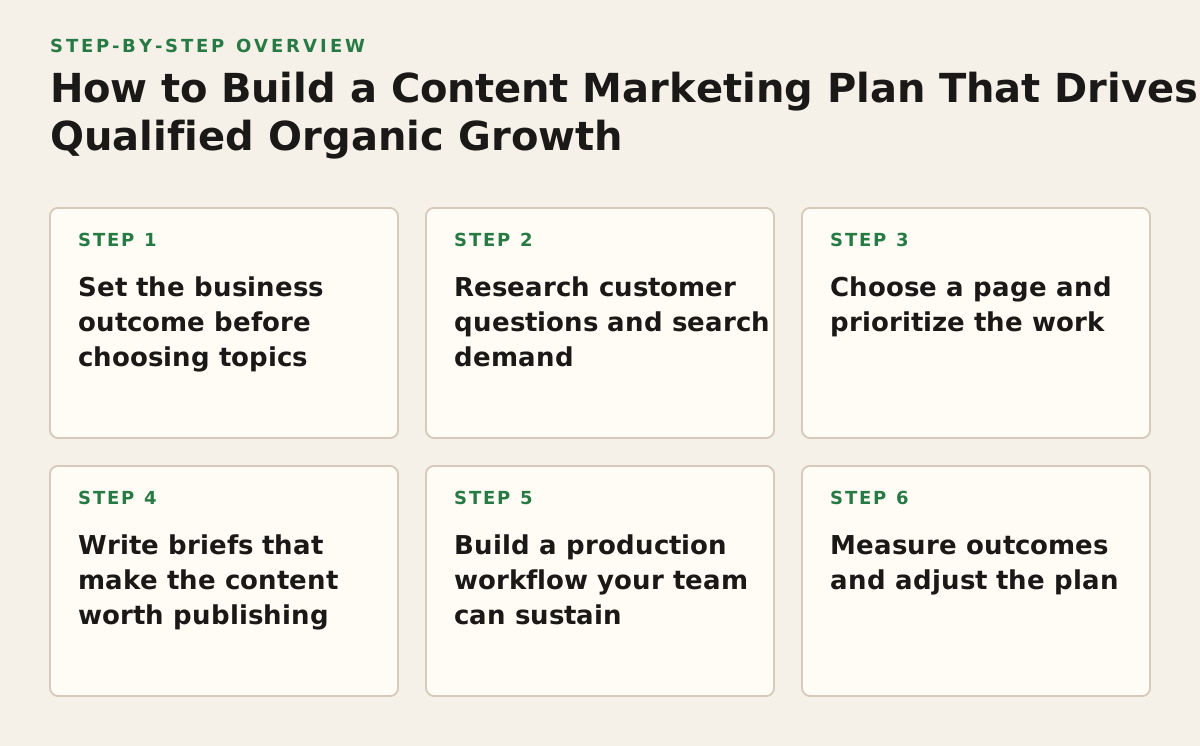
Step 1: Set the business outcome before choosing topics
Start with the action your content should help a customer take. “Increase traffic” is too broad to guide topic choices: it can reward visits from people who will never buy, book, or become qualified prospects. A Dhaka-based service business might prioritize consultation enquiries from companies targeting customers in Bangladesh. An e-commerce brand might focus on product discovery and purchase support.
Write down one primary business outcome and the audience whose decision content can influence. Then decide which action is a useful signal of progress, such as a qualified enquiry, product-page visit, or completed purchase. Treat search visibility as an input to the outcome, not the outcome itself.
- Audience: Which customer, market, or buyer role is the plan for?
- Need: What problem or decision brings that audience to search?
- Action: What should a useful page help them do next?
- Constraint: What expertise, inventory, service area, or production capacity limits the plan?
This keeps priorities grounded in the business. A company selling internationally, for example, may need separate content for Bangladesh-specific service questions and broader product research. Don’t assume a page aimed at one market will satisfy another market’s needs just because the topic wording is similar.
Step 2: Research customer questions and search demand
Collect language from sales calls, support conversations, site search, product reviews, and consultation forms. Add search queries from Search Console, then use a keyword research tool to explore related wording. Google’s Keyword Planner provides keyword ideas and estimates; use it as one input, not a promise of future organic traffic. Google Ads explains how to find keyword ideas with Keyword Planner.
In Search Console, compare queries with the pages already receiving impressions and clicks. Its Performance report lets you review search results data by dimensions such as query and page. That helps identify existing pages to improve before commissioning new ones. See Google’s Search Console Performance report documentation.
Separate topics by intent, not just wording
Group searches that call for the same useful answer. “How to choose an SEO consultant” and “SEO consultant services” may need different pages if one signals evaluation and the other signals service discovery. Conversely, several close variations may belong on one page if the same audience needs the same answer.
- Label each topic as learning, comparing, or ready to act.
- Record the audience, market, and likely next step.
- Check whether your site already has a page serving that need.
- Prioritize topics where your business has relevant expertise and a credible next step.
Search demand is evidence, not a brief. Google’s guidance encourages content made to help people and satisfy their needs; a keyword list alone does not establish that a proposed page will be useful. Read Google’s guidance on creating helpful, reliable, people-first content.
Step 3: Choose a page and prioritize the work
For every topic, decide whether to create a page, update an existing page, consolidate overlapping pages, or leave the topic out. A new URL is not automatically the best SEO action. If an existing guide gets relevant impressions but answers only part of the question, improving it may be more useful than publishing a near-duplicate.
Use a simple decision artifact to make priorities visible. The entries below are examples of the kinds of decisions a small business or marketing team can document.
| Topic opportunity | Customer need | Best action | Success signal |
|---|---|---|---|
| Local SEO for a Dhaka clinic | Understand how to attract nearby patients | Improve a local service page with clear location and service details | Relevant organic visits and qualified appointment enquiries |
| Choosing an analytics consultant | Compare providers and reporting support | Create a comparison guide linked to the relevant service page | Engagement with the guide and attributable consultation enquiries |
| Product care instructions | Use and maintain a purchased item | Add clear instructions to the product or support page | Organic visits to the instructions and fewer avoidable support questions, if tracked |
Rank opportunities using business relevance, evidence of demand, and your ability to provide a better answer. A high-volume topic that attracts the wrong audience can be less valuable than a narrower question tied to a profitable service. If two pages target essentially the same need, decide which one should be the primary destination before adding more content.
Step 4: Write briefs that make the content worth publishing
A content brief should give a writer enough information to create a useful page without dictating a mechanical keyword formula. Include the intended audience, search intent, primary question, evidence or expertise to include, recommended page type, and the action a reader can take next. Note any claims that need verification or approval.
Worked example: a local service business
Suppose a Dhaka consultancy wants to attract international companies considering SEO support in Bangladesh. Rather than assign a generic article called “SEO tips,” the brief could specify a guide explaining how to assess a Bangladesh-focused SEO engagement: which market questions to ask, what access and reporting a client should expect, and how local search considerations differ from an international campaign. The page should link naturally to the relevant service page and make clear which markets the consultancy serves.
This brief gives the writer a distinct audience and a reason for the page to exist. It also creates a checkable editorial standard: if the draft never addresses Bangladesh market needs or the buyer’s evaluation questions, it has missed its assignment.
For product-led content, connect advice to accurate product details and useful next steps. Shopify’s SEO guidance covers product-page considerations such as titles and descriptions, which can inform an e-commerce content review. See Shopify’s SEO guidance for its store platform.
Step 5: Build a production workflow your team can sustain
Assign an owner to each stage: subject-matter input, drafting, fact-checking, SEO review, approval, publishing, and later maintenance. A small team may have one person covering several stages, but the responsibilities should still be explicit. If expertise sits with a founder or service specialist, schedule their input before the draft is considered final; a last-minute review often leaves important detail out.
Set the publishing pace around available capacity. Any proposed frequency or review interval is an illustrative starting policy, not a universal benchmark. Adjust it if drafts repeatedly miss deadlines, expert reviewers cannot keep up, or important pages remain inaccurate. Conversely, if the workflow is reliable and there is clear demand for more coverage, consider increasing output without lowering review quality.
- Keep a status, owner, target publish date, and next action for every planned page.
- Check that each draft answers its assigned question before polishing search snippets.
- Review links, claims, service details, and market-specific language before publishing.
- Update or remove plans when priorities, products, or customer questions change.
Use an editorial calendar to manage work, not to force a post into every date. If your team cannot publish a reliable answer this month, move the item and protect the quality bar rather than rushing a thin page.
Step 6: Measure outcomes and adjust the plan
Track the connection between content and the customer action you selected. Search Console can show whether a page is appearing for relevant searches and earning clicks; your analytics setup or CRM can help assess downstream actions. Google Analytics documents events as a way to measure interactions with a website or app. Decide which interactions matter to your business and verify that your measurement setup records them correctly. Review Google Analytics documentation on events.
Use a recurring review as an illustrative starting policy, then adjust it to your sales cycle and the volume of useful data. Review sooner if a page has a clear technical problem or a time-sensitive offer; allow more time when demand is low and conversions take longer. The signal to change the review interval is whether you can make a sound decision from the data available—not a calendar rule.
When a page underperforms, diagnose before rewriting. Check whether it is indexed, whether impressions match the intended topic, whether its title and content set the right expectation, and whether the page offers a useful next step. A page with relevant impressions but few clicks may need a clearer search result presentation; a page that earns visits but no qualified actions may have an intent, offer, or audience mismatch.
For pages competing with one another, review the site’s internal links and clarify which page should serve the topic. The internal link opportunity tool can help surface relevant linking opportunities. For search snippets, check that each important page has a clear, accurate description; the meta description length checker can support that review.
What to do first: document one customer decision
Start by writing down one audience, one decision they need to make, and one business action your content should support. Use that statement to inspect existing pages and customer questions before adding topics to a calendar. Then choose the most useful page to improve or create, assign an owner, and define the signal you will review.
Mr Haq helps businesses build SEO-focused content strategies, connect content to technical and local SEO priorities, and measure organic performance. If you need support turning research into an actionable plan, explore Mr Haq’s SEO consulting services.
Authored with NotFair SEO
