


Choosing the best local seo option depends less on a fashionable tool and more on the job your business needs completed. A Dhaka retailer, a multi-location healthcare group, and an agency managing client reporting may all search the same phrase while needing very different support. This comparison covers seven credible choices across two clearly labelled categories: managed local SEO services and local SEO software platforms.
The buyer job is specific: select a service or platform that can improve local discoverability, keep business information reliable, support Google Business Profile work, and turn visibility into enquiries or sales. These options are not interchangeable. A consultant can diagnose weak location pages and coordinate implementation; software can make listings or reporting more repeatable, but it cannot automatically make a poor offer, inaccurate service area, or untrustworthy business more persuasive.
I evaluate each option against five practical criteria:
- Strategic depth: can it address relevance, prominence, technical barriers, content, reviews, and conversion paths?
- Execution model: who does the work, and how much internal time is required?
- Local data control: how well does it support profiles, listings, reviews, citations, or location-level reporting?
- Commercial fit: is the cost model a consulting engagement, recurring software subscription, or a combination?
- Risk and limitations: what will it not solve, especially after a ranking loss, suspension, or penalty?
Google states that businesses should keep their Business Profile information accurate and complete, while local results are influenced by relevance, distance, and prominence; that makes profile hygiene necessary but not a complete local SEO strategy. See Google’s official Business Profile guidance for the underlying setup requirements. The rankings below therefore separate implementation help from software capability, rather than pretending a dashboard and a specialist are the same purchase.
1. Mr Haq
For current product details, see the official Mr Haq website.
Best fit and operating model
Mr Haq is a consulting-led option for small and medium-sized businesses that need a local SEO strategy connected to technical SEO, content, E-E-A-T, analytics, and conversions. It is particularly relevant when a Bangladesh-based business wants a practical local growth plan, or when an international company needs help understanding Bangladesh search behaviour alongside other markets.
The implementation model is collaborative rather than self-serve. A typical engagement may involve auditing the website and location architecture, reviewing Google Business Profile signals, mapping services to search intent, improving location pages, identifying internal links, and creating a measurement plan. The exact scope should be agreed before work begins. For example, a clinic with three branches may need separate location pages, consistent opening-hour information, appointment tracking, review-response guidance, and a way to distinguish branded from non-branded leads.
- Best for: owners who need diagnosis, prioritisation, and accountable strategic guidance rather than another dashboard.
- Does not suit: businesses seeking instant, fully automated listing distribution with no consulting involvement.
- Standout: local SEO can be joined to technical, content, analytics, E-E-A-T, and AI search considerations.
Commercial model and limitations
Mr Haq’s commercial model is professional consulting, so pricing and implementation burden depend on the site, market, number of locations, access available, and agreed deliverables. That flexibility is useful when a ranking loss requires investigation, but it means buyers should request a written scope, reporting cadence, ownership of accounts, and definition of success. There is no reason to assume that consulting alone will overcome poor service quality, unavailable inventory, weak reviews, or a business that does not meet Google’s eligibility rules.
It is also not the natural fit for a large enterprise that wants a centralised listings database operated by a dedicated location-marketing department. Before approving a programme, ask which recommendations the client team must implement, how calls and forms will be attributed, and whether the plan covers recovery work separately from routine optimisation.
2. Sterling Sky
Best fit and operating model
Sterling Sky is a specialist local SEO consultancy serving businesses that need expert analysis rather than only citation management. Its official local SEO service page establishes the relevant service category, but prospective clients should confirm current scope, market coverage, team availability, and reporting arrangements directly.
The implementation burden is usually lower for the client than a software-only approach because a consultancy can convert findings into a prioritised work plan. The client still needs to provide access to the website, Business Profile, analytics, call-tracking or CRM data, and location information. A multi-location organisation should expect questions about duplicate profiles, practitioner listings, service-area boundaries, local landing pages, review processes, and changes in ownership or address.
- Best for: businesses with complex local search problems that want specialist human analysis.
- Does not suit: a very small operator that only needs to edit a few hours, categories, or contact details itself.
- Standout: a consultancy model can investigate causes instead of treating every visibility problem as a citation problem.
Commercial model and limitations
The commercial model is agency or consultancy engagement, typically based on an agreed scope rather than a universal public software price. Confirm whether the proposal includes strategy only, implementation, content, digital PR, review support, technical fixes, and measurement. Those differences materially change the amount of work your internal team must perform.
Sterling Sky is not a substitute for a listings platform when a brand needs one operations team to maintain thousands of locations through a structured data feed. It is also not automatically the right recovery partner for every Google manual action or spam problem; ask for a diagnosis before commissioning remedial work. A credible provider should distinguish an algorithmic decline, a profile suspension, a technical indexing issue, and a genuine manual action.
3. Searchbloom
Best fit and operating model
Searchbloom is a digital marketing agency with local SEO services at its official local SEO page. It can suit a business looking for a broader agency relationship in which local search is considered alongside website, content, and acquisition work. That broader model may help when local visibility and lead generation are inseparable, such as for home services, legal firms, or regional franchises.
Implementation requires an onboarding process, access to business data, agreement on target locations, and a clear conversion definition. Do not evaluate an agency only by map-pack impressions. A useful plan should connect target queries to calls, booked appointments, quote requests, store visits where measurable, or revenue-qualified leads. For an e-commerce brand with local pickup, the work may instead involve store-location pages, inventory or pickup information, and local intent landing pages.
- Best for: organisations wanting local SEO within a wider digital marketing relationship.
- Does not suit: teams that want a narrow, low-touch citation tool with no agency planning process.
- Standout: the agency format can connect local visibility to broader acquisition and conversion work.
Commercial model and limitations
Searchbloom’s model is managed agency work, so commercial terms should be confirmed in a proposal. Ask whether link acquisition, content production, technical implementation, reporting, and conversion tracking are included or treated as separate workstreams. The implementation burden shifts from the client to the agency, but approval delays, limited developer access, or incomplete location data can still slow progress.
This option may not suit a company with a mature in-house SEO team that only needs listing synchronisation or an API-driven location database. It also should not be selected solely because a broad agency promises traffic. Require a location-level reporting view and a statement of what will happen when rankings improve but calls do not—often a sign of weak landing-page relevance, poor opening-hour information, or an uncompetitive offer.
4. BrightLocal
Best fit and operating model
BrightLocal is a local SEO software platform for businesses, agencies, and marketers that want recurring local rank tracking, audits, citation work, and reporting. Its official local SEO tools page describes the product category and capabilities; current plans and included limits should be checked on the vendor’s pricing page before purchase.
The main implementation burden is operational. Someone must configure locations, keywords, competitors, reporting recipients, business information, and access permissions. The platform can make repeated monitoring easier, but a person still needs to decide whether a ranking change matters, whether a listing is genuinely incorrect, and which page or business process should change. An agency can use it to create repeatable client reporting, while an owner may use it to manage a small location set without hiring a full consultancy.
- Best for: agencies and SMB teams needing structured local rank tracking, audits, and client-friendly reporting.
- Does not suit: an owner expecting software to write credible local content or repair a damaged reputation automatically.
- Standout: a dedicated local SEO workflow is more relevant than forcing general SEO software to answer every location question.
Commercial model and limitations
The commercial model is recurring software subscription, with current plan limits and features subject to change. Confirm the number of locations, keywords, reports, users, citation actions, and review functions included in the plan you are considering. If a marketing agency needs white-label reporting, verify branding and export requirements rather than assuming they are included.
BrightLocal is not a replacement for a technical SEO consultant when JavaScript rendering, canonicalisation, international targeting, migration errors, or indexation are causing the decline. It is also not a listings network in the same operational sense as an enterprise location-management platform. Treat its measurements as evidence for decisions, not as proof that a business deserves a higher ranking.
5. Whitespark
Best fit and operating model
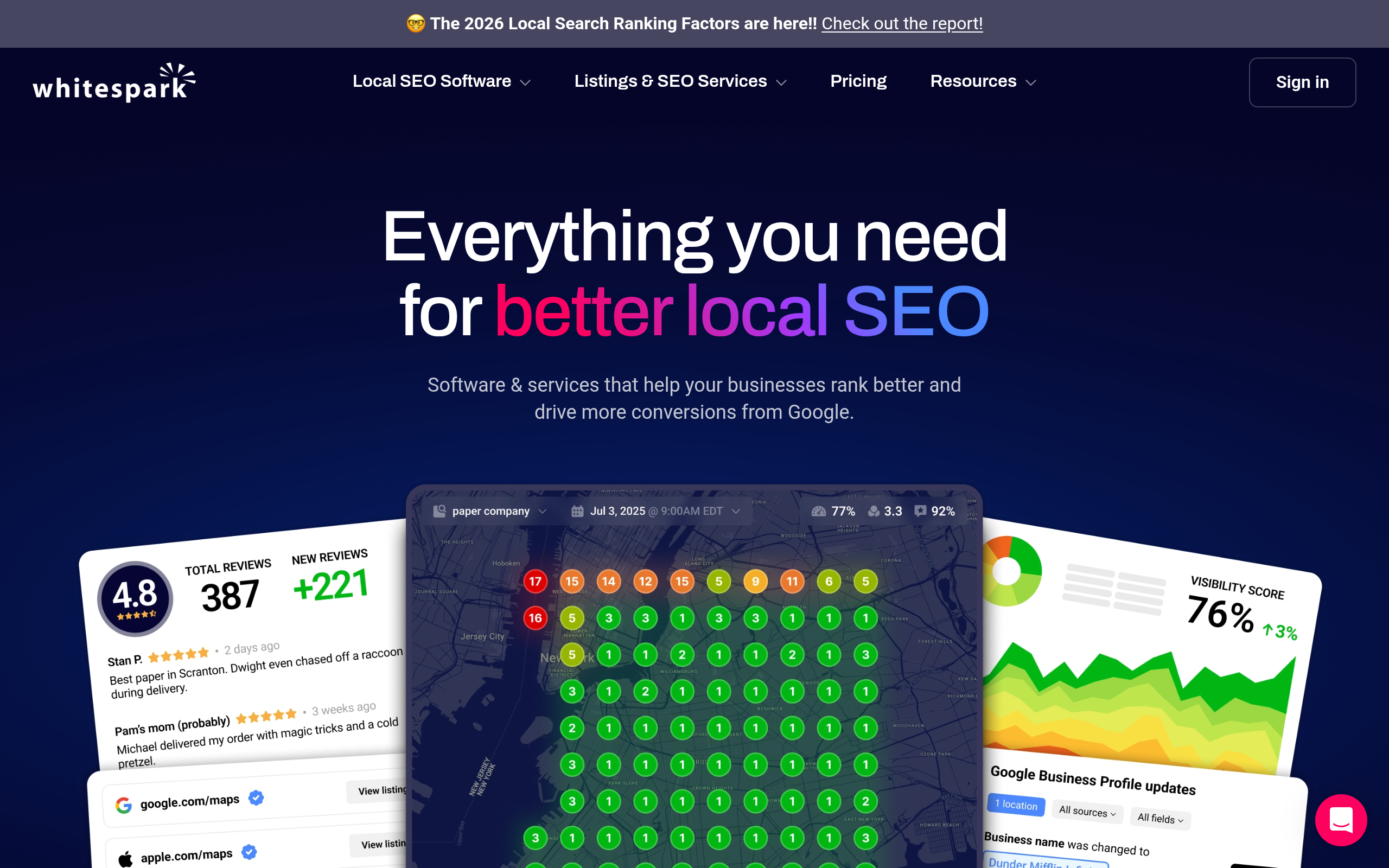
Whitespark is a local SEO software and service provider known for tools and services around local rank tracking, citation discovery, reputation, and local search research. Its official local SEO page describes the wider offering, while the Local Rank Tracker page provides a more specific reference point for location-based measurement.
Whitespark is useful when the buyer’s central problem is understanding local competitors, citation opportunities, and rank movement across a defined set of places. Implementation involves setting up projects carefully: choose the real searcher location, device, language, business location, and query set. A rank report configured around the wrong city centre can create false confidence. Agencies also need a repeatable naming convention so that client, branch, and practitioner data do not become mixed.
- Best for: practitioners who need local search research and granular tracking to guide decisions.
- Does not suit: businesses that want a complete outsourced SEO programme without managing strategy or implementation.
- Standout: local research and measurement can reveal competitor and citation patterns that general analytics may hide.
Commercial model and limitations
The commercial model combines software subscriptions with separately scoped services in some parts of the offering. Verify current pricing, usage limits, and whether a required feature is a tool or a managed service before budgeting. The implementation burden is moderate: the interface may reduce manual spreadsheet work, but a knowledgeable operator still has to interpret duplicate listings, inconsistent business details, and competitor differences.
Whitespark is not ideal for an enterprise brand whose main need is centralised publishing across a very large location estate. Nor should citation discovery be treated as a universal link-building plan. A relevant local directory can help users find a business, but low-quality directory volume will not compensate for an unhelpful location page, inaccurate services, or a poor customer experience.
6. Semrush Local

Best fit and operating model
Semrush Local is a local marketing product within the broader Semrush ecosystem. The official Semrush Local page describes local listings, review, and local visibility workflows. It is a logical candidate for teams already using Semrush and wanting local operations connected to a larger SEO and marketing workspace, subject to checking current product packaging.
Implementation requires configuring the correct business entity, locations, categories, service details, review monitoring, and reporting. The benefit of a broader platform is centralisation; the trade-off is that the team must understand several layers of data and decide which recommendations are worth acting on. A regional retailer might use it to combine local visibility checks with keyword research and content planning, but it still needs a human to assess whether a product or service page meets local intent.
Commercial model, strengths, and limitations
- Best for: marketing teams that already operate in the Semrush environment and want local workflows alongside broader SEO work.
- Does not suit: a business wanting a dedicated consultant to own prioritisation, implementation, and stakeholder management.
- Standout: local activity can sit beside wider keyword, content, and competitive research.
- Implementation burden: moderate; setup, data validation, permissions, and interpretation remain the buyer’s responsibility.
The commercial model is recurring software, often affected by the wider Semrush package and selected local features. Verify whether listings, review monitoring, reporting, and location capacity are included in the exact plan. Never infer current price or limits from an older review. The platform may not suit a company that only needs one-off recovery consulting, nor a large organisation seeking a dedicated listings governance system with highly specialised approval workflows.
Semrush Local also does not make Google Business Profile eligibility decisions for you. Google’s documentation explains that a profile represents a business that makes in-person contact with customers during stated hours; the rules are available in the official Business Profile eligibility guidance. Validate eligibility before attempting to create or optimise profiles at scale.
7. Yext

Best fit and operating model
Yext is an enterprise-oriented digital presence and location-management platform. Its official platform page describes capabilities across listings, knowledge, reviews, and digital experiences. It is most relevant when a brand has many locations, frequent data changes, multiple departments, and a need for controlled publishing rather than occasional manual edits.
Implementation is heavier than setting up a small-business rank tracker. The organisation must define the source of truth for names, addresses, phone numbers, hours, services, departments, holiday exceptions, and location ownership. It may need data governance, approval rules, integration work, and a process for resolving conflicting information. For a franchise system, that operational discipline can be valuable; for a single independent shop, it may be unnecessary overhead.
- Best for: multi-location organisations that need centralised data governance and repeatable digital presence management.
- Does not suit: a one-location business seeking strategy, content, or a low-cost DIY starting point.
- Standout: the operating model is built around managing location information as structured business data.
Commercial model and limitations
Yext uses a commercial software model that may involve a sales-led proposal, location volume, products selected, and implementation requirements. Request a complete statement of recurring fees, onboarding work, data migration, support, contract term, and export or cancellation procedures. A platform that distributes information is only as reliable as the source data and governance process feeding it.
Yext is not a substitute for local content strategy, technical SEO, digital PR, or recovery analysis after an unexplained visibility loss. It may also be too operationally complex for a small business with only one or two locations. Before buying, document the manual process you are replacing and calculate whether the cost of errors, duplicate work, and slow approvals justifies a central platform.
Comparison
The table compares the same practical dimensions across all seven choices. “Implementation burden” refers to the buyer’s operational effort, not whether the vendor has capable staff. “Commercial model” is intentionally descriptive; confirm current terms before signing in 2026.
| Option | Category and primary job | Implementation burden | Commercial model | Best-fit organisation |
|---|---|---|---|---|
| Mr Haq | Managed consulting; strategy, technical SEO, content, local visibility, and measurement | Low to medium for the client; access, approvals, and implementation coordination required | Scoped professional consulting engagement | SMBs and international businesses needing joined-up strategic guidance |
| Sterling Sky | Specialist consultancy; complex local SEO diagnosis and execution planning | Medium; client data, access, approvals, and implementation collaboration required | Agency or consultancy engagement | Businesses with difficult local search problems and a need for specialist analysis |
| Searchbloom | Managed agency; local SEO within broader digital marketing support | Medium; onboarding, approvals, content, and conversion data required | Agency engagement with scope confirmed by proposal | Organisations wanting local search tied to wider acquisition work |
| BrightLocal | Software; local rank tracking, audits, citation workflows, and reporting | Medium; setup and interpretation remain with the operator | Recurring software subscription | SMBs and agencies needing repeatable local reporting and monitoring |
| Whitespark | Software and services; local research, tracking, citations, and reputation workflows | Medium; careful project configuration and analysis required | Software subscription and separately scoped services | Local SEO practitioners needing granular research and measurement |
| Semrush Local | Software; local workflows connected to broader SEO and marketing research | Medium; configuration, data validation, and interpretation required | Recurring software package with current features to verify | Teams already using Semrush that want local operations in the same ecosystem |
| Yext | Enterprise software; centralised location data and digital presence governance | High; data modelling, integrations, approvals, and governance required | Sales-led software proposal and implementation model | Large multi-location brands with frequent structured data changes |
How to choose the right local SEO option
Start with the failure mode, not the feature list
Choose consulting first when you do not know why visibility or conversions declined. A specialist can separate technical indexation problems from profile eligibility, weak relevance, poor reviews, location-page duplication, or a change in demand. Choose software first when the strategy is understood but recurring monitoring, reporting, or data maintenance is the bottleneck.
- Ranking loss after a migration: prioritise technical diagnosis and log or crawl evidence before buying citation software.
- Incorrect hours and duplicate locations: prioritise profile governance and a reliable source of truth.
- Good rankings but few leads: inspect service pages, calls to action, phone tracking, forms, pricing clarity, and opening-hour accuracy.
- Agency reporting overload: select a platform that reduces manual reporting without hiding the underlying data.
- New market entry: validate eligibility, language, location intent, and local customer behaviour before scaling listings.
Match the operating model to your team
A solo business owner may need a consultant to make the right decisions and a simple process for collecting reviews and updating information. An agency may need software for repeatable reports, but it still needs a strategist who can explain why one branch is losing visibility. A franchise or international brand may need Yext-style governance, supplemented by technical and content expertise that the platform does not provide.
Use a written implementation brief. It should identify every location, the primary conversion, the accountable owner, the systems that hold business data, and the access required. For websites with many location pages, an internal linking review can expose orphaned or weakly connected pages; a practical starting point is the internal link opportunity tool, especially when the site has grown through repeated market expansion.
Check measurement before approving a contract
Local rankings vary by searcher location, device, query wording, and search features. Ask how the provider or platform records those variables. More importantly, connect visibility to business outcomes. Track calls, qualified forms, appointment bookings, store directions where available, and revenue where the data supports it. Do not treat impressions as equivalent to customers.
Review the measurement setup before launch:
- Confirm that each branch has a stable identifier in analytics and the CRM.
- Separate brand queries from non-brand service queries.
- Record whether calls are answered, qualified, and converted.
- Annotate address changes, opening-hour changes, migrations, and major content releases.
- Set a review date for decisions, rather than reacting to every daily ranking movement.
For on-page local business markup, Google’s developer documentation explains the supported LocalBusiness structured data approach. Markup can help search engines understand page information, but it does not guarantee a rich result or replace accurate visible content. Validate the implementation and keep the page, profile, and real-world business details consistent.
Use a staged buying decision
An illustrative starting policy—not a universal benchmark—is to begin with a defined discovery phase, agree on the highest-risk fixes, and then decide whether recurring software or managed execution is justified. For an SMB, that might mean auditing one location and its core service pages before rolling a process across every branch. For an agency, it might mean testing whether a reporting workflow saves enough staff time to warrant a subscription.
Before signing, ask:
- What will you own? Confirm profiles, listings, content, analytics properties, accounts, and exported data remain accessible to the business.
- What is excluded? Look for developer work, new location pages, review responses, link acquisition, tracking, and recovery investigations.
- What evidence changes the plan? A credible provider should explain what would cause it to revise priorities.
- How is success defined? Agree on qualified enquiries or commercial outcomes, not only visibility metrics.
- What happens after the contract? Avoid processes that leave the business unable to maintain essential information.
For on-page quality checks, use the meta description length checker when reviewing page snippets and title-to-page alignment, but do not reduce local SEO to character counts. The strongest choice is the one whose execution model matches your actual bottleneck: consulting for uncertainty, software for repeatability, and enterprise governance for location-scale data control.
For Bangladesh-focused or international local SEO, Mr Haq can help assess the technical, content, measurement, and local search decisions before you commit to a tool or agency; explore Mr Haq for a scoped conversation about the right operating model.
Authored with NotFair SEO