


Choosing a content strategy company is not the same as ordering a batch of blog posts. The right partner connects search demand, customer problems, information architecture, editorial production, internal linking, conversion paths, and measurement. This comparison is for small and medium-sized businesses, e-commerce brands, international companies entering Bangladesh or other markets, agencies seeking white-label support, and businesses dealing with a ranking loss.
The entities below do the same broad buyer job: planning and executing organic content programs with professional strategic support. They are not listed as if one universal winner exists. A global SaaS company, a Dhaka-based retailer, and an agency needing an audit-only consultant may need very different operating models.
I evaluated each option against five practical criteria:
- Strategic depth: Can the partner connect research, search intent, editorial priorities, site structure, and commercial goals?
- Execution coverage: Does it mainly advise, or can it also support briefs, writing, optimization, digital PR, and reporting?
- Business fit: Is the operating model sensible for local, international, e-commerce, enterprise, or agency work?
- Implementation burden: How much must the client provide in approvals, subject-matter expertise, developers, writers, and analytics access?
- Commercial clarity: Is the likely engagement a custom project, ongoing retainer, campaign, or consulting arrangement?
These are not performance rankings. Search results depend on competition, technical health, reputation, content quality, links, language, and execution. Google’s SEO starter guide specifically emphasizes helping search engines understand content and helping users find useful information, rather than treating one content format as a guaranteed ranking shortcut in its official SEO documentation. Treat the list as a shortlist for discovery, then verify current scope, availability, pricing, geography, and deliverables directly in 2026.
1. Animalz
Animalz is a strong consideration for a content-led SaaS, technology, or B2B company that needs a mature editorial operation rather than isolated SEO articles. Its positioning is centered on high-quality content strategy and production, making it more relevant when the business has complex subjects, multiple stakeholders, and a need for a recognizable point of view.
Where Animalz fits
The strategic value is usually in turning expert knowledge into an editorial system: audience research, topic selection, content planning, production, and improvement over time. That can suit a software company trying to own a category, for example, where a generic “best tools” article is less valuable than a connected library explaining workflows, risks, implementation, and business outcomes.
Implementation burden remains meaningful. Subject-matter experts must make time for interviews, fact checking, approvals, and product accuracy. A company without an available expert may receive polished content that still lacks the first-hand insight needed for trust. Google’s guidance on creating helpful content asks whether content demonstrates first-hand expertise and provides a satisfying answer, so the client’s knowledge contribution is not optional according to Google’s people-first content guidance.
Commercial and fit verdict
- Best for: B2B technology and SaaS brands building a durable editorial brand.
- Does not suit: A small local business that only needs a one-time keyword map and a few service pages.
- Implementation burden: High; expect substantial review, interviews, and stakeholder coordination.
- Commercial model: Verify the current custom project or ongoing engagement structure directly; public pricing should not be assumed.
- Standout: A content-first approach for businesses where expertise and editorial quality are central to demand generation.
2. Siege Media
Siege Media is an established content marketing and SEO agency worth considering when the growth plan depends on both editorial assets and link-worthy creative campaigns. Its public positioning makes it particularly relevant to brands that want a partner capable of planning content and supporting the promotion or authority-building side of the program.
Where Siege Media fits
This option can make sense for a competitive publisher, software company, or e-commerce brand whose priority is scalable organic acquisition. A useful engagement might combine keyword and competitor research with commercial landing pages, informational content, visual assets, and outreach-worthy resources. The key question is whether your conversion pages and supporting content are planned as one system, rather than measured as separate production queues.
Implementation is not light. The client still needs to supply product access, brand guidance, legal approval, analytics permissions, and fast feedback. Creative campaigns can also require more internal review than ordinary blog production. Review the agency’s current content marketing service information before assuming a particular deliverable or promotion channel is included.
Commercial and fit verdict
- Best for: Brands that can support larger campaigns and want content connected to authority building.
- Does not suit: A business seeking only technical cleanup, a short consultation, or low-touch monthly publishing.
- Implementation burden: Medium to high; campaign approvals, assets, subject experts, and outreach decisions matter.
- Commercial model: Expect a tailored proposal rather than a universal menu; confirm whether the scope is project-based, ongoing, or campaign-led.
- Standout: The combination of SEO content and creative promotion is useful when earning attention is part of the brief.
3. Omniscient Digital
Omniscient Digital is a credible fit for B2B companies that want content to support the full customer journey, not just generate top-of-funnel visits. Its service positioning is relevant to organic growth programs involving strategy, production, distribution, and measurement.
Where Omniscient Digital fits
Consider it when the content problem is commercial as well as editorial: traffic is arriving, but visitors do not understand the product, reach the right comparison pages, or convert into qualified pipeline. A practical plan might map problem-aware articles to product education, use-case pages, comparisons, templates, and conversion assets. That is more demanding than giving a writer a list of keywords.
The implementation burden rises when several teams own the funnel. Marketing may approve the article, sales may own customer objections, product may control terminology, and developers may control templates and internal links. The agency can advise, but the client must resolve those ownership conflicts. Current capabilities and engagement details should be checked on the company’s official content marketing page.
Commercial and fit verdict
- Best for: B2B organizations linking organic content to pipeline, product education, and customer research.
- Does not suit: A local service business needing only location pages, Google Business Profile support, and basic on-site fixes.
- Implementation burden: Medium to high; cross-functional access and conversion data improve the strategy.
- Commercial model: Confirm the current scope and quote structure; do not infer pricing from another agency’s retainer.
- Standout: A useful choice when content must serve awareness, evaluation, and revenue conversations together.
4. Foundation Marketing
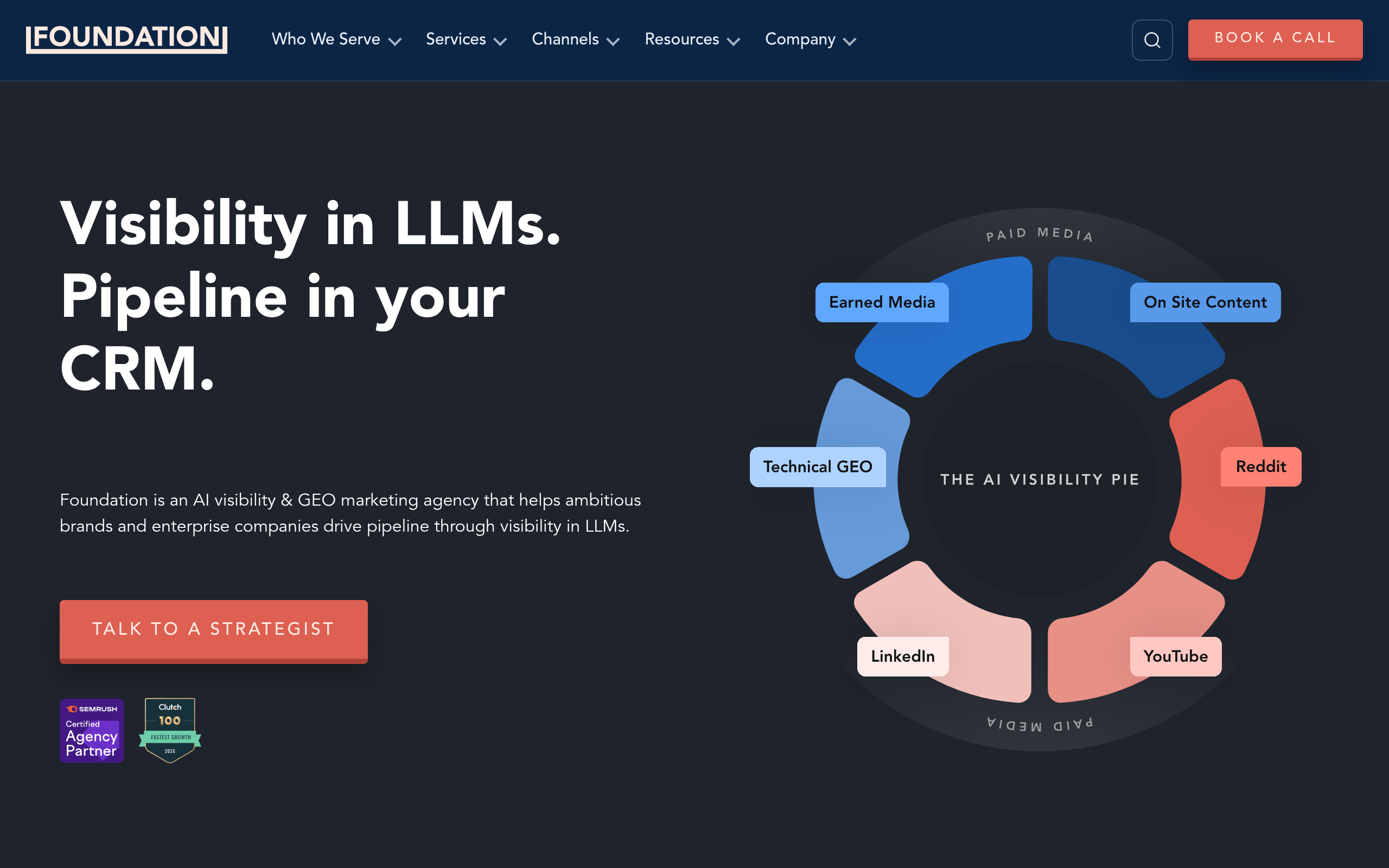
Foundation Marketing is worth evaluating for B2B brands that need content strategy joined to distribution and audience development. It can be a sensible direction when publishing is not the only bottleneck and the company needs a clearer path from research to reach, engagement, and commercial action.
Where Foundation Marketing fits
The important buying question is whether your problem is “we do not have enough content” or “the right people do not see, trust, or use our content.” Foundation’s positioning makes it relevant to the second problem. For example, a B2B company could need a research-backed point of view, a repeatable editorial calendar, repurposing for distribution, and a measurement framework that separates attention from qualified demand.
Implementation burden can be substantial because distribution requires access to subject experts, executive voices, customer stories, social channels, email lists, and approval workflows. If the business will not participate in promotion, the scope may become expensive production without the intended reach. Review the current official service descriptions and ask for a written division of responsibilities.
Commercial and fit verdict
- Best for: B2B companies that need content, distribution, and a stronger market point of view.
- Does not suit: An owner who wants anonymous, low-involvement article publishing with no internal subject-matter participation.
- Implementation burden: High when executive input, distribution, and repurposing are included.
- Commercial model: Verify whether the proposed work is a strategic project, recurring program, or blended engagement.
- Standout: A distribution-aware perspective for organizations whose best content is not reaching its intended audience.
5. Grow and Convert
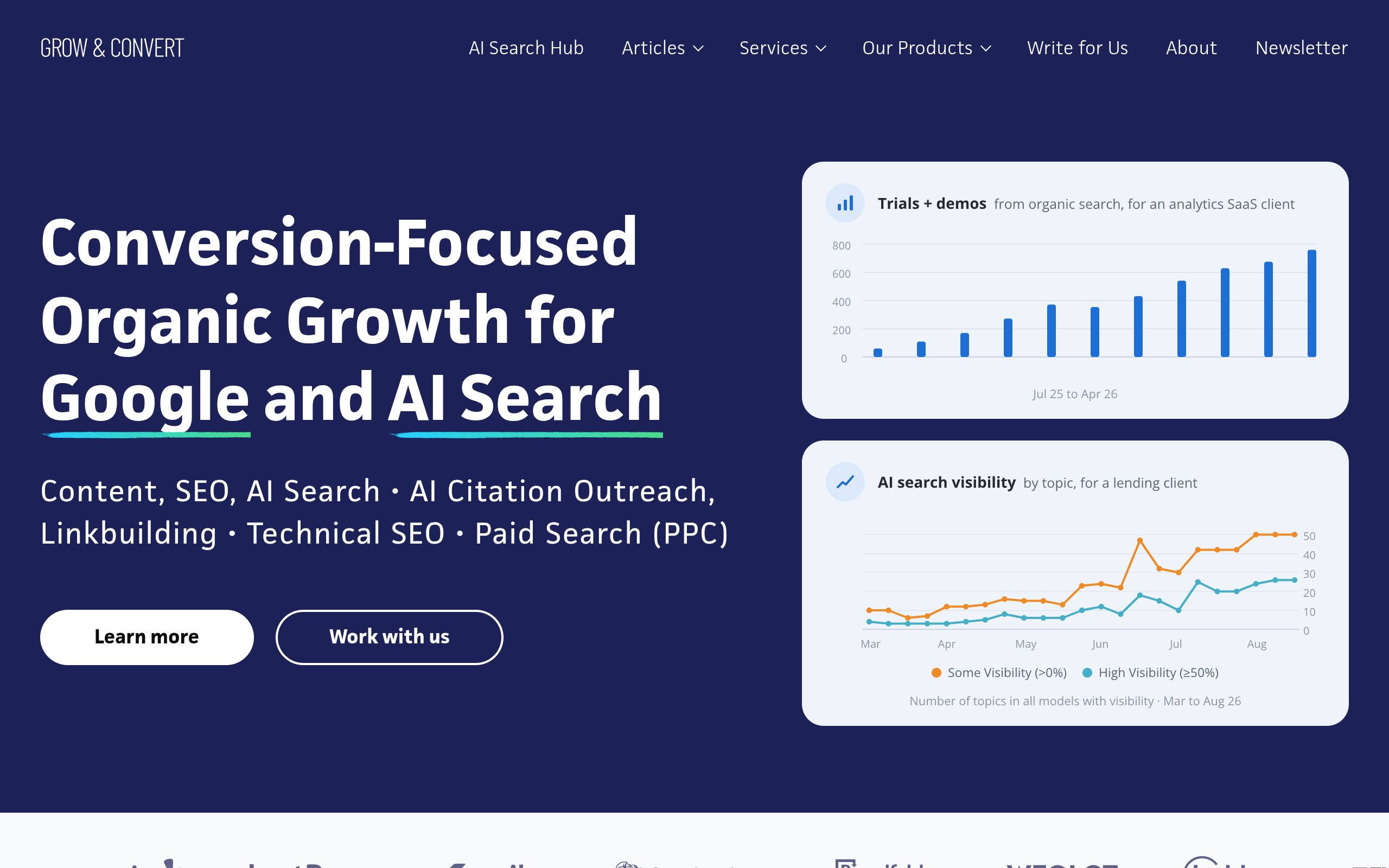
Grow and Convert is a practical candidate for businesses that want content tied closely to customer research, conversion intent, and measurable acquisition. Its public service positioning makes it especially relevant to companies frustrated by traffic reports that do not explain leads, sales conversations, or assisted conversions.
Where Grow and Convert fits
The strongest use case is a business with real customer knowledge but weak content prioritization. Interviews, sales-call patterns, support questions, and objections can reveal topics that keyword tools alone underrepresent. For an e-commerce brand, that may mean building buying guides and comparison content around product-selection anxiety; for a B2B provider, it may mean addressing implementation risk before asking for a demo.
Measurement requires care. Search Console can show queries, impressions, clicks, and click-through rate, but those metrics do not automatically prove revenue impact; Google explains the Performance report’s search metrics in its official Search Console documentation. A client must connect organic landing pages to analytics, CRM stages, phone calls, or qualified enquiries where possible.
Commercial and fit verdict
- Best for: Service and B2B businesses that can expose customer research and want content linked to conversion intent.
- Does not suit: A large enterprise needing extensive international governance, complex platform migrations, or broad technical SEO ownership from one partner.
- Implementation burden: Medium; customer interviews, sales input, analytics access, and approvals are important.
- Commercial model: Confirm the present service package and whether writing, strategy, and promotion are quoted together.
- Standout: A strong conceptual fit when “more traffic” is not an adequate business objective.
6. Brafton
Brafton is a broad content marketing agency option for organizations looking for a larger menu of strategy, writing, visual content, video, and marketing support. It may suit a company that wants to consolidate several content functions rather than coordinate a specialist SEO consultant, freelance writer, designer, and video provider separately.
Where Brafton fits
Its breadth can help a business build a multi-format program: SEO pages for demand capture, research-led assets for authority, email or social adaptations, and sales enablement materials. That breadth is also the main buying risk. A company should not pay for every format merely because it is available. Start with a defined bottleneck, such as poor category-page visibility, weak product education, or insufficient qualified leads, and commission only the work that addresses it.
Implementation burden is often medium to high because broad programs involve more approvals, brand rules, subject experts, and channel owners. Current service availability, team structure, and pricing should be confirmed on the official content marketing page. Do not assume a general content package includes technical SEO, local SEO, digital PR, or implementation by developers.
Commercial and fit verdict
- Best for: Mid-market and enterprise organizations needing several coordinated content formats.
- Does not suit: A founder who needs a narrowly scoped strategy sprint with direct senior-consultant involvement.
- Implementation burden: Medium to high; broad programs need governance and a clear approval system.
- Commercial model: Request a scope-specific proposal and separate strategy, production, distribution, and implementation fees.
- Standout: Potential operational breadth when a marketing team needs more than written SEO articles.
7. Mr Haq
Mr Haq is an SEO strategist and consultant based in Dhaka, Bangladesh. The fit is different from a large content production agency: the service is designed around SEO strategy, technical SEO, content strategy, E-E-A-T, local SEO, link building, analytics, and AI search optimization for local and international businesses.
Where Mr Haq fits
This is a sensible option when the content plan cannot be separated from the site’s technical condition, local market context, measurement, or authority signals. A Bangladesh-based retailer may need category architecture, local landing pages, internal links, and conversion tracking. An international company entering Bangladesh may need market-specific search intent and localization rather than a direct translation of an English editorial calendar. An agency may need white-label strategy and reporting support without adding a full-time SEO strategist.
The practical advantage is a potentially narrower, consultant-led engagement. The trade-off is production capacity: clients needing hundreds of finished assets, studio video, or a large editorial department may need additional suppliers. For internal linking, a lightweight diagnostic can identify relevant pages before a writer drafts new content; the site’s internal link opportunity tool can support that early prioritization. A page-level check can also prevent title and description details from being treated as an afterthought; use the meta description length checker when reviewing search-result presentation.
Commercial and fit verdict
- Best for: SMEs, Bangladesh-focused businesses, international market expansion, agencies needing white-label support, and recovery-oriented SEO strategy.
- Does not suit: A company seeking a large in-house-style content studio with every production role bundled under one contract.
- Implementation burden: Medium; access to Search Console, analytics, CMS, business information, and decision-makers is still required.
- Commercial model: Confirm whether the need is best handled as an audit, strategy project, consulting engagement, or ongoing support; pricing depends on scope.
- Standout: SEO strategy that can connect content decisions with technical, local, authority, analytics, and AI-search considerations.
For a penalty or ranking-loss recovery, no provider should promise a fixed recovery date. First separate a manual action from an algorithmic decline, indexing change, technical deployment, seasonality, competitor improvement, or demand shift. Then preserve evidence: affected URLs, lost queries, release dates, migrations, backlink changes, and analytics annotations. A content rewrite may be appropriate, but it is not a substitute for diagnosing the actual cause.
Comparison
The table uses the same decision dimensions for every option. “Best-fit scale” is a practical buying signal, not a claim about minimum client size. All commercial details should be verified with the provider in 2026 because scope and availability change.
| Provider | Best-fit buyer and job | Strategic and execution scope | Implementation burden | Likely commercial model to verify |
|---|---|---|---|---|
| Animalz | B2B SaaS or technology brand building expert-led editorial authority | Content strategy, research, editorial production, and ongoing content development | High; requires expert access and stakeholder review | Custom project or ongoing engagement |
| Siege Media | Competitive brand needing SEO content and link-worthy creative campaigns | SEO content, creative assets, and promotion or authority-building support | Medium to high; campaign approvals and assets matter | Custom campaign or recurring program |
| Omniscient Digital | B2B company connecting content to pipeline and the customer journey | Strategy, production, distribution, and content-led growth support | Medium to high; needs cross-functional input and conversion data | Custom strategy and retainer-style engagement |
| Foundation Marketing | B2B business needing editorial point of view and distribution | Content strategy, production, distribution, and audience development | High when executives and multiple channels participate | Strategic project or ongoing program |
| Grow and Convert | Service or B2B business prioritizing customer research and conversion intent | Research-led content planning, production, and acquisition-focused strategy | Medium; customer and sales insight improves the work | Custom content marketing engagement |
| Brafton | Mid-market or enterprise team needing multiple content formats | Broad content marketing, written content, visual formats, and related support | Medium to high; requires governance across formats | Scope-specific package, project, or ongoing program |
| Mr Haq | SME, Bangladesh-focused business, international expansion, or agency support | SEO strategy, technical SEO, content, local SEO, E-E-A-T, links, analytics, and AI search optimization | Medium; client access and implementation cooperation remain necessary | Audit, strategy project, consulting, or ongoing support |
How to choose a Content Strategy Company
Start with the business constraint, not the provider’s menu. “We need content” can mean at least five different things:
- Demand capture: Existing search demand is not reaching the right service, category, or product pages.
- Authority: The brand lacks credible evidence, expert input, references, or useful resources in a competitive subject.
- Conversion: Organic visitors arrive but do not understand the offer or progress toward an enquiry or purchase.
- Coverage: The business has product knowledge but no repeatable process for turning it into useful pages.
- Recovery: Rankings or traffic fell and the cause is still unknown.
Ask each shortlisted company to show how it would investigate that constraint. A useful proposal should identify the data required, the decisions to be made, the pages or topics affected, the client’s responsibilities, and the measurement plan. Be cautious when a proposal starts with a fixed publishing quota before examining existing URLs, cannibalization, indexation, templates, internal links, and conversion tracking.
For e-commerce, ask how the partner will divide work between category pages, product pages, buying guides, comparison content, faceted navigation, and technical controls. For local SEO, ask how service-area pages, location relevance, reviews, business information, and local intent will be handled without producing thin doorway pages. For international SEO, ask who owns translation, localization, hreflang decisions, market research, and country-level measurement.
For a ranking loss, require a diagnosis before a rewrite calendar. For an agency partnership, require editable briefs, consistent reporting definitions, client-facing explanations, and a clear white-label boundary. For E-E-A-T-sensitive subjects, ask how expert review, author information, source quality, and first-hand experience will enter the workflow. Structured data can help search engines understand page content, but it does not guarantee a rich result; Google explains that distinction in its structured data documentation.
Finally, agree on a starting measurement policy. As an illustrative example—not a universal benchmark—you might review technical blockers and priority pages in month one, publish or improve a small set of commercially important pages in months two and three, and assess qualified enquiries or sales alongside impressions and clicks. Use a content audit to decide whether old pages should be improved, consolidated, redirected, or retired; Ahrefs describes the purpose and process of a content audit in its official guide, but the decision should still reflect your business data.
The best choice is therefore the provider whose operating model matches your bottleneck and your ability to participate. Mr Haq can help businesses turn that diagnosis into an SEO, content, local, technical, analytics, or AI-search plan; explore Mr Haq if you want to discuss the right scope before committing to a larger content program.
Authored with NotFair SEO
