


Choosing a local seo company is not mainly a search for the agency with the longest service list. It is a decision about who will diagnose your visibility problem, improve the parts of your search presence they can control, and connect that work to qualified enquiries or sales. A Dhaka retailer, an Orlando-area plumber, a Bangladesh-focused e-commerce brand, and an international company entering a new market may all need “local SEO,” but their constraints are different.
This guide helps you compare providers before signing a contract. It focuses on the evidence to request, the mechanisms that create local visibility, the failure modes that waste months, and a practical way to prioritize work. Use it if you are hiring an SEO consultant, evaluating an agency, recovering from a ranking loss, or looking for white-label strategy and reporting support for your own clients.
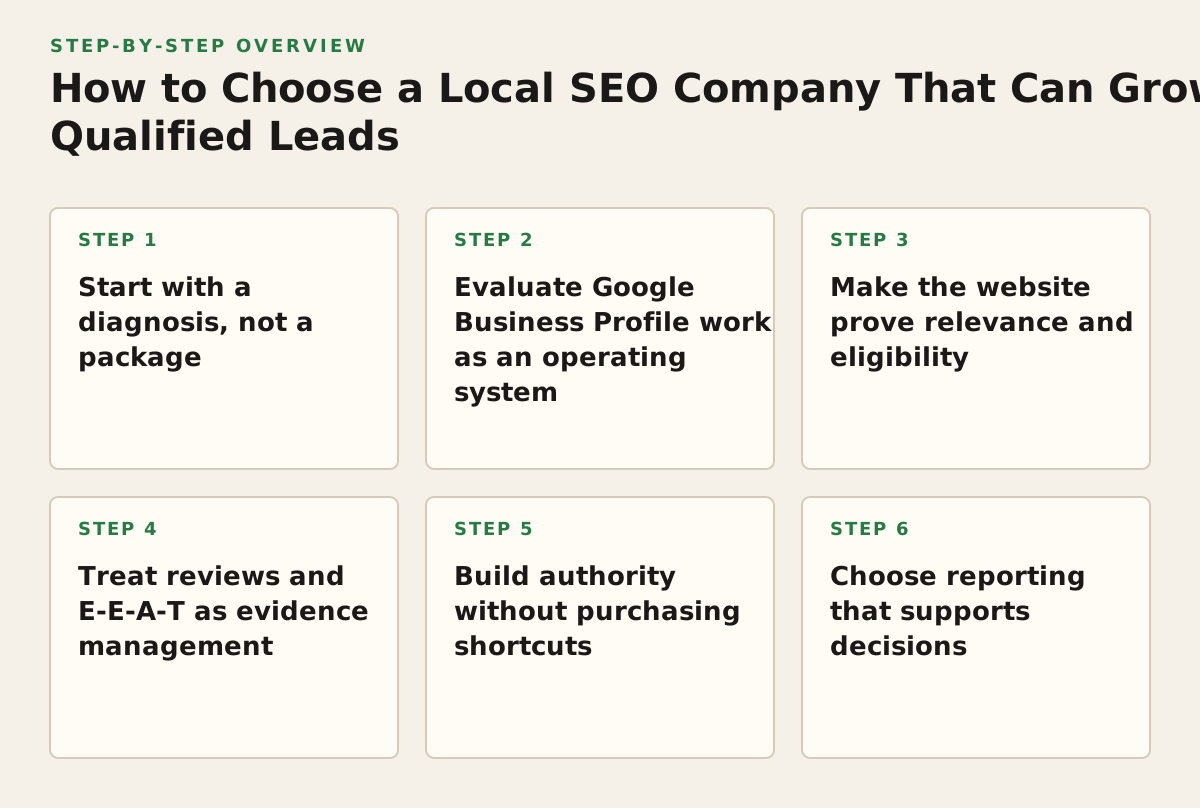
1. Start with a diagnosis, not a package
A credible provider should be able to explain which search demand matters, where your business is currently visible, and what prevents more customers from finding or choosing you. “We will optimize your website and build citations” is an activity list, not a diagnosis.
This principle applies when several symptoms are mixed together: map visibility is weak, important service pages do not rank, organic traffic has fallen, or leads are arriving from the wrong locations. The work differs depending on whether the problem is relevance, distance, prominence, technical accessibility, poor conversion design, or a penalty-like change in traffic.
Google’s Search Essentials describe technical requirements, spam policies, and key best practices for appearing in Google Search; those are useful guardrails when judging whether an audit covers the fundamentals rather than only local directory work. Google’s Search Essentials documentation is especially useful for checking whether a proposed diagnosis includes crawlability, helpful content, and policy compliance.
What to request before accepting a proposal
- A problem statement: for example, “service pages rank outside the target area because location relevance is unclear,” rather than “your domain authority is low.”
- A baseline: non-branded organic clicks, enquiries, calls, direction requests, rankings by location, and conversion rates where tracking is reliable.
- A segmentation plan: separate branded search, non-branded service searches, map actions, organic landing pages, and priority locations.
- A risk review: recent redesigns, deleted pages, manual actions, suspicious links, duplicate listings, tracking changes, or a mismatch between the advertised and delivered service.
- A sequence: what will be fixed first, why it comes first, and what evidence would cause the plan to change.
When it works: diagnosis prevents a provider from selling the same monthly checklist to every business. It also makes disagreements testable. If the agency claims poor technical health is the main constraint, it should identify affected URLs, symptoms, and a validation method.
Failure mode: treating a ranking drop as a link-building problem without checking indexing, migrations, analytics, search intent, or policy issues. More links can increase risk while leaving the actual cause untouched.
Implementation example: an international company targeting Bangladesh discovers that its English service pages receive impressions, but the pages describe global delivery and never clarify Bangladesh availability, currency, fulfilment, support hours, or local contact options. The first project is not “publish 20 city pages.” It is to resolve market intent, page architecture, and conversion trust signals, then measure demand by Bangladesh-related queries.
2. Evaluate Google Business Profile work as an operating system
For a business that serves customers face to face or travels to them, the Google Business Profile is not a one-time listing submission. It is an ongoing local relevance and trust system connected to real-world operations: categories, services, hours, photos, reviews, service areas, calls, and customer questions.
This principle applies to clinics, trades, restaurants, professional services, retail branches, and multi-location organizations. It matters less for a company with no local customer interaction, where a strong organic and commercial content strategy may be more important than map visibility.
Google’s official guidance explains how businesses can improve their local ranking by keeping information complete and accurate, verifying the profile, maintaining hours, responding to reviews, and adding photos and other relevant details. See Google’s guide to improving local ranking before accepting promises about guaranteed map positions.
Questions that expose shallow profile management
- Who owns the profile, recovery email, verification access, and location group?
- How will the provider handle moved, closed, suspended, or duplicate profiles?
- Which primary and secondary categories are being considered, and what customer intent does each support?
- How will service areas reflect actual operations without claiming locations the business does not serve?
- Who answers reviews, and what escalation process handles complaints, privacy issues, or inaccurate claims?
- How will calls, website visits, direction requests, and booked jobs be separated from vanity metrics?
When it works: accurate operational information reduces friction between a searcher’s expectation and the business’s real service. A profile that says “open” when the office is closed, or lists a service that is not offered, may win an impression and lose the customer.
Failure mode: creating extra profiles or stuffing city names into the business name to manufacture coverage. That can create duplication, confuse customers, and expose the account to quality problems. A provider should explain the rule it is applying, not promise that every suburb deserves a separate listing.
Implementation example: a Dhaka home-maintenance company has one legitimate base location and serves several nearby areas. The agency documents the actual service area, selects categories based on the core service, adds useful service descriptions, publishes authentic project photos, and creates a review-response workflow. It tracks calls that become booked visits instead of reporting profile views alone.
If you operate near Orlando and need to compare provider choices, local SEO support explains what to examine when comparing local SEO support options; use it to distinguish an Orlando-area service business focused on qualified leads from a generic listing-management package.

3. Make the website prove relevance and eligibility
Local landing pages should answer a customer’s practical question better than a thin location template. The page must make clear what you offer, where you offer it, why customers should trust you, and what the next action is.
This principle applies when a business has strong map visibility but weak website conversions, when service pages rank for the wrong intent, or when a multi-location site has hundreds of near-identical URLs. It also applies to e-commerce brands selling into a defined market, although “local” may mean market-specific delivery, returns, support, and product availability rather than a storefront.
A useful local page structure
- Service clarity: state the specific service or product in customer language, including meaningful variations such as emergency, commercial, residential, repair, installation, or consultation.
- Location relevance: explain the area genuinely served and the operational details that change by location.
- Evidence: use original work examples, staff expertise, qualifications, testimonials, policies, or process details that can be verified.
- Commercial usefulness: show how to request a quote, book, call, visit, compare options, or check availability.
- Internal pathways: link to related services, FAQs, locations, delivery information, and contact pages where those links help the customer decide.
Use structured data only when it accurately describes visible page content and the organization’s real details. Schema.org maintains the vocabulary for types such as LocalBusiness, Organization, and Service; its documentation is a reference for properties and relationships, not a promise of a rich result. The Schema.org LocalBusiness entry helps a developer check whether the markup reflects the business rather than using fields as hidden keyword storage.
When it works: a relevant page gives search engines and customers the same coherent answer. It can also reduce wasted clicks from people seeking a service, location, price model, or operating condition the business does not provide.
Failure mode: publishing dozens of interchangeable city pages with only the city name replaced. These pages give visitors no local evidence and create maintenance costs. If two pages would be equally useful after swapping the place name, they probably need a stronger reason to exist—or should be consolidated.
Implementation example: a commercial cleaning company creates a page for office cleaning in a target city only after it can explain local scheduling, building types served, response coverage, a relevant project example, and the quotation process. It links to specialized services such as post-construction cleaning only where those pages genuinely help the buyer.
Before publishing, run every important title and description through a meta description length checker to catch truncation and rewrite copy around the searcher’s decision, not a string of repeated location terms.
4. Treat reviews and E-E-A-T as evidence management
Reviews are one visible part of a larger experience, expertise, authoritativeness, and trust system. A provider should help the business earn and present evidence responsibly—not manufacture praise, gate negative feedback, or write claims that customers cannot verify.
This principle is most important for health, legal, financial, home-repair, education, and other services where a poor decision carries meaningful cost or risk. It also matters for e-commerce brands whose product quality, delivery reliability, returns, and support experience influence both conversion and reputation.
Build an evidence inventory
- Who performs the work, and what relevant experience or qualifications can be documented?
- Which claims need proof, such as certifications, guarantees, years in operation, or specialist capabilities?
- Can the business show original photographs, process explanations, case details, or named authors?
- What is the review request process after a legitimate interaction?
- How are complaints routed to an accountable person instead of answered with a generic template?
- Which pages explain limitations, pricing conditions, service boundaries, returns, or appointment expectations?
When it works: evidence reduces uncertainty at the point of choice. It gives a prospective customer a reason to select your business after the search engine has already made the page visible.
Failure mode: confusing polished copy with expertise. An article saying “we are the best” is weaker than a clear explanation from a qualified practitioner, supported by an accurate process, original examples, and a way to verify the claim.
Implementation example: a Dhaka legal consultancy creates author profiles, explains the relevant practice areas, publishes carefully reviewed guidance, states when professional advice is required, and uses a review workflow that does not disclose confidential client details. The SEO provider maps each claim to evidence before promoting the page.
For businesses recovering from a traffic loss, this review should happen alongside technical and policy checks. Google’s spam policies identify practices that can manipulate search rankings; the official spam policies provide a better basis for cleanup decisions than an agency’s unsupported claim that every ranking decline requires a disavow file.
5. Build authority without purchasing shortcuts
Links still matter as discovery and authority signals, but a sound local link strategy begins with why another relevant organization would cite the business. The answer might be useful local data, a community project, a professional resource, a supplier relationship, a genuine event, or a strong piece of research.
This principle applies when the business has a credible offer and content foundation but little recognition in its market. It is especially useful for local professional firms, regional manufacturers, charities, universities, and businesses with partnerships. It is not the first fix for an inaccessible site, inaccurate profile, weak offer, or a page that does not satisfy the query.
Separate legitimate outreach from risk
- Relevant citation: an association, chamber, supplier, publication, or partner mentions the business because the relationship is real.
- Useful asset: a guide, calculator, dataset, map, checklist, or original explanation earns attention because it helps a defined audience.
- Local contribution: a genuine event, scholarship, research project, or community initiative creates an editorial reason to reference the business.
- Digital public relations: subject-matter expertise is offered to journalists or publishers without forcing exact-match anchor text.
- Risk signal: a provider promises a fixed number of links, relies on unrelated sites, or cannot show how placements are selected and reviewed.
When it works: relevant mentions reinforce reputation and can introduce the business to audiences beyond search. The asset or relationship remains useful even if the link is later removed.
Failure mode: buying packages of low-quality links or creating a network of sites solely to pass ranking signals. This can produce a short-lived reporting win while increasing cleanup work and policy risk.
Implementation example: a Bangladesh export consultancy publishes an original checklist for overseas buyers working with local suppliers, asks relevant trade organizations to review it, and uses expert commentary in industry publications. The outreach list is small and qualified; success is judged by referral relevance, assisted enquiries, and earned mentions—not by a target number of links.
6. Choose reporting that supports decisions
Monthly reporting is valuable only when it changes what the team does next. A useful report connects visibility to commercial outcomes, separates leading indicators from results, and explains uncertainty rather than disguising it with a single average ranking.
This principle applies to small businesses that need to know whether an investment is producing enquiries, agencies providing white-label reporting, and international teams comparing locations or markets. It is also essential after a penalty or redesign, when annotation and segmentation matter more than a smooth-looking chart.
The minimum reporting model
- Business outcomes: qualified calls, forms, booked appointments, purchases, revenue where attribution is defensible, and offline outcomes imported or reconciled where possible.
- Search demand: branded versus non-branded clicks, impressions, click-through rate, and landing pages by service and location.
- Local actions: profile calls, website actions, direction requests, messages, and review trends, interpreted with care.
- Delivery: completed technical fixes, published pages, resolved listing issues, earned mentions, and outstanding dependencies.
- Decision notes: what changed, what did not, what may explain it, and what work is being prioritized next.
Google Search Console’s performance report supports analysis by queries, pages, countries, devices, clicks, impressions, click-through rate, and average position. Google’s Search Console performance documentation is a useful reference when an agency presents a chart and claims it proves revenue impact that the underlying data cannot establish.
When it works: segmentation shows whether growth is occurring in the intended service and market. A rise in branded clicks may indicate stronger awareness, but it does not automatically prove that non-branded discovery improved.
Failure mode: reporting only rankings, traffic, or “visibility.” Rankings vary by location, device, personalization, and query set. They are diagnostic signals, not a substitute for qualified-lead tracking.
Implementation example: a multi-location clinic uses a Looker Studio dashboard with separate views for each branch, service, and conversion action. The monthly meeting asks whether the priority page gained qualified enquiries, whether tracking changed, and whether the next constraint is demand, relevance, conversion, or operations.
7. Use this selection and prioritization framework
Compare providers against the work your business actually needs. Score each area using a simple scale: 0 means no credible evidence, 1 means a generic promise, 2 means a plausible method, and 3 means a specific method with an owner, example, and validation step. This is an illustrative starting policy, not a universal procurement standard.
| Area | Evidence to request | Priority when | Red flag | Illustrative score |
|---|---|---|---|---|
| Diagnosis | Annotated audit, baseline, hypotheses, and dependencies | Traffic loss, unclear demand, new engagement, or redesign | Immediate package recommendation without questions | 0–3 |
| Profile operations | Ownership plan, category logic, review workflow, location process | Map visibility and calls are commercially important | Guaranteed map position or mass profile creation | 0–3 |
| Technical SEO | Crawl, indexation, templates, redirects, structured-data validation | Large site, migration, duplicate pages, or ranking loss | One health score with no affected URLs | 0–3 |
| Content and conversion | Briefs tied to intent, evidence plan, CTA, and internal links | Pages attract impressions but not qualified actions | Fixed article volume regardless of demand | 0–3 |
| Authority | Prospect criteria, outreach example, quality review, risk controls | Relevant competitors have stronger recognition | Guaranteed link counts or unrelated placements | 0–3 |
| Measurement | Dashboard sample, conversion definitions, annotations, access plan | Multiple locations, agencies, or offline sales | Traffic and rankings presented as revenue | 0–3 |
| Recovery | Policy review, change log, technical checks, cleanup boundaries | Manual action, sudden loss, migration, or suspicious links | Disavow or mass deletion recommended automatically | 0–3 |
Do not simply choose the highest total. Weight the rows according to the business model. A local emergency service may weight profile operations and call quality heavily; an e-commerce brand may weight technical templates, category architecture, product content, and revenue measurement; a white-label agency may weight repeatable documentation, client-safe reporting, and escalation procedures.
When it works: a weighted framework forces a provider to explain fit. It also makes proposals comparable when one agency emphasizes content and another emphasizes listings.
Failure mode: allowing a polished presentation to outweigh missing access, vague deliverables, or untestable promises. Require the provider to name the data needed, the person responsible, and the condition that would change the recommendation.
Implementation example: a marketing agency scores three potential white-label partners. It gives extra weight to technical diagnosis, transparent reporting, and client communication because its clients already have writers and developers. A provider with impressive content samples but no escalation process does not win merely because its total unweighted score is higher.
8. Put the engagement on a controlled delivery cycle
After selecting a provider, establish a sequence that protects the business from random activity. SEO is cumulative, but it is not indefinite permission to work without review. Use access controls, documented changes, and explicit decision gates.
Phase 1: establish the baseline
- Confirm business goals, priority services, locations, languages, margins, and lead definitions.
- Record analytics, Search Console, profile, call-tracking, CRM, and e-commerce access ownership.
- Annotate migrations, campaign launches, staffing changes, seasonality, tracking updates, and known outages.
- Capture representative queries and landing-page performance without treating a single rank as the truth.
Phase 2: remove blocking problems
- Resolve ownership, duplicate, suspension, or inaccurate-profile issues.
- Fix indexation, canonical, redirect, rendering, template, and important internal-link problems.
- Repair conversion measurement before using lead volume to judge the work.
- Review suspicious tactics, copied content, and unsupported claims before expanding promotion.
Phase 3: improve the highest-value paths
- Prioritize pages where demand, business value, and realistic relevance overlap.
- Rewrite or create service and location content with evidence, operational detail, and a clear next step.
- Connect related pages with descriptive internal links. A site team can use the internal link opportunity tool to identify relevant pathways before manually reviewing whether each suggestion helps the visitor.
- Strengthen review collection and response operations without incentives or selective suppression.
Phase 4: earn recognition and learn
- Develop a small number of useful assets or partnership-led outreach ideas.
- Review performance by service, location, device, and conversion—not only by total traffic.
- Hold a decision meeting at a predefined interval; this timing is an illustrative starting policy and should reflect sales cycles and data quality.
- Continue, revise, pause, or stop initiatives based on evidence and opportunity cost.
The recommendation for 2026: choose the provider that can connect local demand, accurate business information, useful pages, credible evidence, responsible authority building, and measurable commercial actions. Start with a bounded diagnostic and a prioritized first phase rather than an open-ended promise of rankings.
Mr Haq helps businesses and agencies turn that approach into technical SEO, content, local SEO, E-E-A-T, link-building, analytics, and AI search optimization work; Mr Haq when you need a strategy tied to visibility and qualified conversions.
Authored with NotFair SEO