


ai search optimization is the practice of improving a business’s visibility, eligibility, and usefulness across search experiences that generate answers, summaries, recommendations, and follow-up results with artificial intelligence. It is not a separate replacement for SEO. It is a disciplined extension of technical SEO, content strategy, entity building, and measurement for systems that may answer a question without sending a click to a traditional results page.
That distinction matters for a local service company in Dhaka, an e-commerce brand selling internationally, or an agency reporting on behalf of several clients. The work is not simply “adding AI keywords” or asking a chatbot to mention a brand. It involves making important facts easy to crawl, understand, verify, retrieve, summarize, and connect to a real business. The strongest strategy still earns visibility by being genuinely useful; it just accounts for more ways a customer may discover and evaluate the business.
What AI Search Optimization actually means
Traditional search optimization usually focuses on ranking a page for a query and earning a click. AI-mediated search can perform additional steps: interpret a complex request, retrieve information from several sources, synthesize an answer, cite supporting pages, and invite the user to refine the question. The exact interface differs by product, market, device, and query, so a business should optimize for retrieval and evidence rather than a single imagined answer format.
Google’s documentation describes its AI features as search experiences that may use generative AI to create an overview and provide links for further exploration. Google also says the same foundational practices apply: pages need to be crawlable, indexable, and helpful, with no special AI markup or special file required for eligibility. See the official guidance on Google Search AI features and your website. This gives practitioners a useful boundary: AI optimization does not bypass core SEO.
The four jobs behind the phrase
A practical program has four connected jobs:
- Eligibility: allow important pages and business information to be crawled, rendered, indexed, and understood.
- Retrievability: publish clear passages, entities, comparisons, and answers that match how customers ask questions.
- Evidence: support claims with first-hand experience, qualifications, policies, data, references, and consistent business details.
- Measurement: track visibility and business outcomes even when an AI answer does not produce a conventional organic click.
These jobs overlap but are not interchangeable. A technically perfect site may lack evidence. A well-researched guide may be blocked from crawling. A frequently cited brand may attract the wrong audience. A dashboard showing fewer clicks may hide more qualified visits from branded searches and referral sources. The strategy therefore needs a separate measurement model instead of treating every AI mention as a ranking position.
What it is not
AI search optimization is not publishing hundreds of generic pages generated from prompts, inserting a brand name into unrelated answers, or treating a language model’s response as a stable ranking report. It is also not a guarantee that a company will be cited. Search systems choose results dynamically, and eligibility does not equal inclusion.
For a Bangladeshi company targeting overseas buyers, the right question is not “How do we appear in every AI answer?” A better question is: “When a qualified buyer asks who can solve this problem in our market, what reliable information would help a search system represent us accurately?” That question leads to better pages, better conversion paths, and more defensible recommendations.
Why it matters for commercial and local search
AI-assisted discovery changes the shape of the customer journey. A buyer may ask for suitable suppliers, compare product attributes, check whether a service is available in a city, and then visit only two or three sources. The search journey becomes more conversational and comparative, while the commercial decision still depends on price, trust, availability, delivery, expertise, and risk.
Google’s guidance says appearing in AI features is based on the same Search fundamentals rather than a separate submission process. Its documentation on creating helpful, reliable, people-first content emphasizes original value, clear purpose, and content made for people rather than search manipulation. For a business, the implication is concrete: improve the source material that an answer system would need to summarize, not merely the wording of the prompt.
Visibility can move further up the funnel
Classic SEO often targets a page such as “best accounting software for small businesses.” AI-assisted discovery may compress the research stage into a synthesized response that names several options and explains trade-offs. If your brand is absent from the source set, a later branded search may never happen.
That does not mean every business should chase broad informational visibility. A small B2B company may gain more from being accurately represented for a narrow set of high-value questions:
- Which textile sourcing agencies in Bangladesh handle small production runs?
- What documents does a foreign company need before hiring a local SEO consultant?
- Which industrial supplier serves Chattogram and ships to Dhaka?
- Is this skincare product suitable for a customer with a specific ingredient restriction?
- What should an e-commerce brand check after losing rankings following a site migration?
Each question implies different evidence. Location queries need service-area clarity and contact consistency. Product queries need accurate specifications and policies. Consulting queries need experience, process, scope, and limitations. Recovery queries need diagnosis rather than promises. Query-to-evidence matching is more useful than building one generic “AI-friendly” page.
AI visibility is not the same as traffic
A mention can influence a purchase without appearing as a normal organic session. A user may see a business in an answer, search its name later, visit directly, or ask for a quote through a separate device. Conversely, a citation may produce traffic with no commercial value.
Use a broader outcome set when evaluating the work:
- Branded search impressions and clicks for the business or product.
- Qualified organic landing-page sessions and assisted conversions.
- Leads, calls, store visits, product sales, or quote requests by landing page.
- Referral traffic from identifiable answer, browser, or assistant surfaces.
- Accuracy of business facts appearing in sampled answers.
Search Console can show search performance data for a property, including queries, pages, impressions, and clicks; the official overview is available in Google’s Search Console performance report documentation. It will not automatically provide a complete report of every AI answer mention, so combine it with analytics, CRM records, call tracking where appropriate, and a documented sampling process.
How AI search systems find and use business information
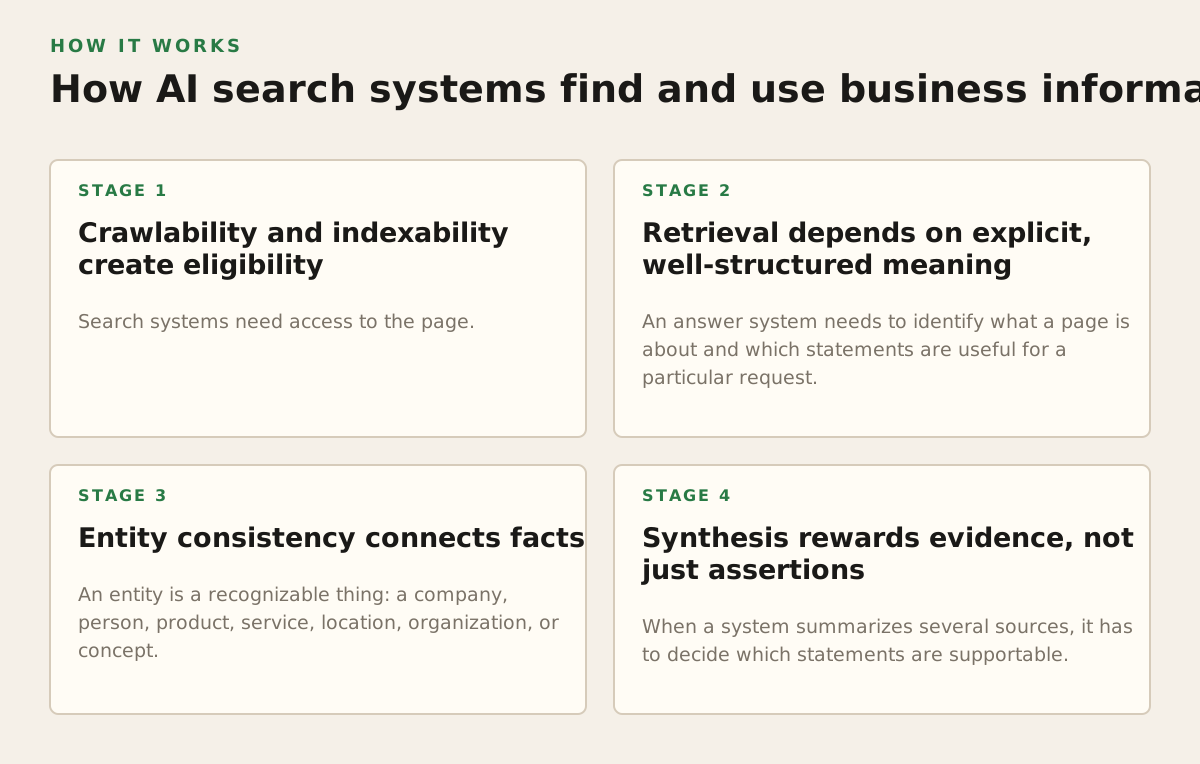
The mechanism is best understood as a chain, not a magic ranking factor: crawl, index, retrieve, interpret, synthesize, and attribute. A weakness at any stage can reduce the chance that the correct page or fact is used.
1. Crawlability and indexability create eligibility
Search systems need access to the page. Review robots directives, response codes, canonical URLs, internal links, JavaScript rendering, XML sitemaps, and accidental noindex rules. Important commercial pages should not depend on a filter state, a login, an image-only interface, or a script that fails for crawlers.
Google’s crawling documentation explains that crawling discovers URLs, while indexing processes and stores content for possible serving; being crawled does not guarantee indexing. The distinction is covered in Google’s crawling and indexing overview. For a ranking-loss recovery project, this prevents a common mistake: rewriting content before confirming that the replacement page is actually accessible and indexable.
For international businesses, also check language and regional signals. Use clear language versions, consistent navigation, and correctly implemented alternate language references when relevant. Do not create near-identical country pages with only the city name swapped. A regional page should explain the actual market difference: delivery, legal context, currency, service availability, support hours, or local proof.
2. Retrieval depends on explicit, well-structured meaning
An answer system needs to identify what a page is about and which statements are useful for a particular request. Headings, descriptive titles, concise introductions, tables, lists, captions, and visible supporting text help people and machines locate meaning. This does not mean every paragraph should be reduced to a short answer. It means the page should make its primary claim and supporting details easy to distinguish.
Consider a page for a Dhaka-based technical SEO consultant. “SEO services” is vague. A more retrievable page explains the problems handled, the sites served, the diagnostic process, deliverables, decision points, and exclusions. It may include a table comparing a crawl audit, migration review, and international SEO assessment. The page becomes useful for both a prospective client and a system trying to understand the business.
3. Entity consistency connects facts
An entity is a recognizable thing: a company, person, product, service, location, organization, or concept. Systems are more likely to interpret a business correctly when its name, address, phone number, service area, founders, products, and relationships are consistent across its own site and reputable external sources.
Review these sources for contradictions:
- The contact page, footer, Google Business Profile, and major business directories.
- Author biographies, professional profiles, conference pages, and association listings.
- Product pages, feeds, marketplaces, shipping policies, and returns documentation.
- Press coverage, customer case studies, partner pages, and supplier references.
- Language and country versions of the same organization’s website.
Consistency does not mean copying identical text everywhere. It means avoiding factual conflicts such as two addresses, different founding dates, outdated service claims, or a product page that contradicts the current return policy. Factual consistency is a trust signal, but it cannot compensate for weak service quality or unsupported claims.
4. Synthesis rewards evidence, not just assertions
When a system summarizes several sources, it has to decide which statements are supportable. Pages with specific definitions, first-hand procedures, transparent methodology, named authors, source links, original observations, and clear update dates give the summarizer more usable material than vague promotional copy.
For example, an e-commerce brand claiming “fast delivery worldwide” gives little decision value. A useful page states eligible countries, dispatch conditions, delivery windows if genuinely known, duties, restrictions, and the policy’s last review date. If the business cannot promise a fixed window, it should say what determines the estimate. Specific uncertainty beats invented certainty.
5. Structured data helps interpretation but is not a shortcut
Relevant Schema.org markup can clarify a page’s type and properties, such as an organization, local business, product, article, breadcrumb, or offer. Markup must match visible page content and remain valid. It should support the page rather than be used to declare claims the page does not show.
For a local business, structured data may clarify the organization name, address, contact details, opening hours, and service area where those details are accurate. For products, it may represent visible price, availability, brand, and identifiers. Treat markup as machine-readable corroboration, not a ranking guarantee. Validate it, monitor changes, and remove properties that are no longer true.
Where AI Search Optimization breaks down
The most expensive mistakes usually come from confusing an appealing theory with a controllable mechanism. AI search systems are probabilistic, query-dependent, and continuously changing. A sound program must define what can be improved and what cannot be promised.
There is no universal “AI ranking” position
Two users can receive different results because of location, language, device, personalization, freshness, query wording, or the available source set. An answer observed on a Tuesday may not appear on the same day for a customer in another country. A prompt-based spot check is useful for quality assurance, but it is not a reliable equivalent of a fixed keyword rank.
Use a sampling protocol if answer visibility matters. Record the date in 2026, market, language, device context, exact question, cited sources, brand facts shown, competitors or alternatives named, and the action available to the user. Repeat the same sample periodically, but label it as directional evidence.
Generated content can multiply weaknesses
Publishing AI-generated pages at scale can produce factual errors, duplicated explanations, thin local pages, awkward translations, and unsupported expertise claims. It can also obscure the pages that deserve updating. Google’s people-first content guidance does not make the use of a writing tool inherently acceptable or unacceptable; the relevant question is whether the result provides original, reliable value and serves visitors.
Before publishing assisted content, assign a responsible reviewer and require evidence for claims involving health, finance, law, safety, product specifications, delivery, or business credentials. A useful editorial checklist includes:
- What customer decision does this page support?
- Which claims require a primary source, internal record, or subject-matter review?
- What did the writer add that is original rather than rephrased?
- Could a customer misunderstand a limitation, eligibility rule, or guarantee?
- Who owns the next update, and what event should trigger it?
Citations do not equal endorsements
An AI answer may cite a page because one sentence matches the query, not because the business is the best supplier. A citation can be incomplete, outdated, or stripped of context. Therefore, do not measure success by citation count alone. Check whether the cited information is accurate, commercially relevant, and consistent with the landing page.
Structured data and authority have limits
Adding organization markup does not create reputation. Earning links from unrelated websites does not prove subject expertise. A detailed author page does not make inaccurate advice trustworthy. Likewise, a large number of reviews can still be unhelpful if they are vague, manipulated, or disconnected from the service being evaluated.
For businesses recovering from a penalty or major ranking loss, this distinction is vital. Start with manual actions, security problems, indexing changes, migration errors, spam patterns, content quality, and demand shifts. Do not relabel every traffic decline as an “AI search problem.” Diagnose the loss before changing the strategy.
How practitioners apply it to real SEO programs
The most effective implementation is an extension of an existing SEO operating system. It begins with commercial priorities, then maps the information required by customers and search systems. The deliverable is not one “AI page”; it is a connected set of reliable assets and measurement rules.
Step 1: Build a question and evidence map
Start with sales calls, support tickets, product returns, customer reviews, internal search data, Search Console queries, and competitor comparisons. Group questions by customer stage and risk. Then record what evidence the business can provide.
| Customer question | Useful page asset | Evidence to provide | Conversion path |
|---|---|---|---|
| Can you serve a business in Dhaka? | Local service page | Address or service area, process, hours, contact details | Consultation request |
| What happens during a technical audit? | Methodology page | Checks, outputs, limitations, sample findings | Audit enquiry |
| Which product fits a small apartment? | Buying guide and comparison table | Dimensions, use cases, exclusions, stock policy | Product category or product page |
| Can you recover lost rankings? | Recovery guide | Diagnostic sequence, possible causes, realistic constraints | Assessment form |
This map prevents a common content failure: publishing a broad article when the user needs a policy, comparison, location detail, or proof of capability. It also gives an agency a defensible way to explain why a page is being created.
Step 2: Strengthen the source pages
Prioritize pages that answer valuable questions and can lead to revenue. Improve the title, opening explanation, section hierarchy, internal links, author or business context, evidence, media where useful, and next step. Keep claims close to the proof supporting them.
Use an internal-link review to connect related assets. A service page should link to relevant process explanations, case studies, FAQs, and contact paths; a guide should link to the product or service it informs. Mr Haq’s internal link opportunity tool can help identify related pages that are not currently connected, but each suggested link still needs editorial judgment.
For descriptions shown in search, write a clear value statement rather than a string of terms. The meta description length checker is useful for checking length during implementation, but length alone does not make a description persuasive or guarantee that search engines will display it.
Step 3: Add first-hand and organizational proof
E-E-A-T becomes practical when it changes what a page contains. Show who performed the work, what was observed, how a recommendation was reached, and where the limits are. For a consultant, that may mean a transparent audit framework, anonymized examples, relevant qualifications, and an explanation of when another specialist is more appropriate. For an e-commerce company, it may mean accurate product testing notes, sourcing information, warranty details, and customer support rules.
Do not fabricate case studies or performance percentages. If confidentiality prevents publishing client data, explain the type of problem, the analysis performed, and the decision made without implying an unsupported result. Credible specificity is better than impressive vagueness.
Step 4: Make local and international signals unambiguous
Local businesses should make the service location understandable in human-readable content, navigation, contact information, and relevant business profiles. Avoid creating dozens of city pages with no local substance. One strong service-area page may be more useful than ten interchangeable pages.
International businesses need a market matrix covering language, currency, delivery or service availability, local terminology, customer support, legal restrictions, and ownership of each regional page. A Bangladesh-targeted page should not merely replace “United States” with “Bangladesh.” It should answer the questions a Bangladeshi customer actually faces.
Step 5: Establish technical controls and monitoring
Create a recurring review that combines technical and editorial checks:
- Confirm priority URLs return the intended status, are indexable, and have a canonical strategy.
- Review new or changed pages for factual accuracy, internal links, headings, and visible business details.
- Validate relevant structured data against visible content and remove stale properties.
- Check product feeds, local profiles, author details, and policy pages for contradictions.
- Compare organic, branded, referral, lead, and revenue data against the date of each change.
- Sample important AI-oriented questions and record whether the answer is accurate, incomplete, or misleading.
An agency can turn this into a white-label monthly report with three separate labels: search performance, answer visibility, and business outcome. Keeping those categories separate prevents a client from mistaking a visibility observation for attributed revenue.
Step 6: Use numbers as policies, not promises
Illustrative starting policies can make the work manageable, provided they are clearly treated as working rules rather than universal benchmarks. For example, a small site might review its ten most commercially important URLs each month, sample twenty carefully chosen questions each quarter, and assign every factual page an owner and review trigger. An international retailer might review regional policy pages whenever shipping rules change.
The correct volume depends on the site, market, risk, and available staff. A large catalog needs different controls from a local consultant’s brochure site. The principle is to create a repeatable review cadence, not to chase an arbitrary number of prompts or pages.
A practical recommendation for 2026
Begin with the pages that already influence revenue: core services, priority products, locations, comparison pages, policies, and high-intent guides. Audit whether those pages can be crawled, whether their claims are supported, whether the business entity is consistent across important sources, and whether a customer can take the next step without confusion.
Then create a small question set for each audience and market. Review the answers manually in 2026, record citations and factual errors, and use the findings to improve source pages. Do not build a separate content factory for every conversational variation. Consolidate overlapping intent, publish original evidence, and keep technical SEO, content, local signals, and conversion measurement connected.
For a business facing ranking loss, diagnose indexing, technical, quality, and demand issues before attributing the problem to AI search. For an e-commerce brand, prioritize accurate product and policy information. For a local company, make service areas and proof easy to verify. For an agency, standardize the evidence map and reporting definitions before promising clients visibility.
Mr Haq helps businesses and agencies connect technical SEO, content strategy, E-E-A-T, local SEO, analytics, and AI search optimization into a practical growth plan. Explore Mr Haq when you need a strategy grounded in crawlability, evidence, qualified visibility, and measurable business decisions.
Authored with NotFair SEO
