


Technical SEO is the work of making a website easier for search engines to crawl, understand, index, and serve to the right searchers. It covers the systems behind visible content: URL structure, redirects, status codes, internal links, XML sitemaps, rendering, structured data, performance, and the controls that determine which pages should appear in search. It is not a substitute for useful content or authority. It is the layer that prevents strong content from being hidden, duplicated, misunderstood, or made frustrating to use.
For a small business, an online shop, an international company entering Bangladesh, or an agency managing several clients, the practical question is not whether every technical recommendation has been implemented. The question is which technical constraint is limiting organic visibility or conversions now, what evidence supports that diagnosis, and what change deserves engineering time first.
What Technical SEO controls
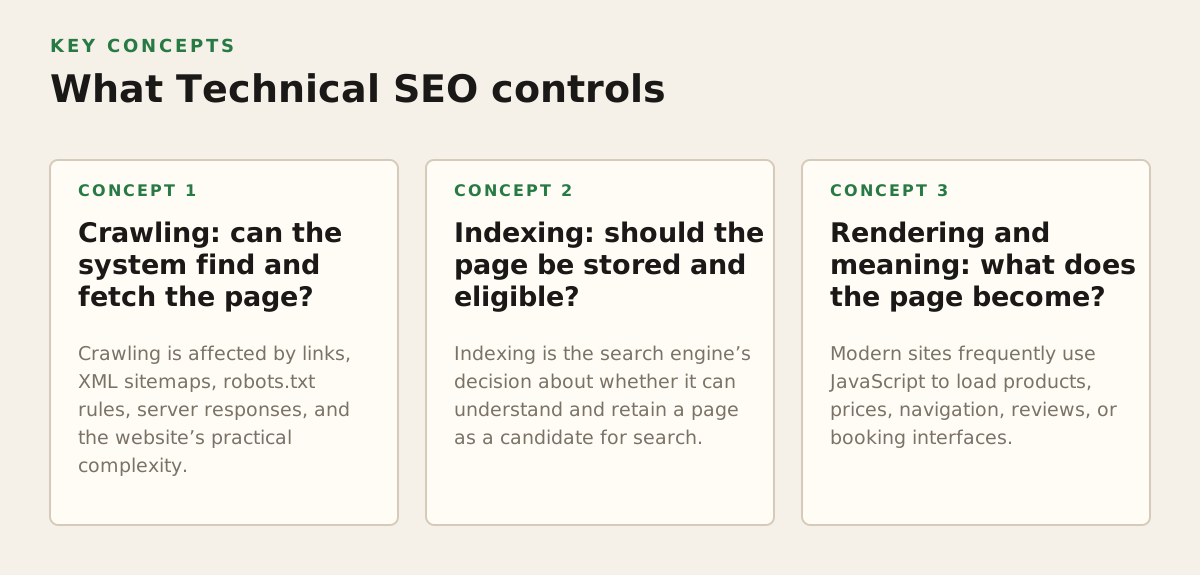
A search engine needs to discover a URL, fetch its resources, interpret the page, decide whether the page belongs in its index, and select the most appropriate result when someone searches. Technical work influences each stage. Google describes crawling and indexing as related but separate processes, and its documentation explains that being accessible to Googlebot does not guarantee that a page will be indexed or shown in search results. See Google’s official crawling and indexing overview for the process and its limits.
Crawling: can the system find and fetch the page?
Crawling is affected by links, XML sitemaps, robots.txt rules, server responses, and the website’s practical complexity. A page with no internal links may exist in a database and still be difficult for crawlers to discover. A page blocked by robots.txt may be known as a URL but not fetchable for normal crawling. A server that intermittently returns errors can make an otherwise valid page unreliable.
Robots.txt is a crawler instruction file, not a universal removal mechanism. Google’s documentation explains the scope and limitations of robots.txt, including the difference between preventing crawling and preventing a URL from appearing in search. That distinction matters when a business owner tries to hide a thin page, a staging path, or a private-looking URL using only a disallow rule: read the official robots.txt guidance before changing production rules.
- Internal links help crawlers and users move from a category page to a product, service, location, or supporting article.
- XML sitemaps provide a declared set of URLs that the site considers important, but they do not force indexing.
- HTTP status codes communicate whether a page is available, moved, missing, restricted, or failing.
- Robots directives can influence crawling and indexing, but the exact directive and delivery method matter.
- Server reliability affects whether a crawler receives the intended HTML and assets rather than an error or timeout.
Indexing: should the page be stored and eligible?
Indexing is the search engine’s decision about whether it can understand and retain a page as a candidate for search. A page can be crawlable but excluded because it is a duplicate, has a noindex directive, lacks enough distinct value, or cannot be rendered and interpreted properly. “Indexed” also does not mean “ranking well.” It means the page may be eligible for retrieval.
Canonicalization helps express the preferred version when several URLs represent substantially similar content. For example, a product may be reachable through a clean URL, a filtered category URL, and a tracking-parameter URL. A canonical link is a signal rather than a command; it should agree with internal links, redirects, sitemap entries, and the page’s content. Google’s documentation on consolidating duplicate URLs explains why these signals need to be consistent.
Rendering and meaning: what does the page become?
Modern sites frequently use JavaScript to load products, prices, navigation, reviews, or booking interfaces. If important text or links appear only after a script fails, is delayed, or depends on a user interaction, both users and search systems may receive a weaker page. Server-rendered or progressively enhanced HTML is not always mandatory, but critical content should have a dependable delivery path.
Structured data is another interpretation layer. It can help search engines understand entities such as products, articles, organizations, local businesses, and events when the markup accurately describes visible page content. It cannot turn an irrelevant page into a relevant result, and it does not guarantee a rich result. Google’s structured data introduction explains the role of supported markup and the importance of following feature-specific guidelines.
Why Technical SEO matters to business outcomes
Technical quality matters because organic search is a chain. A failure early in the chain can make later investments ineffective. Publishing twenty well-researched service pages will not solve a sitewide noindex directive. Building links to product pages will not fix a category template that returns an error. Improving page speed will not compensate for pages that target no meaningful customer need.
The commercial consequence is usually indirect but measurable: fewer eligible pages, less qualified traffic, wasted crawl attention, poor landing-page experience, or avoidable friction between search intent and conversion. For an e-commerce business, that can mean a customer lands on an out-of-stock URL or a filter page instead of a stable category. For a local company, a location page may be duplicated across dozens of areas without unique service information. For an international business, language and regional signals may conflict.
Technical problems distort SEO measurement
Suppose organic traffic falls. The cause could be a ranking change, a seasonal demand shift, a tracking error, a migration, a lost internal-link path, or pages becoming unavailable. Without separating those possibilities, a team may rewrite content when it should restore redirects, or purchase links when the real problem is indexation.
Use a diagnostic sequence rather than treating every decline as a content problem:
- Confirm the date and scope of the change in Search Console and analytics.
- Compare affected templates, directories, countries, devices, and query groups.
- Check whether important URLs return the intended status code and canonical.
- Inspect representative URLs rather than relying only on a sitewide score.
- Review recent deployments, migrations, plugin changes, redirects, and robots rules.
- Form one testable explanation before proposing a large batch of fixes.
This approach is particularly important after a Google update or ranking loss. A correlation with an update date is not proof of a penalty. A manual action, security issue, crawl failure, content-quality problem, and competitor improvement require different responses. Technical evidence narrows the problem; it does not provide a convenient explanation by itself.
Performance affects the experience, not just a report
Users notice when a page shifts while they are trying to tap a button, waits before responding, or takes too long to display the main information. Google’s web.dev documentation defines the Core Web Vitals as metrics covering loading, interactivity, and visual stability, including LCP, INP, and CLS; definitions and current guidance should be checked in the Core Web Vitals documentation.
Do not treat a performance score as the business objective. A low laboratory score may identify an opportunity, while field data may show that real users experience a different bottleneck. A hero image, consent manager, chat widget, advertising tag, or third-party review script can each affect performance. The right fix depends on the page template and conversion path.
An illustrative prioritization example, not a universal benchmark, might look like this:
- A 1,000-product store has 700 URLs with a consistent image-loading problem: prioritize the shared image component rather than editing 700 pages.
- A 40-page consultancy site has one slow booking page caused by a third-party calendar: investigate that page’s script before rebuilding the whole site.
- A local restaurant has stable performance but no crawlable menu text: adding accessible HTML content may matter more than shaving another 100 milliseconds from an image.
- An international site has good page speed but conflicting language versions: resolve regional targeting and discoverability before commissioning more speed work.
How Technical SEO works across a website
Effective implementation is less about collecting an audit’s entire issue list and more about understanding the relationships among templates, URLs, links, and business priorities. A change to a shared template can improve thousands of pages—or create thousands of errors. That is why every recommendation should identify its affected URL pattern, owner, expected effect, and validation method.
Start with URL and site architecture
Architecture should reflect how customers choose. A store might organize products by category, use case, and brand; a professional service business might organize by service and location; an international company may need language or country directories. A sensible structure creates logical paths for users and gives internal links a clear purpose.
For each important page type, document:
- the URL pattern and whether parameters create variants;
- the parent category and links to and from related pages;
- the page’s search intent and conversion action;
- the canonical URL and indexability policy;
- the owner responsible for content, development, or merchandising.
Faceted navigation deserves special attention in e-commerce. Filters such as color, size, material, price, and availability can generate thousands of combinations. Some combinations may deserve indexable landing pages; most should not automatically become search destinations. A starting policy, to be tested against demand and conversion data, could allow indexation for a small set of deliberate category combinations while keeping arbitrary parameter combinations out of the index. The policy must be implemented consistently through links, canonicals, internal navigation, and, where appropriate, crawler controls.
Make status codes and redirects intentional
A successful page should generally return a successful response. A permanently moved page should redirect to the closest relevant replacement, not automatically to the homepage. A discontinued product with a direct successor may redirect; one with no replacement may need a useful discontinued page or an appropriate not-found response. The choice depends on user value and the replacement’s relevance.
Audit redirect chains and loops after migrations. A chain from an old URL to an intermediate URL and then to a final URL creates unnecessary complexity. It may also conceal mistakes such as redirecting every old blog post to a generic service page. Redirect mapping should be based on topical and user intent, not merely on keeping every URL alive.
| Situation | Practical response | Validation |
|---|---|---|
| Old service URL replaced by a matching new service | Map the old URL directly to the relevant replacement | Check response, destination relevance, and internal links |
| Product temporarily unavailable | Keep a useful product page when customers still need its information | Review stock messaging, alternatives, and structured data accuracy |
| Product permanently removed with no equivalent | Choose a helpful retirement or not-found experience | Check links, sitemap inclusion, and search demand before removal |
| Tracking parameters create duplicate URLs | Keep the clean URL as the preferred version and control discovery | Compare canonicals, internal links, redirects, and analytics handling |
Connect internal links to importance
Internal links are not decoration. They help users discover the next useful page and help a search engine infer relationships and relative importance. Link from high-value pages to commercially important pages where the relationship is genuine. Use descriptive anchor text that tells the user what to expect, but avoid forcing the same phrase into every link.
For a service business, a guide about fixing slow websites could link to a technical audit service, a page about measurement, and a relevant case methodology page if those destinations add value. For a retailer, a buying guide could link to a category and selected products, while the category links back to supporting guidance. A systematic review can uncover opportunities with an internal link opportunity tool internal link opportunity tool, followed by human judgment about relevance and placement.
Use sitemaps and indexation controls as a coherent system
An XML sitemap should represent the URLs the business wants search engines to consider: generally canonical, useful, indexable pages. Filling it with redirected, blocked, duplicate, or low-value URLs weakens its role as a clean declaration. Google’s sitemap documentation explains what sitemaps can provide and what they cannot guarantee.
For a large site, separate sitemaps by content type or country when that makes monitoring clearer. This is an operational decision, not a ranking trick. A product sitemap, article sitemap, and location sitemap can help a team see which group has discovery or indexation changes. Submit the sitemap, then inspect representative URLs and search performance rather than assuming submission equals inclusion.
Where Technical SEO breaks down
Many technical recommendations fail because they are applied as universal rules. A website is an interconnected system, and the same change can help one template while harming another. The most reliable work states the assumption, identifies the risk, and includes a rollback or validation plan.
JavaScript hides important content or links
A JavaScript framework is not automatically an SEO problem. The risk appears when the initial response lacks essential content, navigation, product information, or links and the rendered result is inconsistent. Test representative pages with disabled scripts, rendered HTML inspection, URL inspection, and browser-level checks. Compare what a user receives with what the crawler can access.
Common failure patterns include:
- product prices loaded only after an API call that sometimes fails;
- pagination implemented as a button with no discoverable page path;
- navigation links injected after a consent action or interaction;
- location content selected from a browser setting but not represented in a stable URL;
- metadata changed in the browser while the server response remains generic.
The fix may be server-side rendering, pre-rendering, HTML links, better API reliability, or a simpler component. Do not rebuild the entire front end until the failing mechanism is known.
Canonical and noindex signals conflict
A canonical pointing to URL A, a noindex directive on URL B, an internal link to URL C, and a sitemap containing all three create an ambiguous system. Search engines may choose a different canonical or exclude a page that the business expected to rank. A cleanup should start with the desired page set and then align signals around it.
A practical review asks:
- Is the preferred URL accessible and returning a successful response?
- Does its content substantially match the alternate version?
- Do internal links consistently use the preferred URL?
- Does the sitemap list the preferred URL rather than a redirect or duplicate?
- Is there a business reason for the alternate page to remain accessible?
Templates multiply defects
One incorrect canonical tag on a static page is a page-level issue. One incorrect canonical in a product template can affect every product. One accidental noindex rule in a category template can remove a major commercial section from eligibility. Prioritize by template reach, revenue relevance, and confidence in the diagnosis—not simply by the number of warnings in a crawler export.
Illustrative impact scoring, not a universal formula, might assign each issue a value from 1 to 5 for affected URL count, business importance, and evidence strength. A template issue scoring 5, 5, and 4 may deserve attention before twenty isolated image-alt warnings scoring 1, 1, and 2. The score is a decision aid, not a claim about Google’s algorithm.
International and local signals become inconsistent
International businesses need more than translated words. Country or language pages should have stable URLs, genuinely appropriate content, clear navigation, and consistent regional signals. Avoid automatically redirecting every visitor based on IP if that prevents crawlers and users from accessing alternative versions. Review whether currency, shipping, contact details, phone numbers, and service availability match the target market.
Local businesses face a different risk: creating near-identical city pages with only the place name changed. A stronger local architecture explains actual service areas, customer constraints, availability, directions, proof, and local processes. Technical indexation cannot rescue location pages that provide no distinct reason to exist.
How practitioners apply Technical SEO
A useful technical SEO program is a repeating operating process rather than a one-time “health score.” It combines discovery, diagnosis, implementation, and verification. The exact tools may vary, but the reasoning should remain visible to the client, developer, or agency team.
1. Establish a verified baseline
Collect the site’s important templates and business priorities before crawling everything. Include revenue-driving categories, lead-generating services, locations, editorial hubs, and pages affected by a recent migration or ranking loss. Connect analytics and Search Console where available, then record current organic landing pages, conversions, indexation patterns, and known technical changes.
A baseline should answer:
- Which page types generate qualified organic visits or leads?
- Which directories have lost visibility or conversions?
- Which URLs are canonical, indexable, linked, and in the sitemap?
- Where do users encounter errors, slow experiences, or irrelevant landing pages?
- Which recent deployment could explain a change in behavior?
For a small site, manually inspect a representative sample. For a large site, combine a crawl with database exports, log analysis where available, Search Console patterns, and template-level sampling. A crawl alone cannot tell you whether a page is commercially important or whether its content satisfies a customer.
2. Turn findings into hypotheses
Write findings as cause-and-effect statements. “Many URLs have long titles” is an observation. “The product template creates duplicate title patterns that make category and product intent difficult to distinguish” is a hypothesis that can be investigated. “Organic leads declined because the form page began returning a soft error after the March 2026 deployment” is testable through status checks, analytics, and deployment records.
Separate:
- Blockers: issues that prevent access, indexation, or conversion on important pages.
- Scalers: template changes that can improve a large page set when verified.
- Enhancements: useful refinements with limited immediate business impact.
- Unknowns: questions requiring logs, developer review, or controlled observation.
3. Prioritize by risk and reversibility
Fix high-confidence, high-impact, reversible problems first. Restoring an accidentally removed sitemap entry or correcting a broken redirect is usually easier to validate than changing the entire information architecture. For uncertain changes, start with a limited template or directory where the result can be monitored without exposing the whole site to unnecessary risk.
Communicate work in business terms. “Correct canonical signals on 300 product URLs” is more actionable than “resolve duplicate-content warnings.” “Restore the booking page’s successful response” is more urgent than “improve crawlability” when that page is responsible for enquiries.
4. Validate after deployment
Validation should happen at three levels:
- Technical response: status code, redirects, canonical, robots directives, rendered content, structured data, and page assets.
- Search visibility: crawl and indexation observations, impressions, clicks, landing pages, and query patterns over an appropriate observation period.
- Business behavior: qualified leads, completed purchases, booking actions, contact clicks, or other agreed conversions.
Re-crawl changed URLs, inspect representative examples, and compare the result with the original hypothesis. If a change did not produce the expected effect, do not automatically expand it. Revisit the diagnosis. Search visibility can be affected by demand, competition, seasonality, content quality, links, and algorithmic changes, so attribution should remain cautious.
5. Keep content and technical decisions connected
Technical SEO is most valuable when it supports a clear content and conversion strategy. Before creating another article, check whether an existing page is blocked, duplicated, poorly linked, or aimed at the wrong intent. Before publishing a new city page, define what local information makes it useful. Before adding a product filter, decide whether it creates a search destination or merely a shopping control.
For titles and snippets, write for the searcher first and verify that the final text fits the page’s intent and display constraints. A meta description length checker can help check length, but length alone does not make a description persuasive. It should accurately summarize the page and make the next action clear without promising something the landing page does not deliver.
For agencies, this operating model also makes white-label delivery stronger. A client report should connect the technical issue to affected URLs, business relevance, implementation owner, validation status, and next decision. Screenshots and issue counts are useful evidence, but they are not a strategy.
What to fix first on a real business website
For most small and medium-sized businesses, begin with the pages that can produce revenue, enquiries, or qualified visits. Confirm that those URLs are accessible, indexable when appropriate, internally linked, canonically consistent, and usable on mobile devices. Then investigate sitewide template problems, migration risks, performance bottlenecks, and expansion opportunities.
A sensible starting policy for a 2026 audit is:
- Resolve accidental blocking, broken redirects, server errors, and incorrect noindex rules on priority pages.
- Align canonicals, internal links, and sitemaps around the intended URL set.
- Make critical content and navigation available without fragile interaction dependencies.
- Improve the slowest or most commercially important templates rather than chasing every score.
- Use structured data only where it accurately describes visible, eligible content.
- Build local, international, or faceted architectures around genuine customer needs.
- Measure organic outcomes alongside technical implementation status.
Do not approve a large technical backlog merely because an automated tool produced it. Ask what user, search, or business problem each item represents. If the answer is unclear, classify it as an investigation rather than a fix. If your site has suffered a migration loss, indexation problem, or complex template issue, Mr Haq can help diagnose the evidence, prioritize the work, and connect technical SEO with content, local visibility, and reporting through Mr Haq.
Authored with NotFair SEO