


Use this seo checklist to verify that search engines can access your important pages, understand their purpose, trust the business behind them, and connect them with the right customers. Start with indexability and measurement, then fix technical blockers, improve pages against search intent, strengthen local or product signals, and build evidence through relevant links and mentions. This order matters: publishing more content will not solve a page blocked from crawling, and acquiring links will not repair a checkout funnel that fails to convert. The guide below is designed for a Bangladesh-based business, international company, e-commerce team, agency, or site recovering from ranking loss that needs a practical priority list rather than a collection of isolated SEO tips.
1. Establish the measurement and business baseline first
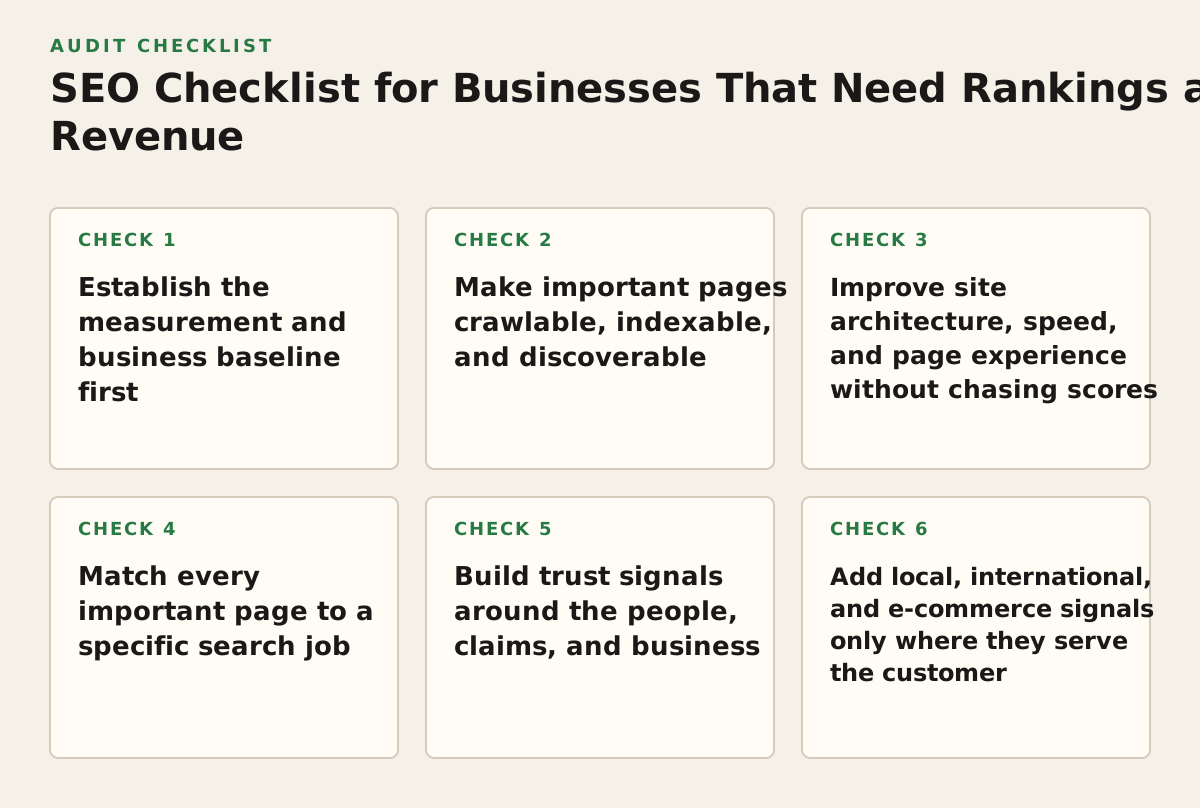
Apply this part before changing templates, URLs, or content. It gives you a defensible baseline for deciding whether a change improved qualified visibility or merely increased impressions. Google Search Console reports search performance and indexing information, while Google Analytics can help connect landing pages with engagement and conversions; use the official Search Console documentation and your analytics platform’s current documentation when configuring access and permissions.
The mechanism is simple: separate visibility from business value. A page can gain clicks for an irrelevant query and still produce no enquiries, purchases, calls, or assisted conversions. Record the pages, query groups, countries, devices, and conversion actions that matter before you interpret a ranking change.
Build a useful starting snapshot
- Export the last available period of organic clicks, impressions, average position, and click-through rate by page and query group.
- Mark revenue pages, lead pages, category pages, location pages, and informational assets separately.
- Record organic conversions using a consistent definition, such as completed purchase, qualified form submission, booked consultation, or tracked phone call.
- Annotate known events: redesigns, migrations, algorithm-related traffic losses, seasonal campaigns, product removals, and tracking changes.
Failure mode: a team reports “traffic is up” while branded searches and low-value blog visits hide a decline in non-brand commercial demand. A better decision is to compare non-brand landing pages and conversion rates against the business baseline.
Implementation example: an international software company can create dashboard filters for Bangladesh, other target markets, brand versus non-brand queries, and demo pages. A marketing agency supporting that company should preserve annotations and a change log so the client can distinguish an SEO issue from a campaign, release, or tracking problem.
2. Make important pages crawlable, indexable, and discoverable
This section applies to every site, but it becomes urgent after a migration, platform change, faceted-navigation launch, or sudden ranking loss. Search engines need access to the page, permission to index it, and a path to discover it. Google’s crawling and indexing overview explains these stages; treat them as separate checks rather than assuming that a submitted sitemap guarantees rankings.
The core decision is whether each URL should be indexed, consolidated, redirected, or removed. An e-commerce filter URL may be useful for users but poor as a search landing page. A discontinued product may need a relevant replacement redirect, a useful successor page, or a clear unavailable response depending on the customer journey.
Run the indexability checks in order
- List canonical, revenue-generating URLs from the CMS, XML sitemap, analytics, and internal navigation.
- Inspect representative URLs in Search Console and confirm the declared and selected canonical are sensible.
- Check robots.txt for accidental disallow rules and review meta robots or HTTP header directives for noindex instructions.
- Compare the sitemap with the canonical URL set; remove redirected, duplicate, thin, and unavailable URLs from the sitemap.
- Crawl internal links to find orphan pages, broken links, redirect chains, and links pointing to non-canonical variants.
Failure mode: blocking a folder in robots.txt and then expecting Google to confirm that its pages are noindex. A crawl restriction can prevent reliable page-level evaluation. Use access controls and page directives for different purposes, and verify the result with URL inspection.
Implementation example: after moving a Bangladeshi retailer from HTTP to HTTPS, create a URL map for old product and category URLs, implement direct one-step redirects, update canonical tags and internal links, submit the new sitemap, and monitor indexed URLs and landing-page clicks. Do not delete the old URL map after launch; it is evidence for diagnosing losses later.
3. Improve site architecture, speed, and page experience without chasing scores
Use this category when users struggle to navigate, important content is several clicks from the main paths, templates load slowly, or mobile visitors abandon key pages. Architecture distributes internal authority and helps users reach commercial pages. Performance work reduces friction, but a high laboratory score cannot compensate for weak relevance or an unusable checkout.
Google describes Core Web Vitals as user-focused loading, interactivity, and visual-stability signals in its official web.dev documentation. Use field data where available and investigate the actual templates and devices affected. The practical objective is faster access to valuable content, not a decorative score-chasing exercise.
Prioritize template-level fixes
- Reduce unnecessary scripts, third-party tags, oversized images, and blocking resources on landing pages.
- Reserve image dimensions and advertising space so content does not jump while loading.
- Keep primary navigation understandable on mobile and expose category, service, location, and support paths.
- Use descriptive, crawlable links rather than relying only on click handlers or image tiles.
- Link from authoritative pages to priority pages with natural, descriptive anchor text.
Failure mode: compressing every image while leaving a heavy booking widget, chat script, or tag manager configuration untouched. The largest delay may come from the interaction layer, not the hero image. Diagnose by template and resource, then test the business-critical page again.
Implementation example: a consultancy serving Dhaka and overseas clients can keep a short route from the home page to technical SEO, local SEO, international SEO, and contact pages. A category page should link to its best subcategories and buying guides; those guides should link back to the relevant service or product page. Use the internal link opportunity tool when reviewing a large site for contextual links that editors may have missed.
4. Match every important page to a specific search job
This is the right focus when pages have impressions but weak clicks, rank for unintended queries, overlap with one another, or attract visitors who do not convert. Search intent is not a label to add to a brief; it determines the page type, evidence, level of detail, and next action.
Map one primary job to each important URL: learn, compare, choose, locate, troubleshoot, or buy. Then satisfy the job faster than a generic article does. One page, one dominant purpose reduces cannibalization and makes internal linking, titles, and conversion paths easier to manage.
Use a page brief that an editor can execute
- Primary query and close variants, with the customer problem stated in plain language.
- Audience, location, product category, stage of consideration, and likely objection.
- Required evidence: specifications, process details, authorship, customer support information, examples, or first-hand observations.
- Page type and conversion action: product detail, service page, comparison, guide, location page, or diagnostic resource.
- Internal links to the next decision and a refresh trigger, such as changed policy, product availability, or outdated regulation.
Failure mode: combining “SEO consultant in Dhaka,” “international SEO agency,” and “free SEO audit” into one broad service page. The page becomes vague, difficult to evaluate, and unable to answer each visitor’s next question. Split the jobs where the audiences, proof, or conversion paths differ.
Implementation example: for a B2B service page targeting Bangladesh, explain delivery method, reporting, communication, relevant technical constraints, and the next consultation step. For an e-commerce category page, provide useful category guidance, product filters that do not create uncontrolled indexable combinations, shipping information, and links to supporting buying advice.
Write titles and meta descriptions for decision clarity rather than repeating the target phrase. If you need to check whether a description is likely to be truncated in search results, use the meta description length checker during editorial review. Treat the snippet as an invitation to inspect the page, not a ranking control.
5. Build trust signals around the people, claims, and business
This category matters most for services, health, finance, legal topics, high-value purchases, and any business asking visitors to provide money or personal information. Google’s Search Essentials recommends creating helpful, reliable, people-first content; its helpful content guidance emphasizes clear purpose, original value, and trust. Do not turn this into a badge-collection exercise.
The mechanism is claim-to-evidence alignment. A statement about expertise should be supported by an identifiable person, relevant experience, methodology, or verifiable business information. A product claim should be supported by specifications, limitations, warranty or return details where applicable, and a way to obtain help.
Operational E-E-A-T checks
- Name the responsible author or reviewer when expertise affects the decision.
- Explain how practical experience, research, testing, or client context informed the content without inventing results.
- Maintain clear About, Contact, service, editorial, privacy, and terms pages appropriate to the business.
- State limitations, eligibility conditions, delivery areas, and what the service does not include.
- Replace unsupported superlatives with specific process details, examples, or sources.
Failure mode: adding an author bio to a thin article written from generic summaries. A bio cannot substitute for original analysis or useful evidence. Improve the underlying page first, then make responsibility and qualifications easy to verify.
Implementation example: an agency publishing a guide about recovering from a ranking loss can explain its diagnostic sequence, distinguish manual actions from algorithmic volatility, show what data a client must provide, and link to official Google documentation. It should not promise a recovery date or invent a percentage improvement without documented evidence.
6. Add local, international, and e-commerce signals only where they serve the customer
Choose this branch according to the business model. A local service needs accurate location and contact information; an international company needs clear market and language paths; an online retailer needs stable product and category structures. These are not interchangeable versions of the same tactic.
For local SEO, keep the business name, address or service area, phone details, opening information, and local landing-page content consistent with the actual operation. For international SEO, give users and crawlers clear language or regional alternatives, avoid automatic redirection that traps visitors in the wrong market, and use appropriate regional URL structures. Google’s localized-versions documentation explains how hreflang annotations help indicate alternate language or regional pages.
For products, use structured data only when it accurately represents visible page content. Schema.org’s Product vocabulary documents available properties, but marking up unavailable or misleading information does not repair the page or guarantee enhanced search results.
| Business situation | Priority asset | First verification | Common wrong move |
|---|---|---|---|
| Dhaka service business | Service and location pages | Real service area, contact path, local proof | Creating many near-identical city pages |
| International company | Regional or language page set | Equivalent content, links, and hreflang consistency | Machine-translating pages without local review |
| E-commerce brand | Category and product templates | Canonical URLs, availability, structured data accuracy | Indexing every filter combination |
| Penalty or ranking-loss recovery | Evidence and change log | Manual actions, technical changes, link history | Deleting content or links indiscriminately |
Failure mode: publishing separate local pages that swap only the city name. They may add no useful local evidence and can weaken trust. Create a location page only when the business can explain a real service area, team presence, delivery constraint, customer context, or locally relevant process.
Implementation example: a Bangladesh-based e-commerce brand expanding into another country can create a market-specific page only when currency, delivery, returns, support, availability, and language genuinely differ. The page should link to products that can actually be purchased by that market.
7. Earn relevant authority and monitor recovery signals
Links are useful when they help people discover a credible resource or confirm that a business is relevant in its field. They are not a substitute for fixing accessibility, intent, or conversion problems. Prioritize relevance and editorial context over raw link volume, especially after a ranking loss.
Start with assets that deserve reference: original research, clear technical explanations, local data, useful tools, expert commentary, or genuinely differentiated resources. Then identify publishers, associations, partners, journalists, and communities whose audiences would benefit. Ask for attention to the resource, not for manipulative anchor text or guaranteed ranking effects.
Use a recovery-safe review process
- Check Search Console for a manual action and review the affected sections.
- Compare the ranking-loss date with migrations, releases, content removals, tracking changes, and major search volatility.
- Review suspicious link patterns, but do not remove legitimate links simply because a third-party tool assigns a low score.
- Fix clear causes in a controlled batch and document each change.
- Measure affected queries, pages, countries, and conversions instead of relying on one headline ranking.
Failure mode: buying a large set of exact-match links after a traffic decline. This can obscure the diagnosis and introduce additional risk. A smaller number of relevant editorial references, combined with technical and content repair, is a more defensible strategy.
Implementation example: an agency can create a quarterly digital PR list for a client’s industry, pitch a locally useful data point to relevant publications, and record the URL, referring domain, linked asset, audience fit, and outcome. A white-label report should show what changed, why it changed, and what evidence will determine the next action.
Implementation plan: turn the checklist into a controlled 2026 workflow
Do not assign every item to every page. Use the following sequence to focus limited time on the pages with the greatest commercial consequence.
- Days 1–3: define the baseline. Confirm analytics and Search Console access, conversion definitions, priority markets, revenue or lead pages, and the date of any known traffic loss.
- Days 4–7: remove blockers. Inspect canonical URLs, index directives, robots.txt, sitemaps, redirects, status codes, internal links, and mobile rendering. Fix issues that prevent priority pages from being discovered or indexed.
- Week 2: repair the highest-value templates. Improve navigation, page speed bottlenecks, titles, headings, content structure, and conversion paths on one service, category, product, or location template before scaling changes.
- Week 3: close intent and evidence gaps. Rewrite pages around distinct customer jobs, add specific proof and limitations, consolidate overlapping URLs, and create an editorial brief for missing commercial or support content.
- Week 4: apply the correct market branch. Validate local business information, international alternates, product availability, structured data, and regional customer journeys. Do not create pages for markets or locations the business cannot genuinely serve.
- After each release: annotate and review. Record the deployment, inspect representative URLs, monitor indexing and landing-page behavior, and compare qualified conversions with the baseline. Use a starting policy of reviewing changes after enough data has accumulated for the business’s normal traffic pattern; any exact timeline is an illustrative operating choice, not a universal SEO benchmark.
- Quarterly: refresh the system. Recheck important templates, expired products, local details, authorship, internal links, external references, and reporting definitions. Escalate migrations, unexplained losses, manual actions, and complex international structures to an experienced SEO consultant rather than applying bulk changes blindly.
The best checklist is not the longest one. It is the one that ties each fix to a page, a customer job, an observable search signal, and a business outcome. If your team needs help prioritizing a technical audit, content system, local strategy, recovery plan, or Looker Studio reporting workflow, Mr Haq provides SEO strategy and consulting for businesses in Bangladesh and international markets through Mr Haq.
Authored with NotFair SEO
