


How to link build effectively is to create something a relevant publisher would genuinely want to reference, identify qualified prospects, make a useful request, and verify the resulting link without manufacturing signals. Before you begin, you need a crawlable website, a clearly defined business goal, a page worth citing, access to analytics and Search Console, and the authority to edit or remove outreach-created content. No universal “build links” switch exists: controls and outcomes are scoped to individual pages, websites, accounts, publishers, and search-engine systems. Links can support discovery and relevance, but they cannot compensate for poor products, thin content, technical blocking, or a page that does not satisfy search intent.
Google’s documentation distinguishes ordinary editorial links from manipulative link spam, including buying links that pass ranking credit, excessive exchanges, and automated link creation. Review the current Google Search spam policies before selecting a tactic, especially if your business is recovering from a manual action or ranking loss. The procedure below is a practical starting framework, not a promise of a particular ranking change.
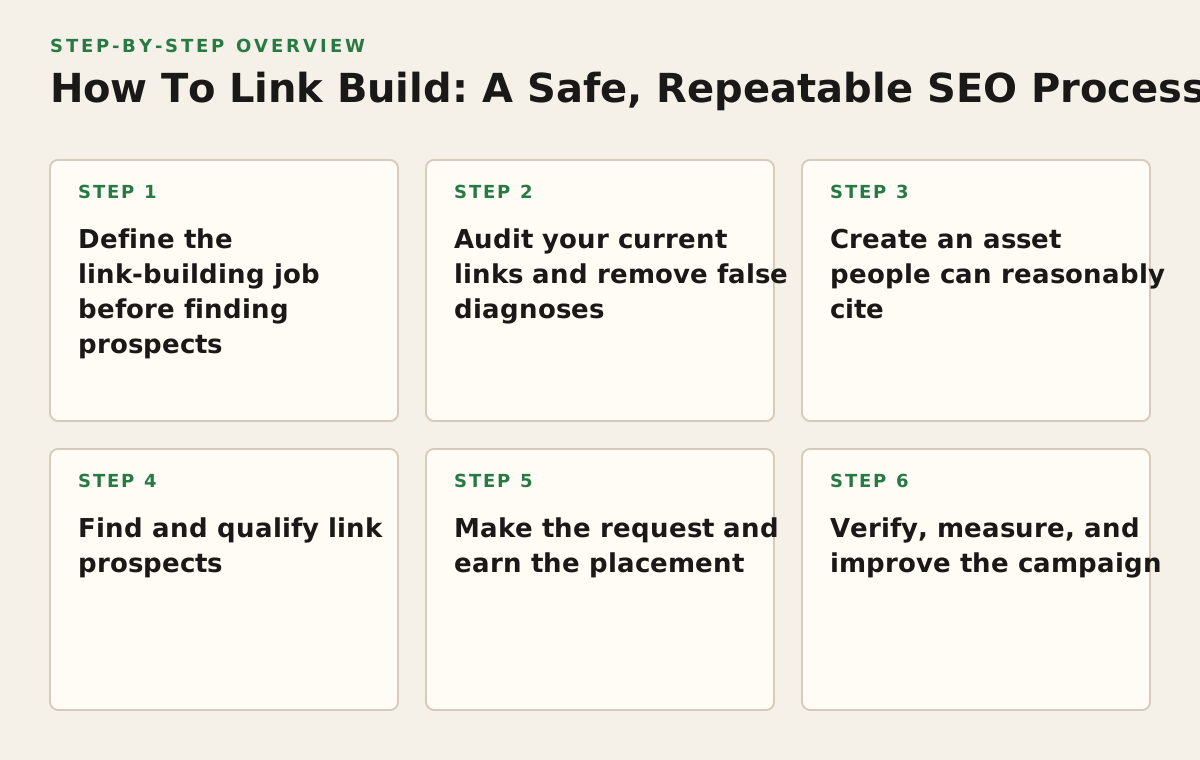
- Set a commercial goal, target page, audience, and risk boundary.
- Audit your existing links and rule out technical or content problems.
- Create or improve an asset that deserves a reference.
- Find and qualify relevant publishers, partners, and local sources.
- Make a specific, honest outreach request and secure the right placement.
- Verify the link, measure business impact, and reverse or escalate problems.
Step 1: Define the link-building job before finding prospects
Start with the outcome, not a list of websites. A link campaign for an e-commerce brand launching a product category should not use the same target page or prospect criteria as a local clinic trying to increase appointment enquiries. The link is an input; the business result is the job.
Choose one target page and one measurable reason
For each campaign, document the page you want referenced, the audience that would benefit from it, and the action that matters after the visit. Suitable targets may include a genuinely useful guide, original research, a local resource page, a comparison tool, or a product collection with strong supporting information. A homepage is sometimes appropriate for a brand mention, but it is often too vague for a focused editorial recommendation.
- Commercial goal: qualified organic visits, assisted conversions, enquiries, local calls, or brand discovery.
- Target URL: one canonical page, not a changing set of redirects.
- Audience: the people who would naturally use or cite the resource.
- Link rationale: why the publisher’s reader needs this page.
- Risk boundary: tactics you will not use, such as paid links passing ranking credit or mass guest-post placement.
Illustrative starting policy: assign one primary target page to each campaign and review it after a defined reporting period. This is not a universal benchmark. Adjust the policy if the page has no meaningful impressions, attracts the wrong audience, or cannot convert referred visitors; the signal is strategic mismatch, not merely a low link count.
Separate earned, paid, and partner placements
Not every mention has the same purpose. An editorial citation may be earned because the content is useful. A sponsorship may be valuable for visibility and referral traffic, but the commercial relationship must be represented appropriately. Google advises using qualifying attributes for links involving paid placements, user-generated content, or situations where you do not want to endorse the linked page; see its outbound-link qualification guidance.
Record the intended relationship before outreach. If a publisher requires payment, ask how the placement is labelled and whether the link will use an appropriate attribute. Do not describe a paid advertisement as an independent editorial recommendation. This distinction protects your brand, gives the publisher clear instructions, and prevents a sales arrangement from being mistaken for an organic endorsement.
Step 2: Audit your current links and remove false diagnoses
Link building is often prescribed for a problem caused by indexing, content quality, competition, or conversion friction. Audit the target page before contacting anyone. Confirm that it is indexable, canonical, internally linked, useful on mobile, and aligned with the query or audience you expect to attract.
Build a baseline you can interpret
Use Google Search Console’s Links report to inspect linking sites, top linked pages, and the link patterns visible to Google. The report is useful for direction, but it is not a complete inventory of every link on the web; Google describes it as a sample of links rather than a guaranteed exhaustive export in its Search Console Links report documentation. Combine it with your analytics platform, server or crawl data, and a reputable backlink index if the campaign justifies that investment.
| Audit question | What to inspect | Decision |
|---|---|---|
| Can search engines access the target? | HTTP status, robots directives, canonical URL, internal links, rendered content | Fix access or duplication before outreach |
| Does the page deserve a citation? | Originality, evidence, freshness, usability, clear author or business context | Improve the asset before asking for attention |
| Are current links relevant? | Referring page topic, audience, placement, anchor language, destination | Keep useful links; investigate anomalies |
| Do links create business value? | Referral sessions, engaged visits, enquiries, assisted conversions, branded searches | Prioritise sources that reach buyers or influencers |
| Is there a penalty or security issue? | Search Console manual actions, hacked pages, sudden unnatural patterns, suspicious redirects | Pause acquisition and diagnose before scaling |
Do not “clean” every unfamiliar link
A low-authority-looking domain is not automatically harmful, and a high-metric domain is not automatically valuable. Judge the linking page, context, intent, and whether the link exists because a real audience could use it. A sudden pattern of irrelevant anchors, sitewide placements, hacked pages, or automated directories deserves investigation, but deleting legitimate brand mentions can remove useful referral paths.
Illustrative starting policy: review the newest and most commercially important links first rather than imposing a numeric toxicity cutoff. Adjust the review depth when Search Console shows a manual action, analytics reveals referral abuse, or the pattern is clearly automated. Third-party scores are prioritisation aids, not Google decisions.
Step 3: Create an asset people can reasonably cite
Prospecting becomes easier when the target page contains a specific reason to link. “Please link to our services page” gives a publisher little editorial value. “Your guide explains export documentation; this maintained checklist covers the Bangladesh-specific fields your readers need” gives the editor a credible reason to consider the reference.
Use an asset format matched to the audience
- Local businesses: a neighbourhood resource, service-area guide, original local data, or practical checklist for customers.
- E-commerce brands: buying guidance, sizing or compatibility information, original product comparisons, or a useful maintenance resource.
- International companies: market-specific terminology, regulations explained with qualified sources, local examples, and translated or localised evidence.
- Agencies: a clearly documented methodology, anonymised process guide, reporting template, or client-safe research resource.
- Penalty recovery projects: genuinely helpful assets first; do not attempt to drown an unresolved manipulation pattern in new links.
Worked example: a Dhaka-focused e-commerce campaign
Suppose an online retailer sells home appliances and wants qualified organic traffic to a washing-machine buying guide. The existing page lists features but does not help shoppers compare capacity, installation constraints, electricity considerations, or after-sales questions. A link-worthy revision could include a comparison table, a measurement checklist, manufacturer-source citations, a downloadable room-measurement worksheet, and a clear explanation of which claims vary by model.
The campaign’s target audience is not “anyone with a website.” It is home-improvement publishers, property managers, appliance-maintenance educators, interior designers, and local consumer-resource pages whose readers are deciding what to buy. A credible outreach reason might be: “Your apartment handover checklist covers kitchen planning; our measurement worksheet helps readers check whether a selected appliance will fit before delivery.” The request is narrow, useful, and easy for an editor to reject without pressure.
Before publishing, check claims with the relevant manufacturer documentation and date the parts that may change. If the page uses original survey or sales data, explain the collection method, sample limitations, and who produced the analysis. That supports E-E-A-T signals through transparency, but it does not guarantee rankings or make unsupported claims trustworthy.
Make the destination technically usable
Ensure the final URL returns the intended content, has a stable canonical, and contains normal HTML links where appropriate. Google explains that crawlable links generally use an anchor element with an href containing a resolvable URL in its guidance on crawlable links. A link hidden behind an inaccessible script, broken by a redirect chain, or pointing to a discontinued page is a weak campaign destination.
Use descriptive, natural anchor language. Do not give every publisher an exact-match phrase such as “best washing machines in Bangladesh.” Let the publisher choose wording that fits its sentence. Your job is to make the destination valuable, not to control every token surrounding the link.
Step 4: Find and qualify link prospects
Build a prospect list from places where your customers, partners, researchers, and professional communities already gather. Search results, competitor citation patterns, industry associations, event websites, local chambers, suppliers, universities, journalists, and complementary businesses can all reveal opportunities. The prospect must still pass a relevance and editorial test.
Use a qualification rubric instead of domain vanity metrics
| Criterion | Evidence to record | Action |
|---|---|---|
| Topical fit | The page serves the same audience or discusses a connected problem | Prioritise if the connection is obvious |
| Editorial fit | The site publishes references, resources, interviews, or useful partner information | Find the right page or editor |
| Audience value | Readers could visit, learn, compare, or take a relevant action | Estimate referral usefulness |
| Business relationship | Supplier, association, event, customer, expert, or community connection | Lead with genuine context |
| Risk indicators | Unrelated categories, obvious link-selling language, copied articles, excessive outbound links | Exclude or request a clearly labelled sponsorship |
| Operational fit | Named contact, current page, valid URL, realistic editorial process | Personalise and track outreach |
Illustrative starting policy: score each prospect on a simple low-to-high relevance scale and contact only those above your chosen minimum. The number is a workflow setting, not a quality standard. Raise it when outreach produces irrelevant referral traffic or complaints; lower it only when a niche has few publishers and you can manually inspect every opportunity.
Segment by context and country
For Bangladesh-focused campaigns, investigate local associations, universities, city resources, trade publications, event organisers, and credible Bengali or English publishers. For international SEO, keep country intent separate: a link from a local resource may be excellent for one market and irrelevant for another. Check language, currency, shipping or service availability, local terminology, and whether the target page actually serves visitors from that country.
For agencies providing white-label work, maintain a client-approved prospect and exclusion list. Do not reveal confidential campaign details, fabricate relationships, or place links on a network simply because it is easy to scale. Record the reason each opportunity fits the client so another strategist can audit the decision later.
Step 5: Make the request and earn the placement
Good outreach is a relevance memo, not a broadcast. Identify the exact page or paragraph where your resource may help, explain the reader benefit, disclose any relationship, and make one reasonable request. If the content is not a fit, offer no alternative pressure tactic.
Use a short, verifiable outreach structure
- Context: mention the specific article, event, product, or audience connection.
- Gap: identify what a reader may still need, without insulting the publisher’s work.
- Resource: describe the relevant section of your asset and its evidence or maintenance date.
- Request: suggest a location or resource page, while allowing the editor to decide.
- Disclosure: state sponsorship, partnership, or commercial involvement where applicable.
- Exit: make it easy to decline and stop follow-ups when asked.
Example:
Subject: Measurement checklist for your apartment handover guide
Your handover checklist covers kitchen planning, but it does not mention checking appliance depth and door clearance before delivery. We maintain a model-neutral measurement worksheet for shoppers comparing washing machines. If it helps your readers, you could reference it beside the appliance-planning section. If not, no action is needed.
Do not promise ranking improvements, claim a link is “required,” or offer reciprocal links as the default exchange. Avoid sending the same template to hundreds of unrelated sites. Personalisation should reflect a real editorial reason, not merely insert the publisher’s name into a generic paragraph.
Handle guest contributions, sponsorships, and partner links carefully
A contributed article can be legitimate when it has a real subject-matter purpose, is useful to the host audience, and is not primarily created to place keyword-rich links. A sponsorship can be a valid marketing activity when it is transparently labelled and the link treatment reflects that relationship. A supplier or customer page may naturally mention your business, but do not require a ranking-focused link as a condition of doing business.
If a publisher asks for money, excessive exact-match anchors, multiple sitewide links, or a network of unrelated placements, treat those as risk signals. Pause and ask whether the opportunity would still exist if ranking credit were unavailable. If the answer is no, the commercial arrangement needs closer review by the business owner and SEO lead.
Step 6: Verify, measure, and improve the campaign
Outreach is not complete when someone replies “added.” Verify the actual page, destination, context, visibility, and relationship attributes. Then measure whether the source brought the right people or supported the campaign’s broader business goal.
Use a verification checklist
- Open the live linking page in a normal browser and confirm the link is present.
- Check that the URL resolves to the intended canonical destination and does not create an avoidable redirect.
- Confirm the anchor describes the destination naturally and is not misleading.
- Inspect whether the link is editorial, sponsored, user-generated, or otherwise qualified as agreed.
- Check that the surrounding paragraph makes sense for the publisher’s readers.
- Record the date, source URL, target URL, contact, relationship, and any removal terms.
- Annotate analytics or reporting so referral visits and assisted conversions can be evaluated.
Use Search Console for search visibility and links, analytics for referral behaviour and conversions, and a crawl or monitoring tool for link status. Do not expect Search Console to show every newly acquired link immediately or to attribute a conversion to one link without a suitable measurement setup. A link can be valuable for referral traffic, discovery, brand credibility, or partnership development even when its ranking effect cannot be isolated.
Illustrative starting policy: review each placement after an agreed internal interval and compare referral quality, assisted conversions, branded demand, and link persistence. The interval is a reporting convention, not a Google timeline. Adjust it when the publication updates slowly, the sales cycle is long, or the link is expected to support a seasonal campaign.
Use your internal-link system to compound value
A successful external mention may send visitors to one guide, while your commercial pages remain disconnected. Map the target page to relevant product, service, location, and supporting content pages. Mr Haq’s internal link opportunity tool can help identify related internal opportunities, but review every suggestion manually: an internal link should clarify the next step for a visitor, not create a dense block of mechanically optimised anchors.
For title and snippet hygiene on the destination, use the meta description length checker when reviewing whether the search result accurately represents the page. Better snippets do not turn an irrelevant resource into a link-worthy asset, but they can reduce the gap between earned attention and qualified visits.
Platform and context variants
Local SEO
Prioritise organisations and pages that genuinely serve the same area: local associations, chambers, community resources, event partners, suppliers, and relevant professional directories. Verify the business name, address, phone details, service area, and landing page before asking for a mention. A directory with no editorial or user value is not automatically useful because it contains a location name.
E-commerce
Earn links to decision-support resources rather than forcing every placement to a product URL. Product pages change, sell out, or vary by country; a durable buying guide can attract citations and then direct shoppers to current inventory. Use product schema and feed controls separately from link building, and do not imply that an external link validates claims the page does not substantiate.
International SEO
Qualify the source and destination by market. A relevant link from a Bangladeshi trade publication may support local visibility, while an unrelated international publication may provide little value for that audience. Keep hreflang, language, currency, delivery, and local service information technically correct; external links cannot fix a country-targeting mismatch.
Agencies and white-label teams
Agree on prohibited tactics, approval thresholds, disclosure rules, and reporting fields before prospecting. Give the client a placement log with source, target, reason, status, relationship type, and verification evidence. If a client requests bulk links or exact-match anchors that conflict with search-engine spam guidance, explain the risk and offer a defensible alternative rather than silently executing it.
Reversal and troubleshooting when something goes wrong
Every campaign needs a rollback plan. If a publisher adds the wrong URL, misleading anchor, undisclosed commercial wording, or a sitewide link you did not approve, contact the publisher with a precise correction request. Ask for removal or an appropriate qualification where the relationship warrants it, and retain the correspondence.
Diagnose the symptom before changing tactics
- No replies: reassess prospect relevance, contact accuracy, asset usefulness, and outreach specificity.
- Replies but no placements: the request may be too demanding, the page may lack evidence, or the publisher may expect a legitimate sponsorship process.
- Placements but no qualified visits: review audience fit, article context, country targeting, referral tracking, and the destination’s conversion path.
- Sudden ranking loss: investigate indexing, technical releases, content changes, competitors, manual actions, and security issues before blaming one link.
- Suspicious link pattern: stop scaling, preserve evidence, identify the source and intent, and seek specialist review.
Google states that the disavow tool is intended for cases involving a considerable number of spammy or artificial links and a manual action, or likely manual action, that cannot be resolved through removal; consult the official disavow links guidance before using it. It is not a routine cleanup button. A mistaken disavow file can distract from the real problem, so document the domains or URLs, reason for inclusion, outreach attempts, and reviewer approval.
Rollback decision artifact
| Problem | Immediate action | Evidence to retain | Next decision |
|---|---|---|---|
| Wrong destination or anchor | Request an edit or removal | Before-and-after URLs and emails | Keep only if corrected and relevant |
| Unexpected paid placement | Pause payment or request proper labelling and qualification | Invoice, agreement, live HTML | Approve, revise, or cancel |
| Irrelevant network placement | Request removal and stop related outreach | Source pattern and campaign records | Escalate for risk review |
| Manual action | Follow Search Console’s stated issue and clean the cause | Removal log, policy changes, review notes | Submit reconsideration only when remediation is complete |
| Traffic but poor conversions | Inspect intent and landing-page friction | Referral paths, events, recordings where lawful | Improve destination or stop that prospect class |
Do not respond to a ranking loss by buying more links automatically. The corrective action should follow the evidence. If the source was irrelevant, remove that source; if the page is weak, improve the page; if the site has a technical or manual-action issue, resolve that issue first.
What to do first on your next campaign
Open Search Console and choose one commercially important page that is indexable, useful, and already aligned with a clear audience. Record its current links, referral performance, conversion role, and any technical limitations. Then write a one-sentence link rationale: who should reference it, which reader problem it solves, and why that reference would be editorially reasonable.
Next, improve the asset before building a prospect list. Find a small set of closely related publishers or organisations, inspect each page manually, and send a concise request that offers value without demanding ranking credit. Verify every placement and keep a rollback log. If you need an accountable strategy across technical SEO, content, local visibility, E-E-A-T, reporting, and AI search optimisation, Mr Haq can help you turn that first-page audit into a defensible search growth plan.
Authored with NotFair SEO