

A useful content strategy guide should do more than list blog topics. It should explain how a business chooses audiences, search opportunities, formats, evidence, distribution, and success measures so that each published asset supports a commercial decision. For a Dhaka retailer, an international software company, or an agency managing several client sites, the practical question is the same: what should we create, for whom, why now, and what should happen next?
What a content strategy actually is
Content strategy is the operating system for a company’s information. It connects business goals to audience problems, then turns those problems into a prioritized set of pages, briefs, publishing actions, and measurement rules. A content calendar is only one output. A strategy also defines what the company will not publish, which claims require evidence, how pages relate to one another, and when an asset should be improved, consolidated, or retired.
Content strategy is not a keyword list, a collection of writing prompts, or a promise to publish every week. Keywords describe language used in search; strategy decides which language represents a worthwhile customer problem and whether the business can answer it credibly. Google’s own SEO documentation describes search optimization as helping search engines understand content and helping users decide whether to visit, rather than guaranteeing a particular ranking position. That distinction is explained in the Google SEO Starter Guide.
The five decisions inside the strategy
- Audience: which customer, in which market, at which stage of buying?
- Job: what decision, task, or risk does the content help the customer handle?
- Proof: what experience, data, process, authorship, or source makes the answer trustworthy?
- Path: which page should the visitor read next, and what conversion is appropriate?
- Review rule: what evidence will trigger an update, merge, redirect, or removal?
These decisions prevent a common failure: a website has many individually reasonable articles but no useful journey between them. An e-commerce brand might publish “how to choose running shoes,” “best running shoes,” and product pages, yet fail to explain the differences between trail, road, and beginner shoes. A local accounting firm might publish tax tips but never create service pages for the locations and business types it actually serves.
A strategic unit is a problem-to-outcome path. For example, “Bangladesh VAT invoice requirements for online sellers” may lead to a compliance explainer, a downloadable checklist, a software comparison, and finally a consultation. The content is not valuable merely because the phrase has search demand. It is valuable when it reduces uncertainty for a commercially relevant audience and gives the business a legitimate next step.
Strategy versus tactics
| Layer | Question | Example decision |
|---|---|---|
| Business | Which offer needs demand? | Prioritize inventory financing for small retailers. |
| Audience | Who has the problem? | Owners with uneven monthly cash flow, not all businesses. |
| Search | How do they describe it? | “How to manage seasonal stock payments.” |
| Content | What answer earns attention? | A scenario-based guide with a cash-flow worksheet. |
| Conversion | What is the sensible next step? | Request an assessment, not an immediate sales call for everyone. |
Why content strategy matters for SEO and revenue
Search visibility is an allocation problem. A business has limited subject expertise, editorial time, design capacity, and authority. Publishing another generic article may be easier than improving a service page, but it may also be less useful. Strategy directs scarce effort toward pages with a credible route to business value.
Search engines need to interpret a page’s subject, purpose, and relationship to other pages. Visitors need to determine whether the advice applies to their situation. A well-planned content system serves both by using clear scope, descriptive headings, internal links, useful examples, and evidence. Google’s documentation on creating helpful, reliable, people-first content emphasizes original value, clear purpose, and content made for users rather than material produced primarily to manipulate search rankings; see the official guidance on helpful content.
Three kinds of value to separate
Acquisition value is the ability to attract a qualified searcher. A page targeting “technical SEO audit for Shopify” may attract a smaller audience than a broad SEO definition, but the visitor could be much closer to hiring. Assistance value is what the page does for an existing prospect or customer: it answers objections, explains a process, or prevents an expensive mistake. Evidence value is the way content demonstrates competence through methodology, examples, limitations, and accountable authorship.
Do not assume every page must generate a lead directly. A comparison page may introduce a product category, a troubleshooting article may reduce support load, and a detailed methodology page may help a procurement team validate a provider. The measurement model should reflect the job of the page.
- A local service page can be evaluated by qualified enquiries, calls, direction requests, and assisted conversions.
- An educational guide can be evaluated by relevant organic impressions, engaged visits, scroll behavior, and movement to a service or product page.
- A product comparison can be evaluated by clicks to product detail pages, add-to-cart actions, and revenue-assisted sessions.
- A recovery article can be evaluated by whether it resolves a known objection after a ranking loss or algorithmic concern.
The numbers in a planning model should be explicit assumptions, not invented benchmarks. For example, an illustrative starting policy might assign 60% of a quarterly editorial capacity to pages tied to existing offers, 25% to high-value supporting topics, and 15% to experiments. That split is not a universal rule; it is a way to make trade-offs visible. A business with a new category, weak brand demand, or serious technical problems may choose a different allocation.
How strategy protects against traffic vanity
Traffic can increase while commercial performance declines if content attracts people outside the service area, answers a question without connecting to an offer, or ranks for loosely related terms. Build a measurement chain instead:
- Search exposure for the intended query family.
- Qualified click or visit, segmented by country, device, and landing page.
- Meaningful interaction, such as product exploration, form start, phone click, or email signup.
- Sales-qualified action or assisted revenue where the business can measure it reliably.
- Content maintenance decision based on evidence, not publication pride.
Search Console’s Performance report provides data such as queries, pages, clicks, impressions, and click-through rate; the official documentation is available from Google Search Console Help. Treat those metrics as diagnostic signals, not a complete revenue system. CRM stages, analytics configuration, call tracking, and sales feedback still determine whether the traffic is commercially useful.
How to build a content strategy step by step
A practical process starts with business constraints, not a keyword tool export. Before selecting topics, document the offers, margins, service areas, sales cycle, customer objections, and proof available to the business. This is especially important for companies entering Bangladesh from another market: translated content without local pricing context, regulations, delivery expectations, or examples can attract attention while failing to earn trust.
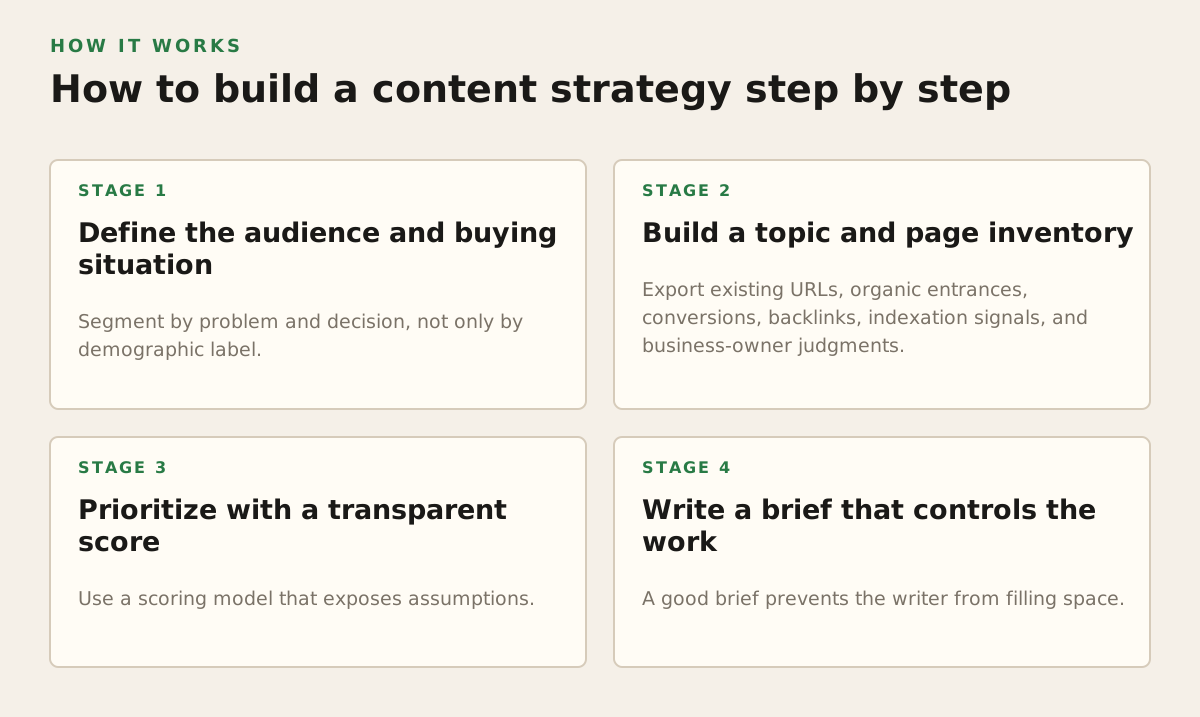
1. Define the audience and buying situation
Segment by problem and decision, not only by demographic label. “Small business owner” is too broad to produce a useful brief. “Dhaka-based online retailer deciding whether to outsource technical SEO after losing non-brand traffic” is actionable. Record the customer’s current solution, urgency, desired outcome, internal objections, and language.
Search intent is a business hypothesis, not a label copied from a tool. A query may look informational but contain a strong commercial concern. “Fix product pages not indexed” could come from an owner seeking a checklist, an in-house SEO needing diagnostics, or an agency evaluating support. The page should choose a primary job and signpost other paths without trying to serve everyone equally.
2. Build a topic and page inventory
Export existing URLs, organic entrances, conversions, backlinks, indexation signals, and business-owner judgments. Then group pages by topic, intent, offer, audience, and geographic relevance. Look for gaps and conflicts:
- Important services with no page that explains the offer in customer language.
- Several articles competing for the same intent without a clear primary URL.
- High-impression pages with weak click-through because the title or description misstates the benefit.
- Pages receiving visits but offering no relevant next step.
- Advice that is outdated because regulations, product models, or searcher expectations changed.
For on-page diagnostics, a meta description is a promise of relevance, not a guaranteed ranking control. When checking length and truncation risk during editorial QA, use the meta description length checker: meta description length checker. The strategy question remains more important than character count: does the snippet accurately preview why this page deserves the click?
3. Prioritize with a transparent score
Use a scoring model that exposes assumptions. An illustrative example is to score each opportunity from 1 to 5 for business value, audience fit, evidence strength, search opportunity, and implementation effort. A simple priority formula could be:
Priority = (business value + audience fit + evidence strength + search opportunity) ÷ implementation effort.
This is a decision aid, not a scientific forecast. A high-volume topic with weak evidence may deserve a lower score than a niche service topic with strong customer insight. A page requiring legal review, original data, photography, development, and translation may be strategically sound but unsuitable for the next sprint.
4. Write a brief that controls the work
A good brief prevents the writer from filling space. Include the primary audience, page purpose, query family, conclusion the reader should reach, required evidence, internal links, competing page risks, conversion path, and update owner. Also state what the page must not claim. For a penalty-recovery article, that might include no promise of reinstatement, no unsupported diagnosis, and no recommendation to remove large groups of URLs without evidence.
Internal linking should be intentional: link where the destination expands the current task, use descriptive anchor text, and confirm that important links are crawlable. Google explains how to create crawlable links and recommends standard links with descriptive text in its official link guidance. During an audit, the internal link opportunity tool can help surface relevant connections: internal link opportunity tool.
5. Publish, distribute, and learn
Publishing is one stage in a loop. Give sales, support, subject-matter experts, and local teams a way to correct assumptions. Repurpose only when the underlying idea remains useful in the new format: a detailed guide can become a checklist, webinar outline, email sequence, or short video, but each format needs its own job and quality control.
Where content strategies break
Most content failures are not caused by a writer’s grammar. They come from a mismatch between promise, evidence, audience, and measurement. More content cannot repair a broken decision system.
Failure: publishing to a quota
A monthly article target encourages easy topics, shallow briefs, and duplication. It also creates a false sense of progress when important commercial pages remain incomplete. Replace the quota with a portfolio of outcomes: improve a priority category, support a sales objection, build a local service cluster, or clarify a product decision. A smaller number of complete assets can be more useful than a large number of disconnected posts.
Failure: confusing originality with novelty
Original content does not need an unprecedented subject. It needs a reason to exist beyond rearranging search results. Add first-hand process detail where the business genuinely has it, explain trade-offs, show calculations, include local context, or state where the recommendation stops applying. Do not manufacture experience, customer stories, statistics, or testing claims. Trust is damaged faster by invented specificity than by honest limits.
Failure: ignoring technical delivery
Excellent information can underperform if important pages are blocked, duplicated, orphaned, slow to render, or presented with confusing canonical signals. Content and technical SEO must share an acceptance checklist. Verify indexability, status codes, canonicalization, structured data where appropriate, mobile rendering, internal links, and template behavior. A content strategist does not need to implement every fix, but must know when a publishing problem is actually a delivery problem.
Failure: treating AI-generated drafts as finished work
AI can help cluster notes, propose outlines, identify missing questions, or transform an approved explanation into a different format. It cannot supply real expertise, verify a local claim, or take responsibility for a regulated recommendation. Review for factual accuracy, implied guarantees, citation quality, repetition, tone, and whether the page adds information unavailable in generic summaries.
- Remove claims that cannot be traced to a reliable source or internal evidence.
- Replace vague advice with a decision, condition, example, or diagnostic step.
- Ask a qualified subject expert to review high-risk sections.
- Check names, locations, product specifications, dates, and legal terminology.
- Keep a record of the reviewer and the next planned review date.
Failure: measuring the wrong time horizon
Some pages support a long research cycle; others should produce a direct action quickly. Ranking movement may also be obscured by seasonality, changing demand, technical changes, or a sitewide loss of trust. Use a comparison period appropriate to the page, annotate major changes, and avoid declaring success from one short-term fluctuation. A page with flat clicks but better qualified leads may be improving; a page with rising impressions but falling conversions may need sharper targeting.
How practitioners apply the strategy in real businesses
Application begins by matching the operating model to the content system. An e-commerce team needs category architecture, faceted-navigation controls, buying guidance, product data, and merchandising coordination. A local service business needs location relevance, service clarity, proof of presence, and a conversion path that works on mobile. An international company needs market-specific research rather than a single English-language page copied across countries.
Example: an e-commerce category cluster
Imagine an illustrative online retailer selling office chairs in Bangladesh. The commercial goal is not “rank for chairs.” It is to help a buyer select a chair by use case, budget, body support needs, and delivery constraints. The strategy could include:
- One category page for office chairs, with clear product filtering and buying context.
- One guide comparing ergonomic features, written for buyers who do not know the terminology.
- One comparison page for mesh versus fabric, including maintenance and climate considerations.
- Four supporting pages addressing height adjustment, lumbar support, assembly, and warranty questions.
- Product pages with specifications, availability, delivery information, and clear returns language.
The internal links should reflect decisions. The feature guide links to relevant categories; the category links to the guide; product pages answer the specific concern without forcing every visitor through a blog. If stock changes frequently, do not build a strategy around a product URL that will disappear every few weeks. Put durable buying knowledge on stable pages and connect it to current inventory.
Example: local SEO for a professional service
A Dhaka-based accounting consultancy may serve startups, exporters, and established manufacturers, but each group asks different questions. A single “accounting services” page cannot explain all three buying situations clearly. Create a service architecture around actual capability, then add location context only where the business can provide meaningful local information.
Local relevance must be useful, not decorative. A page that swaps “Dhaka” into a generic paragraph is weaker than one that explains office access, service areas, local filing considerations, response expectations, or the types of businesses served. Confirm all location claims with the business. Keep business name, address, phone details, opening information, and service descriptions consistent across the site and relevant profiles.
Example: international SEO and localization
For a company targeting Bangladesh and other markets, decide whether the audience needs translation, localization, or a separate market proposition. Translation changes language. Localization changes examples, terminology, currency presentation, regulations, delivery assumptions, and calls to action. Maintain a market matrix so each page has an owner, target country, language, currency treatment, and review requirement.
An illustrative matrix might assign five columns—market, language, offer, proof, and conversion path—to every priority URL. If the Bangladesh page has no local proof or operational route, the correct decision may be to publish a narrower educational resource first rather than pretend the company serves the market fully.
Example: recovering after ranking loss
Ranking loss requires diagnosis before rewriting. Separate a technical incident, a demand change, a content-quality problem, a SERP-format change, and a competitor improvement. Compare affected URL groups, query classes, dates, templates, and page intent. Inspect logs and indexation where appropriate. Ask sales whether the audience or offer changed.
Then create a recovery backlog with reversible actions first: correct accidental noindex directives, restore broken internal links, consolidate genuine duplicates, improve missing evidence, and update obsolete guidance. Do not delete pages merely because they have low traffic. A page may support a valuable query, a customer journey, or a link relationship that is not visible in last-click analytics.
Recommended operating cadence
Use a cadence that fits the team’s capacity. An illustrative starting policy for 2026 could be a weekly editorial and technical triage, a monthly page-quality review, and a quarterly portfolio decision. These are planning examples, not universal timelines.
- Weekly: resolve blocked publishing tasks, factual corrections, broken links, and urgent commercial changes.
- Monthly: inspect priority-page performance, query alignment, conversion paths, and new customer objections.
- Quarterly: re-score opportunities, merge overlapping pages, retire unsupported claims, and assign owners.
- After major changes: annotate releases, migrations, template updates, and market launches before interpreting performance.
The final recommendation is to start with one commercially important audience and build a complete path from question to outcome before expanding the calendar. Mr Haq can help businesses and agencies turn that path into technical SEO, content planning, local visibility, E-E-A-T, analytics, and AI search optimization work; Mr Haq is the natural next step if you need an experienced strategy partner.
Authored with NotFair SEO