


A local seo agency can help improve visibility for nearby searches, but the right choice depends on what is blocking growth and who will implement the work. Use this guide to match your business situation to a service model, test a provider’s evidence and reporting, and compare the work, risks, and budget terms before you sign.
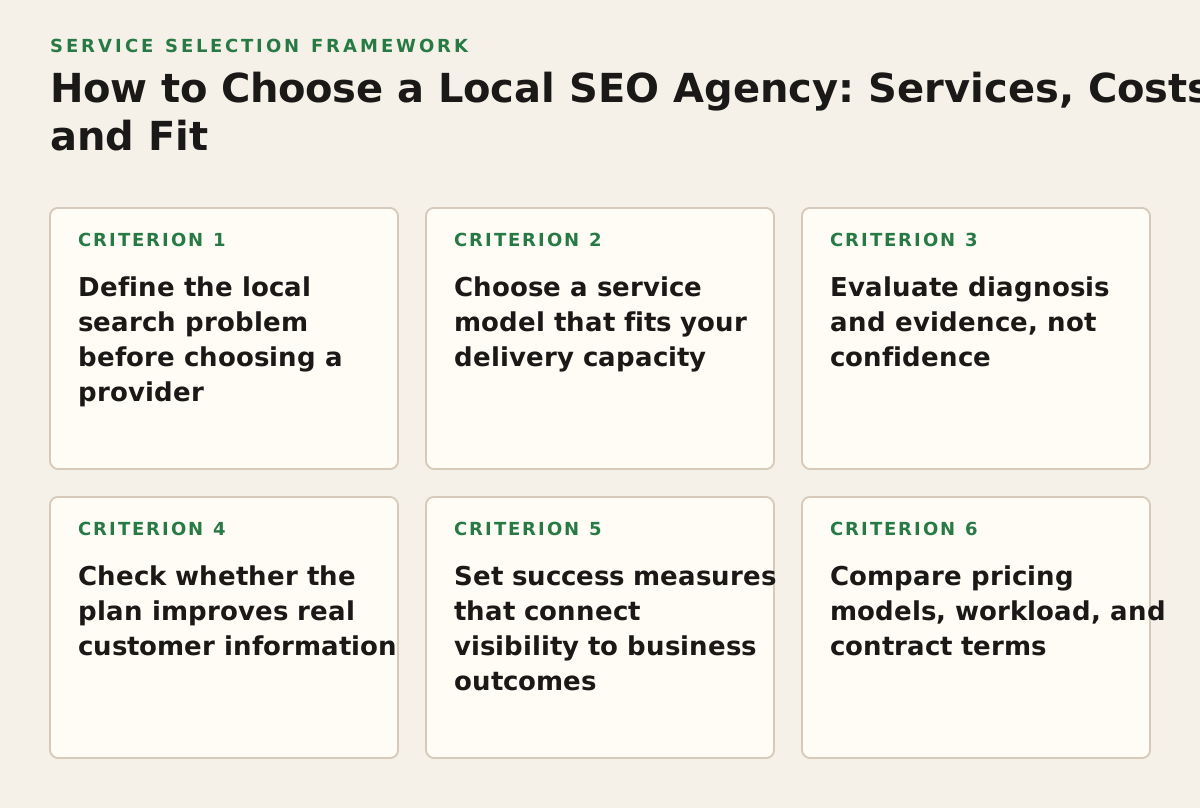
1. Define the local search problem before choosing a provider
Local SEO is the work of improving a business’s visibility in searches with local intent, such as searches for a service in a city or a nearby provider. It can involve a business profile, location pages, technical fixes, reputation processes, and measurement. Those are different tasks, so “we need local SEO” is not yet a useful scope.
Start with the customer journey you need to improve. A single-location service business may need people to find its address, call, or request directions. A multi-location company may need each branch to appear for relevant local queries. An ecommerce brand targeting a country or region may need locally relevant pages, but that does not automatically make it eligible for a business profile.
Google says a Business Profile is for businesses that make in-person contact with customers during stated hours; online-only businesses are not eligible. Check the Google Business Profile eligibility guidelines before paying anyone to create or optimize a profile for an ecommerce-only operation. If your business model is unusual, ask Google or review the policy rather than relying on a vendor’s assurance.
Write a one-page problem brief
- Locations and markets: List real customer-facing locations and the areas you actually serve; do not treat a target country as proof of physical presence.
- Priority action: Specify whether you need qualified calls, bookings, store visits, quote requests, or non-branded organic visits to location pages.
- Known constraint: Note access problems, duplicate profiles, limited developer time, inaccurate business information, or a past ranking loss.
- Baseline: Record the current numbers and the period they cover, even if the data is incomplete.
Why this works: it lets you compare proposals against the same job. A failure mode is selecting a provider because its package promises many tasks, then discovering those tasks do not address the actual bottleneck. For example, if customers cannot find the right branch phone number, a large content plan may be premature.
2. Choose a service model that fits your delivery capacity
Providers use similar labels for different arrangements. Compare the delivery model, not just the words “agency,” “consultant,” or “local SEO package.” Your own team’s capacity matters: a strategy that requires frequent developer changes or location-manager approvals may stall if nobody owns those tasks.
| Buyer need | Service type to consider | Trade-off and implementation burden |
|---|---|---|
| Several connected issues across profiles, pages, technical SEO, and reporting | Full-service SEO agency | Broader execution can reduce coordination, but confirm which work is actually included and who controls site or profile changes. |
| A diagnosis, roadmap, or specialist oversight while your team does the work | SEO consultant or strategy engagement | Often keeps implementation with your team; it requires an internal owner with time and authority to act. |
| Many locations with recurring data checks and profile workflows | Listings-management provider or platform | Can support repeatable operations, but software does not replace strategy, local content decisions, or fixing website problems. |
| An agency needs specialist capacity or reporting support for client accounts | White-label consultant or fulfillment partner | Can extend the agency’s delivery, but account ownership, client communication, and quality control need clear boundaries. |
| A single, narrow technical or content issue | Fixed-scope audit or project specialist | A defined deliverable can be easier to evaluate; it may not include implementation or follow-up measurement. |
Choose based on the work you can absorb. A full-service engagement is not automatically better if your team cannot provide approvals, access, source data, or implementation support. Conversely, a roadmap-only engagement may leave a small business with a list of fixes it cannot complete.
Failure mode: buying a listings platform when the core issue is that the site has no useful location information, or hiring an auditor when the company needs someone to coordinate changes. Ask for a responsibility map showing provider tasks, client tasks, approval points, and dependencies.
3. Evaluate diagnosis and evidence, not confidence
A credible proposal should connect a specific observation to a recommended action and a way to check whether the action helped. Google describes local results in terms of relevance, distance, and prominence; a provider cannot control a searcher’s distance, and no vendor can promise a particular position for every location or query. Review Google’s explanation of how local ranking works when assessing claims about guaranteed map rankings.
Ask to see the chain of reasoning
- Observation: What did the provider inspect—profile status, location-page content, indexation, query data, or conversion tracking?
- Diagnosis: What does the evidence suggest is limiting qualified visibility?
- Action: What will change, who will make the change, and what must be approved?
- Verification: Which report or record will show whether it was completed and what changed afterward?
For example, a useful recommendation might identify two branch pages with the same generic copy, explain how that makes it harder for a visitor to distinguish the locations, and propose adding genuinely useful branch-specific details. The example is illustrative; a provider should verify the issue on your site before recommending that work.
Look for falsifiable claims. “We will improve your visibility” is too vague to evaluate. Ask the provider to name the pages, profiles, queries, or conversion events it intends to work on. A failure mode is treating a polished audit deck as evidence of implementation quality. Request a sample deliverable with sensitive client information removed, plus a clear explanation of what the sample does and does not show.
For ecommerce or international businesses, test whether the provider distinguishes local demand from general country-level organic visibility. If it recommends Business Profiles, ask how your locations meet eligibility rules. If it cannot explain the distinction, pause before approving profile creation.
4. Check whether the plan improves real customer information
Local visibility is not only a ranking task. A searcher who reaches the wrong branch page, sees outdated hours, or cannot tell which location offers a service may not become a lead. Ask how the provider will verify that business details and page content match what customers can actually access.
Profile and location accuracy comes first. Agree who can edit business details, who confirms changes, and how duplicates or incorrectly represented locations will be handled. Do not approve invented addresses, virtual locations presented as staffed offices, or review tactics that ask customers to misrepresent their experience.
Location pages should answer location-specific questions. When a business has multiple branches, useful distinctions might include the services offered at that branch, its contact route, access information, and the areas it genuinely serves. Replacing only the city name in a shared template is a failure mode: it creates little decision value for customers and can lead to thin, repetitive pages.
Structured data can help describe information on a page, but it is not a substitute for visible, accurate content. Google’s LocalBusiness structured data documentation explains the information search engines may understand from this markup. The Schema.org LocalBusiness type defines a vocabulary for local businesses; using a type does not guarantee a particular search display or position.
For a site with many relevant pages, internal links can help users and search engines navigate between related content. Identify links that genuinely help a visitor move from a service explanation to the correct location or next step; the internal link opportunity tool may help you explore potential linking opportunities. It does not decide whether a suggested link is useful or appropriate, so review each opportunity in context.
5. Set success measures that connect visibility to business outcomes
Before work begins, agree on a small set of measures and how each one will be collected. Separate leading indicators from business outcomes. Completed profile fixes, published pages, and resolved technical issues show that work shipped. Qualified calls, bookings, or sales help show whether the work contributed to a business result.
Google Search Console’s Performance report documentation explains how to review search results data such as clicks, impressions, click-through rate, and average position. Use those measures to examine organic search trends, but do not treat average position as a guaranteed rank at every location. Pair search data with analytics or a reliable lead record when the business needs to judge conversions.
Agree on measurement rules in writing
- Choose the pages, profiles, locations, and query groups that are in scope.
- Define a qualified lead in business terms, such as a relevant service request rather than every form submission.
- Record the reporting period, attribution method, and any known tracking gaps.
- Review results alongside changes in staffing, seasonality, service availability, or marketing activity.
A practical reporting view might show non-branded clicks to selected location pages, tracked calls or forms by branch, completed work, and unresolved blockers. If your title and description snippets need review as part of a page update, the meta description length checker can help check their character length; length alone does not establish relevance or predict a click-through rate.
Failure mode: reporting only rankings from a small, fixed set of searches. Search results can vary by context, and a rank report without qualified traffic or lead data may reward movement that has little commercial value. Ask the provider to explain what decision each metric supports and what would cause the plan to change.
6. Compare pricing models, workload, and contract terms
Local SEO proposals may charge for a recurring retainer, a defined project, consulting time, or access to a platform. There is no responsible way to compare the headline fee without knowing the work, the duration, and what your team must contribute. Compare deliverables and ownership before comparing totals.
Ask whether the fee covers diagnosis, implementation, content, profile work, reporting, meetings, and follow-up—or only some of them. Confirm whether third-party software, content production, development, location photography, or additional locations are separate costs. For a project fee, clarify what happens if the audit uncovers work outside the original scope. For recurring fees, ask how priorities are reviewed and what triggers a scope change.
Budget for your share of the work. Staff time for approvals, access, data checks, developer changes, and location-level fact-checking is part of the implementation burden even when it is not part of the invoice. For an illustrative planning exercise, list each expected task, assign an internal owner, and ask the provider to flag dependencies before the start date; do not treat a vendor’s proposed schedule as a universal timeline.
Review cancellation terms, account and profile ownership, data access, change approvals, reporting access, and what happens to work files when the engagement ends. A failure mode is paying for an ongoing package with no clear exit route or relying on an agency-controlled login for a business asset. The business should retain appropriate control of its own accounts.
7. Interview the provider and screen for red flags
Use the same questions with each shortlisted provider. Specific, bounded answers are more useful than sweeping promises. Ask for examples of process and decision-making, while respecting client confidentiality; a provider should be able to explain its approach without disclosing another business’s private data.
Vendor interview checklist
- What did you inspect to reach your diagnosis, and what evidence would change your recommendation?
- Which actions will you deliver directly, and which require our staff, developer, or location managers?
- How will you handle eligibility, duplicate profiles, business ownership, and approval of profile edits?
- Which outcomes will you report, how will leads be attributed, and what tracking limitations should we expect?
- What work is excluded from the proposed fee, and how are out-of-scope requests approved?
- Who owns the accounts, data, content, and reporting access during and after the engagement?
- What would make you recommend stopping, changing, or delaying the work?
Red flags include guaranteed rankings, pressure to create profiles for ineligible locations, undisclosed link schemes, fabricated reviews, unexplained bulk pages, or refusal to state who implements changes. Also be cautious if a provider claims a technical or content change caused a result without discussing other possible factors or the measurement method.
For a business recovering from a ranking loss, ask for a sequence that distinguishes diagnosis from remediation. A responsible provider should inspect what changed, check relevant technical and policy issues, and document proposed fixes before making broad edits. Do not authorize a large rewrite or mass deletion solely on the basis of a dramatic promise.
8. Use a staged selection and implementation plan
A staged process limits the risk of buying a broad engagement before you know what is needed. Start with the smallest meaningful scope that can establish the diagnosis and expose the implementation burden. Expand only when the evidence and internal capacity support it.
- Prepare the brief. List target locations or markets, priority customer actions, current constraints, known data sources, and the person who can approve changes.
- Screen for fit. Remove providers whose model does not match the job—for example, a platform-only offer when you need technical diagnosis, or strategy-only support when nobody can execute.
- Compare proposals line by line. Match each recommendation to an observed issue, named owner, deliverable, dependency, measurement method, and fee treatment.
- Agree on a baseline and guardrails. Record current performance, access arrangements, business facts, approval rules, and prohibited tactics before work starts.
- Run an initial work cycle. Complete a bounded set of priority fixes, verify implementation, and review both leading indicators and business outcomes against the agreed baseline.
- Continue, adjust, or stop. Expand only if the first cycle produces useful learning, the work is being delivered as agreed, and the next set of actions has a clear rationale.
Make the decision on fit, evidence, and execution—not the size of the promise. Mr Haq provides SEO strategy and consulting covering local SEO, content, technical SEO, and measurement. If you need help assessing a local search problem or planning the work, learn more at Mr Haq.
Authored with NotFair SEO