


Local seo ranking factors are the signals Google uses to decide which nearby businesses best match a search. Google describes local results in terms of relevance, distance, and prominence: make your business information accurate and specific, build credible evidence of its reputation, and remember that proximity can limit visibility even when your SEO is strong. The practical priority is to improve what you can control without treating any one profile field, review, or citation as a guaranteed ranking lever.
What local ranking factors mean in practice
A local ranking factor is not a checklist item with a fixed score. It is a piece of information or evidence that may help a search engine assess whether a business is a good match for a particular local query. The same business can appear differently for “emergency plumber,” “water heater repair,” and a search that names a neighborhood because the intent and the searcher’s location differ.
Google says local results are mainly based on relevance, distance, and prominence. Relevance is how well a profile matches what someone searched for; distance is how far away the business is from the searcher or location in the query; prominence concerns how well-known the business is. Google also notes that businesses cannot request or pay for a better local ranking. Those principles come from Google’s official guidance on improving local ranking.
That framework is useful because it separates a ranking problem from a conversion problem. A business may be eligible and relevant but too far from a searcher to appear prominently. Or it may show in results but lose the click because its hours are wrong, its service offering is unclear, or its reviews raise concerns.
- Relevance: Does the profile and supporting website content clearly describe the service, product, and business type?
- Distance: Is the business close enough to the searcher or the place named in the query to be a plausible option?
- Prominence: Is there credible evidence that the business is established and trusted, both online and in the real world?
Why these signals matter to a business
Local SEO affects more than map visibility. For a clinic, restaurant, repair company, or shop, a local result can influence whether a prospective customer calls, requests directions, checks availability, or visits the website. For an e-commerce brand, local intent may matter when shoppers want same-day pickup, a showroom, or a service area. A ranking that attracts the wrong customer is not a useful outcome, so measure qualified actions, not position alone.
Results also depend on context. A searcher in one part of Dhaka may see a different set of nearby businesses from someone searching across town. A service-area company without a customer-facing storefront has different profile constraints from a shop where customers visit. If the business serves multiple locations, its presence should reflect genuine operations at each location—not a set of near-identical pages or profiles created to cover more map pins.
Start with the job customers need done and the areas the business can actually serve. Then compare rankings and leads for specific service-and-location combinations. A broad “near me” report can hide that the company is visible for one service but absent for another, or that calls are coming from outside its viable service area.
- A restaurant should distinguish dine-in, takeout, and delivery if those options are genuinely available.
- A B2B supplier should clarify whether it serves walk-in customers or operates by appointment.
- An online retailer should make local pickup or showroom availability clear only where customers can use it.
- A service-area contractor should describe its real coverage rather than imply it has staffed offices everywhere.
How the main local SEO signals work
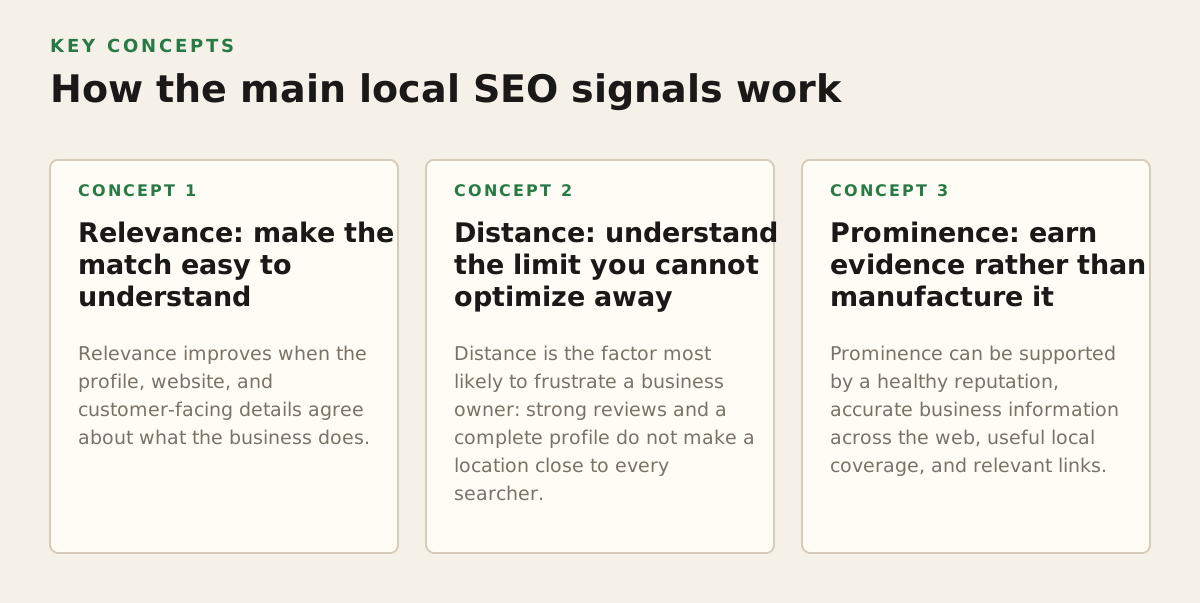
Relevance: make the match easy to understand
Relevance improves when the profile, website, and customer-facing details agree about what the business does. Choose the most accurate primary business category, add other categories only where they describe real services, and write service descriptions in plain language. A profile that lists a broad category while its site focuses on a different specialty gives people—and search systems—an unclear picture.
Google asks businesses to represent themselves accurately and consistently, including using a real-world business name and providing information that reflects the actual location or service area. Review the Business Profile representation guidelines before changing names, adding locations, or creating profiles for departments. Keyword additions to a business name are not a safe substitute for a relevant category or useful site content.
On the website, build pages around meaningful services and locations that the business can support. A page for “commercial air conditioning repair in Mirpur” should explain the commercial service, coverage, process, and contact route—not merely swap the place name into a generic template. Structured data can help search engines interpret details on a page, but it does not make inaccurate content true or guarantee a local ranking. Google’s LocalBusiness structured data documentation explains the supported markup and required details.
Distance: understand the limit you cannot optimize away
Distance is the factor most likely to frustrate a business owner: strong reviews and a complete profile do not make a location close to every searcher. For a single-location business, map visibility may naturally be stronger near its premises. For a service-area business, the appropriate service area should reflect where it genuinely operates; setting a wider area in a profile should not be treated as a promise of equal visibility throughout it.
Use location-specific tracking to see where visibility changes, but treat the map as a diagnostic rather than a guarantee. A rank grid can show a pattern—strong near the shop, weaker farther away—but it cannot by itself explain whether the cause is distance, competition, relevance, or a poor landing page. Pair it with real calls, direction requests, bookings, and lead quality.
Prominence: earn evidence rather than manufacture it
Prominence can be supported by a healthy reputation, accurate business information across the web, useful local coverage, and relevant links. These are not interchangeable votes with a known universal weight. A mention from a local chamber, trade association, or news outlet may provide context and referral value; a large batch of unrelated directory listings may add little. Prioritize sources that customers in the market recognize and can verify.
Reviews help prospective customers judge the business, but a review campaign must not cross into fabricated or manipulated feedback. Google’s Maps user-contributed content policy prohibits fake engagement, including incentives offered in exchange for reviews. Ask customers for honest feedback through a neutral process, respond constructively, and use recurring complaints to improve operations rather than trying to suppress criticism.
Where local SEO efforts break down
Most weak local campaigns do not fail because the owner missed a secret ranking factor. They fail because business information is inconsistent, the offering is difficult to understand, or the strategy tries to create coverage without a real customer experience behind it. Fix the underlying mismatch before investing in more citations or location pages.
- Incorrect profile details: A closed location, outdated hours, wrong phone number, or inaccurate service area can cost trust and prevent a customer from completing the next step.
- Category drift: Selecting categories to chase search terms rather than describe the business can make the profile less accurate and less useful.
- Thin location pages: Pages that only replace a city name provide little reason for a customer to choose that location and can create a poor site experience.
- Duplicate or ineligible profiles: Creating multiple profiles for one operation or using a virtual address as though it were a staffed location can conflict with Google’s representation requirements.
- Review shortcuts: Buying reviews, offering rewards for positive sentiment, or asking only happy customers can undermine credibility and violate platform policy.
There is also a measurement trap: comparing a single ranking screenshot month to month as though the result were fixed. Record the query, device, search location, and result type, and compare like with like. In Search Console, local organic pages can be assessed separately from Business Profile interactions; those datasets answer different questions and should not be added together as if they were the same click metric.
How to apply the factors in a practical audit
Audit in an order that resolves basic eligibility and accuracy before pursuing authority-building work. For a small business, a spreadsheet with the target service, location, landing page, profile status, and customer action is enough to expose many gaps. The numbers below are illustrative examples, not universal thresholds or ranking benchmarks.
- Choose a small query set. For example, a Dhaka repair company might track “AC repair,” “commercial AC repair,” and “emergency AC repair” in two actual service areas. Keep the service and area combinations distinct.
- Verify the business facts. Check the public name, address or service-area setup, phone, hours, categories, and booking route against the way the business operates today. Resolve duplicates and ownership problems before adding more profiles.
- Match each intent to a useful page. If three services have different processes or customers, assess whether each needs its own page. Include practical proof such as service details, coverage, qualifications, and a clear next step; do not create a page simply because a keyword tool shows a location phrase.
- Review customer evidence. Look for repeated review themes, unanswered questions, and relevant third-party mentions. Ask for honest reviews consistently, but do not dictate ratings or offer incentives.
- Measure business outcomes. Track calls, booked appointments, direction requests, and qualified form leads alongside search visibility. Segment by location or service where the reporting setup allows it, then investigate changes instead of assuming every fluctuation is an algorithm issue.
For pages with similar titles and overlapping content, check whether they serve separate customer needs or compete with one another. Use a crawl and internal-link review to find important service pages that are hard to reach; the internal link opportunity tool can help surface pages that may deserve a contextual link. When refining search snippets for those pages, a meta description length checker can help check length, but the description should still accurately summarize the page rather than promise a ranking boost.
Structured data is a supporting layer, not a replacement for this audit. If a page describes a real local business, check that its markup matches visible page content and the business’s actual details. Google explains that structured data can make a page eligible for certain search appearances, but eligibility does not guarantee that a rich result will appear. Prioritize accurate information and a useful page before adding markup.
Choose the next action by the constraint
Use the evidence to decide what to fix next. If customers cannot find the correct address or hours, resolve profile accuracy first. If the profile is complete but searches for a core service do not match the business, improve category and page relevance. If visibility weakens with distance, focus on serving the closest viable market and converting those customers well; do not create artificial locations. If visibility is reasonable but leads are poor, inspect the offer, landing page, response process, and review themes before chasing more rankings.
For businesses managing multiple markets, keep a separate record of the real location, service eligibility, target query, landing page, and lead outcome for each market. For a Bangladesh business expanding internationally, do not assume a local profile strategy transfers unchanged: the business must have a legitimate presence or service model that fits the platform’s rules in each market. Apple Maps is also a separate customer touchpoint; Apple’s Business Connect guide explains how businesses manage their information across Apple services, so verify that listing independently rather than assuming Google profile edits update it.
Recommended next step: fix the clearest accuracy or relevance gap, then measure whether qualified local enquiries improve before expanding the campaign. Mr Haq provides local SEO strategy, technical audits, and reporting support for businesses in Bangladesh and international markets; explore how Mr Haq prioritize the work.
Authored with NotFair SEO