


When comparing technical seo vs on page seo, the practical question is not which one matters more. It is which constraint is preventing a specific page, template, or website from earning qualified organic visits and conversions. Technical SEO makes a site accessible, crawlable, indexable, fast, and structurally understandable. On-page SEO improves the meaning, usefulness, relevance, and persuasion of the content users see. A page can need both, but the remedy is different.
That distinction matters to an e-commerce brand with thousands of product URLs, a local business trying to rank in Dhaka, an international company managing multiple markets, and an agency reporting on a client’s ranking loss. Fixing title tags will not repair a blocked product directory. Improving server response will not make a service page answer an unclear customer question. The work starts by identifying the failure mode.
What technical SEO and on-page SEO actually control
Technical SEO controls access and interpretation between a search engine and the website. It covers the systems and signals that help crawlers discover URLs, retrieve resources, understand page relationships, select canonical versions, and store eligible pages in an index. It also includes important user-facing engineering factors such as mobile rendering, page performance, and secure delivery.
On-page SEO controls relevance and usefulness on an individual URL. It includes the subject covered, search intent, headings, body copy, title element, meta description, image context, internal links, structured answers, and the evidence that makes a claim credible. It is not simply inserting a keyword into a page. It is aligning the page’s promise and content with what a qualified visitor needs to decide or do.
These are overlapping disciplines, not two isolated checklists. A descriptive internal link is an on-page choice that helps users and crawlers discover related pages. A canonical tag is a technical control that can change which version receives indexing signals, but its value depends on having a coherent content and URL strategy. Google’s SEO Starter Guide describes both discoverability and helpful page content as parts of search optimization, rather than treating them as competing activities: Google Search Central’s SEO Starter Guide.
| Area | Primary question | Typical work | Common failure |
|---|---|---|---|
| Technical SEO | Can a search engine access, render, understand, and index the right URL? | Crawl controls, redirects, canonicals, XML sitemaps, JavaScript rendering, performance, structured data, international signals | The best page is inaccessible, duplicated, slow, or excluded |
| On-page SEO | Does this page satisfy the searcher better than available alternatives? | Intent mapping, titles, headings, copy, media, internal links, product information, author and business evidence | The page is visible but vague, thin, mismatched, or unconvincing |
| Shared territory | Does the site communicate a clear page purpose? | Information architecture, topic clusters, anchor text, templates, structured content | Users and crawlers cannot distinguish important pages |
A useful operating rule is this: technical SEO removes access constraints, while on-page SEO improves the value of the accessible page. If a URL is not eligible to appear, content optimization has limited opportunity to help. If it is indexed but fails to earn clicks or satisfy visitors, more crawling work may not solve the commercial problem.
A simple diagnostic split
- If important URLs are absent from a site: investigate discovery, internal links, robots directives, redirects, status codes, and indexation.
- If URLs are indexed but impressions are weak: investigate search demand, targeting, templates, internal competition, and whether the page addresses a real query.
- If impressions exist but clicks are weak: investigate the title, snippet promise, SERP competition, and intent alignment.
- If clicks arrive but leads or sales are weak: investigate content depth, trust evidence, offer clarity, UX, pricing transparency, and conversion friction.
- If rankings fall across many templates: look for technical releases, migrations, indexation changes, or broad quality and intent problems before editing individual paragraphs.
Why the distinction matters for rankings and revenue
Search performance is a chain. A page must generally be discoverable, retrievable, eligible for indexing, selected as an appropriate representation, matched to a query, shown attractively, and then satisfy the visitor. Technical and on-page work influence different links in that chain. Treating them as interchangeable creates misleading reports and poorly prioritized backlogs.
For example, an online retailer may publish excellent descriptions for every product but expose faceted URLs that generate thousands of near-duplicates. The copy may be strong, yet crawl resources and canonical signals are diluted by URL combinations for color, size, sort order, and filters. Conversely, a retailer may have a clean XML sitemap and excellent Core Web Vitals but use identical manufacturer copy on every product page. The site is accessible, but it gives searchers little differentiated value.
Indexation is not the same as ranking. A URL appearing in an index does not guarantee strong visibility, and a URL absent from an index cannot compete normally for organic results. Google explains that crawling, indexing, and serving are separate stages in its documentation on how Google Search works. This is why a technical audit should report each stage separately rather than label every problem “low rankings.”
Traffic is not the same as business value. A high-volume informational query may produce visits without generating demand for a consulting service. A lower-volume query such as “technical SEO consultant Dhaka” may be commercially stronger for a local provider. On-page strategy therefore needs a business mapping layer: page type, audience, intent, conversion action, and geographic or product relevance.
What happens when teams prioritize the wrong layer
- Content-first mistake: publishing ten new articles while category pages remain blocked by a noindex directive or disconnected from navigation.
- Technical-first mistake: spending weeks refining schema and redirects while service pages lack a clear offer, proof, audience, or answer to the buying question.
- Keyword-first mistake: creating several pages targeting nearly identical terms, causing internal competition and confusing the site’s information architecture.
- Reporting mistake: presenting impressions as success when qualified leads, assisted conversions, or revenue have not improved.
For a small business, the priority may be correcting a Google Business Profile and a service-page intent mismatch rather than rebuilding the website. For a large international organization, hreflang, faceted navigation, rendering, and migration controls may deserve attention before a content expansion. The right answer depends on the failure’s scale, reversibility, and commercial impact.
How technical SEO works in practice
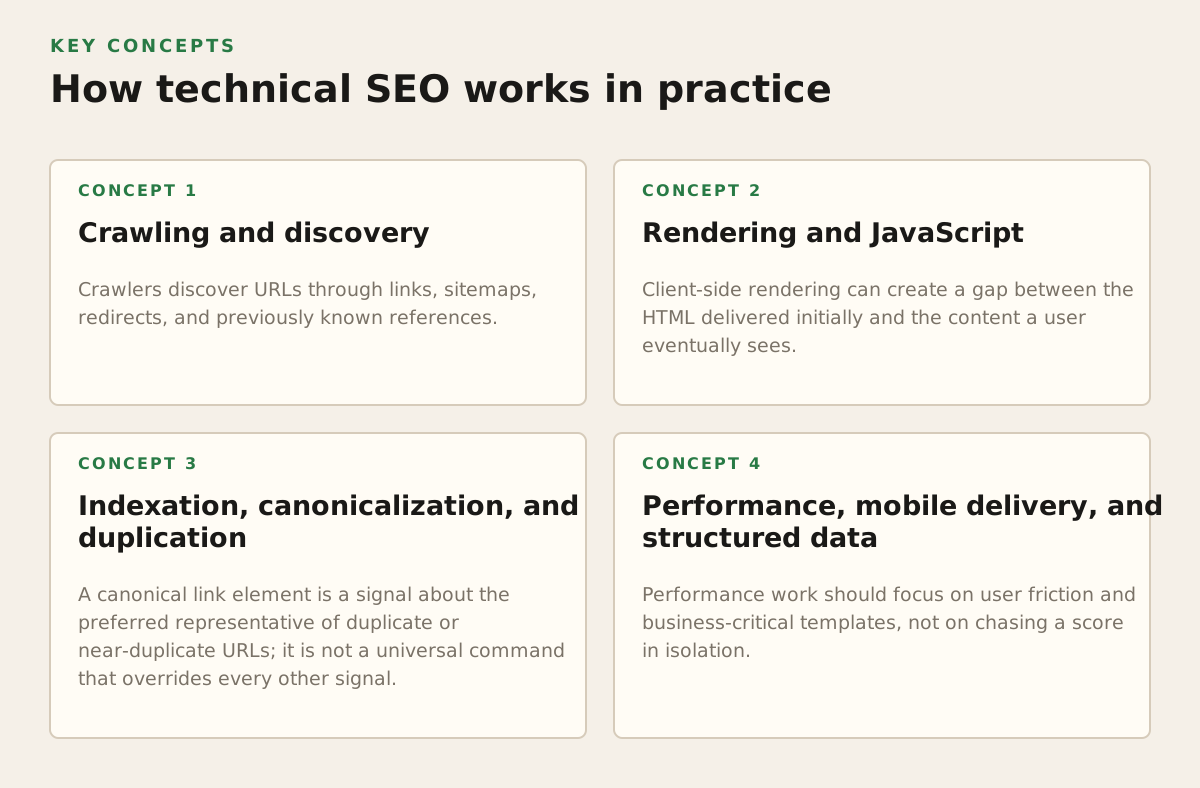
A technical SEO process turns a large website into a set of testable assumptions. The question is not “Is the site technically optimized?” It is “Which important URLs can Google not reliably discover, render, index, or interpret, and why?” Start with representative URL groups rather than inspecting only the homepage.
Crawling and discovery
Crawlers discover URLs through links, sitemaps, redirects, and previously known references. A sitemap can support discovery, but it does not replace useful internal links or guarantee indexing. Important pages should be reachable through a logical navigation and contextual links, with clear status codes and minimal unnecessary redirects.
Check the relationship between the sitemap, navigation, and analytics or sales data. If a revenue-generating category is absent from the sitemap and receives no internal links, its problem is architectural. If it is linked prominently but returns a server error, the problem is delivery. If it returns a successful response but is excluded with a directive, the problem is indexation policy.
Rendering and JavaScript
Client-side rendering can create a gap between the HTML delivered initially and the content a user eventually sees. Product names, links, prices, reviews, or body text that appear only after scripts execute should be checked in rendered HTML, not assumed to be present because the page looks complete in a browser. Google’s JavaScript SEO guidance explains how rendering affects the discovery and processing of page content: Google’s JavaScript SEO basics.
For an e-commerce application, test whether:
- Product links exist as crawlable anchor elements rather than only click handlers.
- Important copy is available in the rendered document.
- Each meaningful product or category has a stable, shareable URL.
- Client-side route changes update titles, canonicals, and status behavior correctly.
- Unavailable products return an intentional outcome instead of a soft 200 page.
Indexation, canonicalization, and duplication
A canonical link element is a signal about the preferred representative of duplicate or near-duplicate URLs; it is not a universal command that overrides every other signal. A technical review should compare canonical targets with redirects, internal links, sitemap URLs, pagination, parameter behavior, and page content.
Common causes of indexation waste include:
- Filter and sort parameters generating crawlable combinations with no standalone search value.
- HTTP, HTTPS, www, and non-www versions resolving inconsistently.
- Trailing-slash or uppercase variants creating duplicate paths.
- Soft 404 pages that display “not found” messaging while returning a successful status.
- Old campaign, tag, or internal-search URLs remaining linked after their purpose ends.
Canonical strategy must follow business intent. If two URLs represent genuinely different products, locations, or language versions, collapsing them into one canonical can remove useful visibility. If they are merely tracking or sorting variants, consolidating them may be sensible. The decision requires URL-level evidence, not a blanket rule.
Performance, mobile delivery, and structured data
Performance work should focus on user friction and business-critical templates, not on chasing a score in isolation. Large images, render-blocking resources, unstable layouts, excessive third-party scripts, and slow server responses can make product comparison or lead submission harder. Google describes page experience as a collection of signals, while also emphasizing that good page experience does not replace relevant content: Google’s page experience documentation.
Structured data can help search engines understand entities such as products, organizations, articles, or local businesses. It does not guarantee a rich result, and invalid or misleading markup can create maintenance and eligibility problems. Use the vocabulary that accurately describes visible page content, then validate it and monitor the relevant search appearance. Google explains the purpose and limitations of structured data in its structured data introduction.
A practical technical audit should produce an owner, severity, affected URL pattern, evidence, recommended fix, and validation method for every issue. “Improve site speed” is not an actionable ticket. “Compress hero images on the product template, preserve intrinsic dimensions, and compare mobile interaction metrics before and after deployment” is.
How on-page SEO works in practice
On-page SEO begins before writing. It starts with deciding what a page is for, who should land there, what evidence they need, and which action matters to the business. A page should have one dominant purpose even when it supports several related queries.
Intent and page-type alignment
Search terms are clues, not complete briefs. “Best accounting software” suggests comparison and evaluation. “Accounting software pricing” suggests commercial detail. “How to file VAT in Bangladesh” suggests an instructional need. A single page can address related variations, but forcing all intents into one generic article usually weakens the experience.
Map each target to a page type:
- Service page: explain the service, suitable client, process, deliverables, proof, limits, and next step.
- Category page: help shoppers compare a coherent set of products with useful filters and buying guidance.
- Product page: provide unique specifications, availability, use cases, delivery information, returns, media, and decision support.
- Location page: demonstrate genuine local relevance without copying the same city paragraph across every market.
- Editorial guide: explain a problem thoroughly, cite dependable evidence, and connect readers to a relevant commercial or next-step page.
The title sets an expectation; the opening section must confirm it. Headings should make the document scannable, but they should not become a list of awkward keyword variations. The meta description is not a direct ranking lever to treat as a guarantee, yet it can clarify the offer in the search snippet when Google uses it. Use a meta description length checker to check length while prioritizing accurate, compelling wording over an arbitrary character target.
Evidence, specificity, and E-E-A-T
Trust is built through particulars. A consulting page can state the types of businesses served, the audit process, decision criteria, reporting approach, and known limitations. A product page can show dimensions, materials, compatibility, warranty terms, and delivery conditions. A health or financial page needs especially careful sourcing and transparent expertise.
Do not add invented testimonials, performance percentages, client logos, certifications, or guarantees to make a page look authoritative. For a business recovering from a ranking loss, document the actual change history, affected templates, observed symptoms, and remediation plan. Specific evidence beats generic authority language.
Internal linking and content structure
Internal links distribute discovery paths and give users a next step. Their anchor text should describe the destination naturally. A technical SEO guide might link to a crawl audit service; a local SEO article might link to location-page guidance; a product comparison might link to the relevant category. Avoid adding links merely to increase a page’s link count.
Review existing content for links before commissioning more articles. An internal link opportunity tool can help surface related pages, but the final decision should consider intent, prominence, destination quality, and whether the link interrupts the reader. A link from a relevant paragraph is usually more useful than a random “read more” block repeated across every page.
For an illustrative content brief, define:
- The primary audience and commercial problem.
- The dominant intent and appropriate page type.
- Three to five questions the page must answer.
- Proof or first-hand detail the business can legitimately provide.
- The primary conversion action and two logical internal destinations.
- The measurement plan: impressions, qualified clicks, leads, sales, or assisted conversions.
Where each approach breaks down
Technical SEO has boundaries. A technically perfect page can still fail because the offer is uncompetitive, the topic has little demand, the content is generic, or stronger pages satisfy the query more directly. Schema cannot compensate for missing information. Faster delivery cannot compensate for a misleading title. A clean sitemap cannot make a poor page persuasive.
On-page SEO also has boundaries. Rewriting a page cannot fix a robots.txt rule that blocks critical resources, a noindex directive on the target URL, a broken rendering path, or a redirect to the wrong market. Adding keywords to a page that users cannot reach is activity without access.
Do not diagnose from rankings alone. A ranking loss may be caused by a migration, accidental deindexation, changed search intent, seasonality, competitor improvement, manual action, algorithmic reassessment, or tracking differences. Google Search Console’s Performance report can separate queries, pages, countries, devices, clicks, impressions, click-through rate, and average position, which makes it a useful starting point for narrowing the pattern: Google Search Console Performance report documentation.
Typical failure patterns and the right response
- All pages lose impressions after a migration: inspect redirects, canonicals, robots directives, sitemap changes, URL patterns, and server responses before rewriting content.
- One service page receives impressions but few clicks: compare its title and offer with the actual query set, then improve the promise and intent match.
- Many product pages are indexed but do not convert: inspect unique product information, availability, trust details, images, delivery expectations, and checkout friction.
- Local pages rank for irrelevant locations: revise location architecture and genuine local evidence instead of adding more city names.
- International pages compete with one another: review language, country targeting, internal links, canonicals, and hreflang implementation together.
- AI-generated drafts are technically published but weak: add expert review, original analysis, verifiable sources, and useful details that answer the customer’s real decision.
There is also a measurement limitation. Technical fixes may improve crawlability without producing immediate ranking movement, especially when the affected pages have little authority or weak demand. Content revisions may take time to be recrawled and re-evaluated. A recommendation should therefore specify the expected mechanism and the observable validation signal, not promise a fixed lift.
An illustrative prioritization example
The following is an illustrative starting policy, not a universal benchmark. Imagine a retailer with 1,200 product URLs, 180 category URLs, and a recent template deployment:
- Audit the 20 highest-revenue category and product templates first.
- Resolve the 3 template defects that cause important pages to return the wrong canonical or become unavailable to crawlers.
- Validate 50 representative URLs across products, categories, mobile rendering, and discontinued items.
- Rewrite 10 category titles and introductions where Search Console shows impressions but poor query alignment.
- Add unique buying information to 30 products with traffic but weak add-to-cart activity.
- Review performance and conversion data after a defined observation period, then expand the fixes only if the same pattern is confirmed.
The sequence protects revenue-bearing URLs, validates the mechanism, and avoids publishing hundreds of pages before the template is trustworthy.
How practitioners combine both disciplines in a 2026 SEO workflow
For most businesses, the best approach is a dependency-led workflow rather than a permanent choice between technical and on-page SEO. Start with the pages that matter commercially, identify the constraint, fix the smallest system that resolves it, and then improve the page’s relevance and conversion path.
Step 1: Build a page and template inventory
Group URLs by function: homepage, service, location, category, product, article, author, campaign, and utility pages. Add revenue, leads, organic clicks, impressions, indexation state, template owner, country, and priority where available. This prevents an audit from treating a revenue category and a low-value tag page as equivalent.
Step 2: Establish the technical baseline
Inspect representative URLs and compare crawlable HTML with rendered content. Review status codes, indexation directives, canonicals, XML sitemaps, internal links, mobile behavior, performance, structured data, and international signals. Use a sample large enough to reveal template patterns, while manually checking commercially important pages.
Step 3: Classify the search intent
For each priority page, record the query theme, audience, stage of decision, geography, and desired action. Check whether the current URL is the right page type. If a product page is trying to rank for a broad educational query, adding more product adjectives may not solve the mismatch; a guide or comparison page may be needed, with a clear path to products.
Step 4: Improve the on-page experience
Rewrite the title and opening to make the subject and value clear. Organize headings around decisions and questions. Add original detail, examples, limitations, source links, media context, author or business information, and relevant internal links. For commercial pages, make the next step visible without turning the page into an advertisement.
Step 5: Validate and report by mechanism
After deployment, verify that the intended technical change exists in production and that important URLs remain accessible. Monitor impressions, clicks, queries, indexation patterns, organic conversions, and template-specific behavior. Report “canonical corrected on priority category template” separately from “category copy revised for comparison intent.” That level of detail lets a client decide what to scale, roll back, or investigate.
A useful prioritization formula is qualitative but disciplined: business impact × affected URL scale × confidence in the diagnosis, divided by implementation effort and risk. A one-line accidental noindex on a lead-generation template may outrank a lengthy article refresh. A technically clean site with poor service-page conversion may justify content and offer work before another crawl report.
For a local consultancy in Dhaka, this may mean fixing location and service architecture, ensuring contact and business details are consistent, and creating genuinely useful pages for the markets served. For an international company, it may mean separating country intent, validating localized content, and controlling duplication during expansion. For a white-label agency, the deliverable should make these decisions visible: affected URLs, evidence, owner, priority, acceptance criteria, and reporting metric.
Use technical SEO to make the right pages eligible, then use on-page SEO to make those pages the best practical answer for the intended customer. If a business is recovering from a ranking loss, begin with a segmented diagnosis rather than a blanket content rewrite: identify when the loss began, which templates and markets changed, whether indexation shifted, and whether the query mix changed. That sequence is more defensible than choosing a discipline based on which checklist is familiar.
Mr Haq helps businesses connect technical audits, content strategy, local SEO, E-E-A-T, analytics, and AI search optimization to measurable organic growth. If you need a prioritized diagnosis rather than separate task lists, Mr Haq can help shape the right technical and on-page SEO plan for your site.
Authored with NotFair SEO