


SEO and content strategy are most effective when treated as one operating system: SEO reveals how search engines discover, interpret, and rank pages, while content strategy decides which business problems to solve, for whom, and in what order. For a Dhaka-based service company, an e-commerce brand, an international business entering Bangladesh, or an agency supporting clients under a white-label arrangement, the goal is not simply to publish more pages. The goal is to create the right page, make it accessible and trustworthy, and connect it to a measurable commercial outcome.
What SEO And Content Strategy actually means
SEO and content strategy is the coordinated planning of search demand, website architecture, content quality, authority, and measurement. SEO supplies constraints and opportunities: crawlability, indexability, query intent, internal links, structured data, page experience, and search-result presentation. Content strategy supplies priorities: audience segments, problems, offers, formats, editorial sequencing, differentiation, and conversion paths.
Neither discipline is a substitute for the other. A technically sound website can remain invisible if it has no useful answer to a meaningful search. A beautifully written article can fail if it is blocked from crawling, aimed at the wrong intent, buried in the site structure, or unsupported by evidence and relevant internal links.
The four decisions inside the discipline
A practical strategy should answer four questions before a writer opens a document:
- Demand: What do customers search for, and what language do they use at each stage of evaluation?
- Relevance: Which page type best satisfies the searcher’s task: a product page, service page, comparison, guide, calculator, location page, or support answer?
- Credibility: What first-hand experience, specialist knowledge, proof, references, or transparent limitations make the page worth trusting?
- Action: What should a qualified visitor do next, and how will that action be measured without confusing a page view with business value?
Google’s SEO documentation explains that search engines rely on discoverable, understandable pages and recommends organizing content logically for both users and search engines; the 2026 reference is the Google SEO Starter Guide. That does not mean every page needs a keyword in every heading. It means the page should make its subject, purpose, and relationship to the rest of the site clear.
What it is not
This framework is not a publishing quota, a list of keywords copied into briefs, or a promise that every page will rank. It is also not the practice of writing one generic article and expecting it to serve an early-stage researcher, a ready-to-buy customer, and an existing customer with a support question.
A useful distinction is search visibility versus business usefulness. A page can receive impressions for an attractive query while attracting the wrong country, company size, or intent. Conversely, a low-volume page about a specific service or product problem may generate fewer visits but more qualified enquiries. Strategy has to account for both.
Why the integration matters to commercial performance
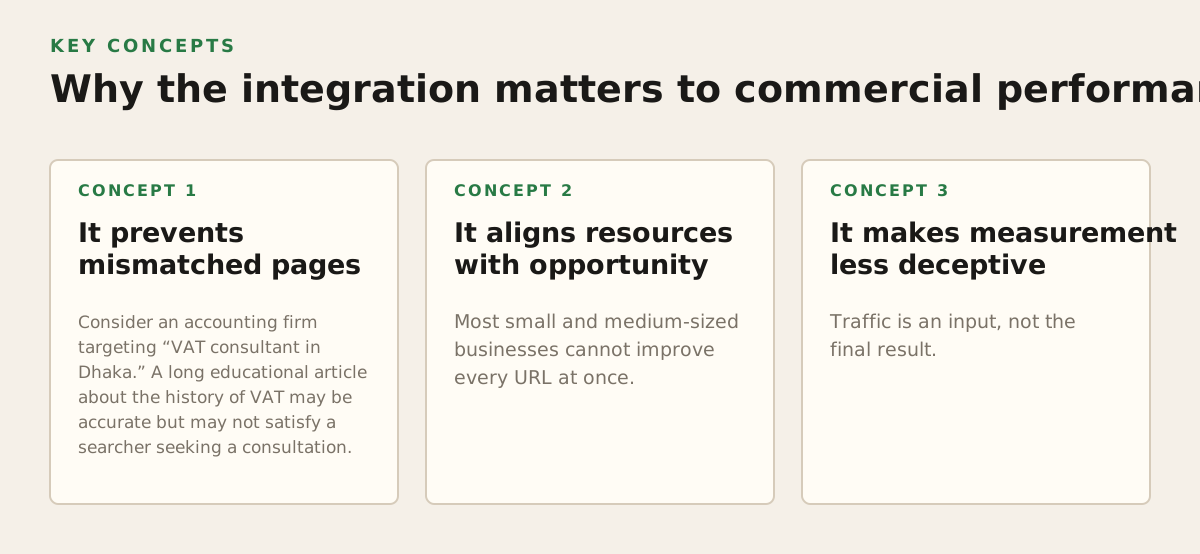
Search visibility becomes commercially useful only when the content answers a real question and the website makes the next decision easy. The integration matters because search engines evaluate individual URLs, while businesses operate through journeys: discovery, evaluation, comparison, purchase, implementation, retention, and referral.
It prevents mismatched pages
Consider an accounting firm targeting “VAT consultant in Dhaka.” A long educational article about the history of VAT may be accurate but may not satisfy a searcher seeking a consultation. A focused service page can explain scope, eligibility, process, documentation, service area, and a sensible enquiry route. The article still has a role, but it should support the service page rather than compete with it.
The same problem appears in e-commerce. A category page should help customers browse and compare products. A product page should resolve purchase objections such as specifications, compatibility, delivery, returns, and availability. A buying guide can address uncertainty before the visitor knows which product to choose. Treating all three as “blog content” creates weak templates and unclear internal linking.
It aligns resources with opportunity
Most small and medium-sized businesses cannot improve every URL at once. A strategy creates a defensible order of work. A page may deserve priority when it combines strong business value, existing search demand, a realistic competitive position, and a clear path to improvement.
An illustrative prioritization policy, not a universal benchmark, could score each opportunity from 1 to 5 for business value, current visibility, intent fit, effort, and evidence gap. A high-value service page scoring 5 for business value and 4 for intent fit may outrank a low-value informational article scoring 5 for traffic potential but 1 for conversion relevance.
- A local clinic could prioritize “dermatologist in Dhanmondi” over a broad article about common skin conditions if appointments are the primary commercial outcome.
- A software company could improve a migration guide and comparison page before publishing another introductory definition.
- An e-commerce brand could repair faceted navigation and category templates before producing hundreds of near-identical product articles.
- An international company entering Bangladesh could create country-specific service information only where pricing, delivery, regulations, language, or support genuinely differ.
It makes measurement less deceptive
Traffic is an input, not the final result. A strategy should connect search exposure to meaningful events, such as qualified form submissions, phone calls, booked consultations, completed checkouts, assisted conversions, or sales-qualified leads. The exact event depends on the business model and must be defined before reporting begins.
For example, a B2B consultancy may have a long sales cycle. An article may introduce the company, a service page may receive the enquiry, and a case study may influence the final decision. Last-click reporting can hide that sequence. A more useful report separates visibility metrics, engagement signals, and commercial outcomes instead of treating them as interchangeable.
To place SEO within a broader digital marketing strategy, digital strategy expertise explains how organic search can work alongside performance marketing, brand strategy, and conversion optimization; use that perspective to decide which work belongs in SEO and which requires a wider digital marketing plan.
How the system works from research to measurement
A reliable workflow moves from business reality to search evidence, then from page design to technical delivery and measurement. Skipping the early decisions usually creates rework: writers produce pages that developers cannot template cleanly, or technical teams optimize URLs that do not deserve investment.
1. Define the commercial and audience map
Start with products, services, margins, locations, customer types, sales objections, and operational limits. Ask what the business can actually deliver. A company that serves only Dhaka should not create hundreds of location pages for cities it does not cover. An international company should identify whether Bangladesh requires a separate offer, currency, language treatment, delivery promise, or support model.
Build a simple audience-and-task map:
- Problem aware: the customer describes a symptom, such as “website traffic dropped after redesign.”
- Solution aware: the customer compares approaches, such as a technical audit versus a content refresh.
- Provider aware: the customer evaluates consultants, agencies, or software vendors.
- Decision ready: the customer needs scope, proof, process, access requirements, and a clear next step.
This map prevents an expensive mistake: asking an introductory article to perform the job of a sales page. It also gives writers a reason to link pages together rather than treating each URL as an isolated campaign asset.
2. Investigate query intent and the result type
Keyword research should go beyond volume. Review the language used by customers in sales calls, support tickets, product reviews, competitor comparisons, and internal site searches. Then inspect the search results for the target query. The composition of the results is evidence about the task Google is attempting to satisfy.
Record:
- Whether results are mostly guides, category pages, product pages, tools, local listings, videos, or forums.
- Whether the query implies a location, price, urgency, compatibility requirement, or professional qualification.
- Which subquestions appear repeatedly in titles, snippets, related searches, and page sections.
- Whether the current results are broad and educational or narrow and transactional.
Do not copy competitors’ headings as a strategy. Instead, identify the underlying information need and add a useful distinction: local operating knowledge, an original process, a decision framework, a worked example, transparent limitations, or evidence from qualified practitioners.
3. Assign one primary job to each URL
Each important URL should have a primary query theme and a primary user task. This does not prohibit ranking for related queries. It prevents multiple pages from making the same promise with slightly different wording.
| Page type | Primary job | Useful supporting elements |
|---|---|---|
| Service page | Help a qualified buyer assess fit and enquire | Scope, process, exclusions, proof, FAQs, contact path |
| Category page | Help shoppers browse a product group | Filters, comparison guidance, category copy, availability information |
| Product page | Resolve purchase objections | Specifications, delivery, returns, compatibility, reviews where legitimate |
| Educational guide | Explain a problem or method | Definitions, steps, examples, limitations, related services |
| Location page | Prove local relevance for a real service area | Address or coverage details, local process, contact information, unique evidence |
4. Build the brief around evidence and decisions
A strong brief includes the intended audience, task, primary topic, related concepts, page type, internal links, evidence requirements, author credentials where relevant, conversion goal, and measurement event. It should also state what the page will not cover, reducing overlap with adjacent URLs.
For a guide about recovering organic traffic after a redesign, the brief might require a migration checklist, examples of redirect mapping, indexation checks, analytics annotations, and a section distinguishing technical loss from demand decline. It should not promise recovery within a fixed period because the cause, site size, history, and implementation quality vary.
5. Make the page technically usable
Technical SEO is the delivery layer of the content strategy. Confirm that the intended URL is crawlable, returns the correct status, has a self-consistent canonical setup, appears in the XML sitemap where appropriate, and is not unintentionally blocked. Check mobile rendering, page templates, navigation, pagination, redirects, and duplicate parameter URLs.
Google’s 2026 documentation describes links as a way for crawlers to discover pages and recommends using crawlable anchor elements with descriptive text; see the Google guidance on crawlable links. This supports a practical rule: internal links should help a person predict what they will find after clicking, not merely repeat an exact-match phrase.
For sites with many pages, use a controlled publishing process:
- Validate the URL, canonical, indexability, and template before publication.
- Connect the page to at least one relevant hub and one related detail page where the relationship is genuine.
- Check title, meta description, headings, structured data eligibility, and visible contact or product information.
- Test forms, phone links, checkout paths, and analytics events in the production environment.
- Annotate the launch date and any simultaneous technical changes for later diagnosis.
Meta descriptions do not rescue weak content, but accurate snippets can clarify the page’s promise. For a quick length and truncation check during editorial QA, use the meta description length checker rather than judging the text only in a document editor.
6. Connect content to the site’s information architecture
Internal linking is not a final formatting task. It communicates relationships and distributes navigational attention. A service page might link to a diagnostic guide, a case study, a process page, and a contact route. The diagnostic guide should link back when the service is a logical next step, using context that sets expectations.
On a large site, identify missing connections by comparing pages that discuss the same entity or task. The internal link opportunity tool can help surface possible connections, but every suggested link still needs human review for relevance, placement, and user benefit.
7. Measure, diagnose, and update
Use Search Console for query and page visibility, analytics for on-site actions, and the organization’s sales or commerce system for qualified outcomes. Google’s official Search Console documentation, referenced in 2026, explains that the Performance report exposes search traffic data such as queries, pages, clicks, and impressions; see the Search Console Performance report documentation.
Interpret changes by separating possible causes:
- Impressions decline: demand, eligibility, indexing, rankings, or result layout may have changed.
- Impressions stable but clicks decline: title, snippet, position mix, or search-feature competition may be involved.
- Clicks stable but enquiries decline: offer fit, page clarity, form friction, traffic quality, or tracking may be responsible.
- Rankings fluctuate after a change: inspect technical deployment, intent alignment, content quality, and broader demand before rewriting everything.
Where SEO and content programs break
Most failures are not caused by one missing keyword. They come from a mismatch between promise, page, evidence, technical access, and commercial follow-through.
Publishing at the expense of usefulness
A calendar can create the appearance of progress while expanding maintenance debt. Thin articles, lightly rewritten summaries, and pages created only to capture variants often produce overlap and dilute editorial attention. Google’s 2026 guidance on creating helpful, reliable, people-first content emphasizes useful content made for users rather than content created primarily to manipulate search rankings; the official reference is Google’s helpful content guidance.
Before commissioning a page, require a defensible answer to: “What will this page help the customer decide, do, or understand better than the existing result?” If the answer is weak, consolidate, improve an existing URL, create a tool, or wait.
Confusing topical breadth with authority
Publishing about every loosely related subject does not automatically establish expertise. A Bangladesh-focused logistics company may have a credible reason to cover customs documentation, delivery zones, warehouse operations, and import requirements. It may not have a credible reason to publish generic articles about unrelated personal finance topics merely because those queries have traffic.
Topical focus must follow customer and organizational expertise. Demonstrate it through accurate detail, named or qualified contributors where appropriate, original examples, clear sourcing, update responsibility, and honest boundaries.
Creating local pages without local substance
Location landing pages fail when only the city name changes. Real local relevance may include the service area, travel or delivery constraints, local regulations, staff availability, branch details, customer questions specific to the area, and verifiable business information. If none of those differ, one strong service-area page may be more useful than dozens of interchangeable URLs.
Ignoring technical consequences
Content teams can unintentionally create indexation problems through faceted navigation, duplicate print pages, tag archives, JavaScript-only links, inconsistent canonicals, or accidental noindex directives. Technical teams can create content problems by changing URL structures, removing copy, flattening headings, or launching a new template without preserving internal links and structured information.
Structured data can help search engines understand eligible page elements, but it is not a guarantee of enhanced search appearances. Google’s 2026 introduction to structured data explains that markup gives explicit clues about page meaning and that eligibility depends on additional requirements; consult the official structured data documentation.
Reporting activity instead of decisions
A report that lists published articles, ranking movements, and sessions may be busy but still fail the client. Every recurring metric should support a decision:
- Which pages deserve improvement, consolidation, or removal?
- Which queries indicate a new product, service, or FAQ opportunity?
- Which technical issue blocks valuable content from being discovered or used?
- Which landing pages attract the right market but lose visitors before enquiry or purchase?
- Which changes require sales, product, development, or customer-support input?
For agencies providing white-label support, this decision layer is especially important. A client-facing report should translate search data into priorities, owners, dependencies, and next actions rather than presenting a dashboard without interpretation.
How practitioners apply the framework in real situations
The same principles produce different plans depending on the business model, risk, and available evidence. The examples below are illustrative planning models, not promises of traffic or revenue.
Small local service business
Suppose a dental clinic in Dhaka wants more qualified appointment enquiries. Begin with the services it actually provides, neighborhoods it genuinely serves, emergency availability, practitioner qualifications, patient concerns, and booking friction. Prioritize a clear service page for each major treatment only when the clinic can provide distinct, useful information.
A sensible starting structure might include:
- A main clinic page with location, opening information, contact options, and practitioner context.
- Focused treatment pages explaining suitability, process, preparation, aftercare, and when another professional should be consulted.
- Helpful questions addressing cost factors, appointment preparation, and expected next steps without making unsupported medical promises.
- Locally relevant information that is specific to the clinic rather than copied across city pages.
The measurement plan should distinguish calls, completed booking forms, and directions-related actions from general organic sessions. If the clinic receives many irrelevant enquiries, the strategy may need clearer eligibility language rather than more traffic.
E-commerce catalog with technical constraints
An e-commerce team may want to publish buying guides while its category pages have inconsistent filters and duplicate URLs. Fix the commercial browsing path first. A guide cannot compensate for products that are difficult to find, unavailable items that remain prominent, or a checkout flow that loses trust.
An illustrative six-week starting sequence, not a universal timeline, could be:
- Week 1: map categories, products, filters, stock states, and duplicate URL patterns.
- Week 2: select three commercial categories and define their browse-and-compare purpose.
- Week 3: improve category copy, internal links, product attributes, and indexation controls.
- Week 4: create one buying guide tied to genuine product-selection uncertainty.
- Week 5: review search queries, product engagement, add-to-cart events, and merchandising gaps.
- Week 6: consolidate weak pages and document the next category priority.
The sequence is useful because it links editorial work to inventory and merchandising realities. If a product line is discontinued or stock changes daily, the content strategy must account for that rather than treating evergreen publishing as automatically valuable.
International company targeting Bangladesh
International expansion requires more than adding “Bangladesh” to titles. Research local terminology, payment expectations, delivery or implementation constraints, support hours, regulations, currency communication, and whether the offer is available nationwide or only in selected areas.
Decide whether the site needs a country page, localized service pages, translated content, or simply a clear international service page. Separate URLs are justified by meaningful differences in audience needs and business operations, not by a desire to multiply keyword targets. Have local subject-matter reviewers check claims that depend on law, tax, logistics, health, or market practice.
Recovering after a ranking loss or penalty
Do not begin by deleting pages or changing every title. First establish what changed and when. Compare affected URLs, query groups, countries, devices, templates, indexation status, links, deployments, and business demand. A ranking loss after a redesign may involve redirects or rendering; a loss limited to one topic may indicate quality, intent, or authority issues; a traffic loss with stable rankings may reflect falling demand or a measurement problem.
Create a diagnosis table:
| Observation | Initial question | Next check |
|---|---|---|
| Pages disappeared from indexed coverage | Were access or indexation signals changed? | Inspect robots rules, noindex, canonicals, status codes, and rendered HTML |
| Queries remain visible but clicks fall | Did result presentation or snippet relevance change? | Review current result pages, titles, descriptions, and intent fit |
| One template loses visibility | Was a shared component deployed incorrectly? | Compare affected and unaffected templates |
| Leads fall while traffic is stable | Did the conversion path or lead quality change? | Test forms, calls, qualification, attribution, and sales feedback |
Make one controlled class of improvement at a time where possible. Preserve before-and-after records, communicate uncertainty, and avoid promising a recovery date that the available evidence cannot support.
White-label strategy and reporting for agencies
Agency partners usually need repeatable thinking without generic deliverables. Establish a shared intake covering business goals, priority markets, access, previous work, technical stack, brand restrictions, sales objections, and reporting definitions. Then provide artifacts the account team can explain:
- A prioritized opportunity register with rationale, owner, dependency, and expected decision.
- A content map showing URL purpose, audience stage, query theme, evidence needs, and conversion path.
- A technical backlog grouped by impact and implementation risk.
- A reporting view that separates exposure, landing-page behavior, leads or revenue, and unresolved data limitations.
- A change log recording launches, migrations, template edits, and major content updates.
This approach gives the agency something more valuable than a keyword spreadsheet: a defensible narrative about why each action exists and what evidence will determine the next action.
A practical operating policy for 2026
For most businesses, the best next move is not “publish more.” It is to select a commercially important customer task, assign it to the right URL, remove technical obstacles, add evidence that the business can genuinely support, and measure the resulting action.
Use this compact policy when planning the next quarter:
- Choose one market and one business priority: avoid mixing unrelated country, product, and audience goals in one backlog.
- Audit the existing URL set: improve, merge, redirect, or retire pages before adding near-duplicates.
- Design around intent: match each query group to the page type and decision it should support.
- Require evidence: include first-hand detail, qualified expertise, original analysis, transparent sourcing, or clear limitations.
- Ship technical and editorial work together: test crawling, rendering, links, forms, analytics, and page presentation.
- Review outcomes by cause: distinguish demand changes, visibility changes, landing-page problems, and commercial conversion issues.
- Document what would change your mind: define the evidence that would justify expansion, consolidation, or a different channel.
SEO and content strategy work best as a cycle of research, prioritization, production, technical validation, and diagnosis. That cycle is especially valuable when budgets are constrained, markets are changing, or a business is recovering from an unexplained visibility loss. It turns organic search from a publishing habit into a managed growth system with explicit assumptions.
If your business needs that system translated into a technical audit, content roadmap, local SEO plan, E-E-A-T improvement program, or clear reporting workflow, Mr Haq can help connect the search work to practical marketing and revenue decisions through Mr Haq.
Authored with NotFair SEO
