


A marketing agency for small business should be chosen by matching its work to the business problem you need solved—not by the number of services on its website. If organic visibility is the constraint, compare SEO specialists; if several channels need coordination, consider a broader agency. Before signing, check the proposed work, your team’s implementation burden, the full cost and how results will be measured.
This matters whether you run an e-commerce store, serve customers in a defined area, or need help investigating a traffic or ranking loss. More clicks are not automatically more sales, and a marketing campaign cannot repair every problem with an offer, website or sales process. A useful brief describes the outcome you want and the evidence that suggests marketing is the obstacle.
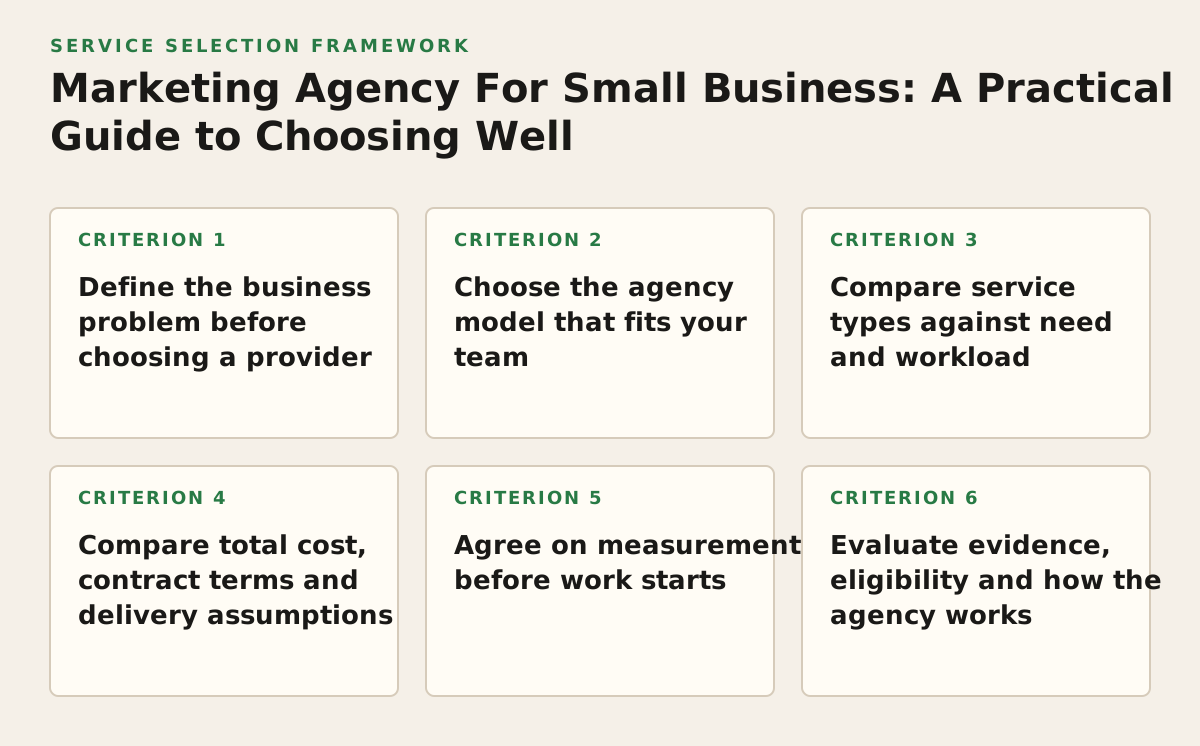
1. Define the business problem before choosing a provider
Start with an outcome and a constraint. “Get more traffic” leaves too many unanswered questions: which audience, which pages, and what should visitors do? Instead, name the business result—such as qualified enquiries or product orders—and describe the point where the current path is failing. This is most useful when a business has several possible marketing needs but limited time or budget to address them all.
A diagnosis makes proposals comparable because each provider must explain how its work could address the same problem. It also guards against buying a familiar service simply because it appears in a package. A retailer with steady visits but few completed purchases may need to investigate product pages, checkout friction or offer clarity before paying for more traffic.
Turn observations into a brief
- Desired outcome: state the business action you want to increase, such as qualified enquiries or completed orders.
- Current evidence: note what has changed, where it happens and which records support the observation.
- Constraints: list staff capacity, approval steps, website access, stock, service geography or other limits.
- First decision: specify what you need to learn before approving a larger engagement.
Failure mode: treating a symptom as a diagnosis. A drop in organic visits, for example, could involve site changes, content relevance, shifts in demand or measurement. Ask a prospective provider what it would inspect before recommending a remedy. For a small e-commerce team, an illustrative brief might be: “Identify why key category pages are not attracting qualified non-brand search visits, then prioritize the next actions.” Google’s SEO Starter Guide is a useful reference for discussing search fundamentals, but it does not establish that a particular agency’s proposed work will produce a specific result.
2. Choose the agency model that fits your team
Choose scope as well as expertise. A specialist concentrates on a discipline such as SEO or paid media. A full-service agency coordinates work across channels. A consultant may assess a problem and advise your staff without handling every implementation task. In-house execution with external advice can also suit a business that has capable staff but needs help setting priorities.
The right model depends on how many connected tasks are needed and who can manage them internally. A specialist can focus on a defined bottleneck, but may need a developer or content lead to carry out recommendations. A broader agency can coordinate more work, but the proposal should identify who will actually deliver it and how decisions across channels will be prioritized.
Match the model to your capacity
- Specialist: consider when one channel is the clear constraint and you can coordinate adjacent work.
- Full-service: consider when several channels need a shared plan and one person on your team can manage approvals and access.
- Consultant or project engagement: consider for a defined audit, investigation or strategic decision; confirm who will implement the result.
- External support for an in-house team: consider when staff can execute but need outside expertise, review or prioritization.
Failure mode: buying “everything” without assigning ownership. An SEO audit can identify issues, but progress may stall if nobody can change the site. Google advises businesses to research prospective SEO providers and warns that no one can guarantee a first-place ranking. Its guidance on hiring an SEO supports evaluating a provider’s reasoning and process rather than relying on ranking promises. For example, a business recovering from a visibility loss could first commission a scoped investigation, with an internal technical contact identified before work begins.
3. Compare service types against need and workload
Use service labels to build a shortlist, not a shopping list. The table connects common buyer situations to a service type and the practical trade-offs to test. It is especially useful when proposals use different language for similar work. Ask each provider to specify deliverables, your responsibilities and the evidence it will use to assess progress.
| Buyer need | Service type to consider | Implementation burden | Trade-off and evidence to request |
|---|---|---|---|
| Unclear search visibility or technical problems | SEO audit, technical SEO or recovery investigation | May require developer, content or site-owner changes | Request evidence for each issue, priority, owner and validation method; an audit alone does not make changes. |
| Pages do not address the needs of relevant searchers | Content strategy and editorial support | Requires subject-matter input, review and publishing approvals | Ask how topics and content quality will be assessed; volume alone does not show usefulness. |
| Customers need to find a location-based business | Local SEO | Requires accurate business details and internal coordination | Confirm which locations and offerings are in scope; avoid guarantees about map positions. |
| You want to test paid demand | Paid search or paid social management | Requires budget oversight, conversion tracking and often creative or landing-page approvals | Separate media spend from fees; clarify who controls accounts, tracking and creative. |
| Several channels need a coordinated plan | Full-service or integrated marketing | Involves more access, approvals and coordination | Ask who leads the account and how work is prioritized against shared business goals. |
Failure mode: selecting work your team cannot review or implement. A company with limited subject-matter review capacity may not be ready for a demanding content schedule. For each proposed service, name an internal owner and ask what the agency can complete without waiting on your staff. If that workload is unrealistic, narrow the scope or adjust the sequence.
4. Compare total cost, contract terms and delivery assumptions
Compare what the fee buys, not just the fee itself. Common arrangements include a fixed project fee, recurring retainer, hourly or day rate, and performance-linked fee. No structure is automatically best. The important comparison is the work included, the people assigned, revision limits, outside costs, reporting, meeting cadence and how changes to the plan are handled.
Ask whether the quote includes media spend, software, content production, development or other third-party costs. Clarify who supplies source material, how many review rounds are included, and what happens if you pause or end the work. For performance-linked pricing, establish how attribution, lead quality, baseline performance and outside factors are defined before agreeing to a formula.
Make the budget comparison complete
- List agency fees separately from advertising or production costs.
- Estimate the staff time needed for meetings, approvals and implementation.
- Identify work excluded from the proposal and assign an owner or obtain a separate estimate.
- Check notice periods, scope-change rules, account access and asset ownership.
Failure mode: choosing the lowest quote when it excludes work your team cannot do. For example, a proposal for recommendations and a proposal that includes implementation are not directly comparable until the implementation gap is costed or assigned. For paid search, ask who sets and approves spend changes and how spend is separated from management fees. Google’s Google Ads budget documentation explains how platform budgets are managed; it is not a universal guide to what a small business should spend.
5. Agree on measurement before work starts
Define success in business terms and make the data path explicit. For SEO, a useful measure might connect qualified organic visits to enquiries or sales. For paid campaigns, assess the intended conversion and the quality of resulting leads or orders alongside media costs. Supporting indicators can explain what is happening earlier in the process, but should not replace the outcome the engagement is meant to influence.
Measurement depends on the sales process as well as analytics setup. A form submission may be countable, while sales staff still need to record whether the enquiry fits the business. In Google Analytics, key events can be designated as conversions for reporting; consult Google’s conversion documentation when discussing setup. The event and reporting definitions still need to match your own business process.
Write down the measurement agreement
- Primary outcome: the business action the work is intended to affect.
- Supporting indicators: the earlier signals that help explain progress.
- Data owner: who controls analytics, advertising accounts, CRM records and access.
- Review rule: how the team will decide to continue, change or stop the work.
Failure mode: reporting rising clicks when the business cannot tell whether they became qualified customers. An illustrative starting policy is to verify that the agreed conversion event works and that lead quality can be assessed before judging campaign performance. A business with a longer sales process may need a review cadence that allows outcomes to be recorded; do not copy another company’s timetable without checking how your own sales cycle works.
6. Evaluate evidence, eligibility and how the agency works
Ask for reasoning you can inspect. A proposal should connect its findings to actions and explain what it needs from you. Request relevant examples, then ask what the provider did, what conditions shaped the outcome and what limitations applied. Case studies offer context, not a forecast: your market, site, offer, tracking and capacity may be different.
For local SEO, verify that the business and locations fit the work being proposed. Google’s Business Profile eligibility guidance describes eligibility in relation to business models. A provider should not imply that any business can create a profile for any address. When refining page snippets, meta description length checker may be relevant; when planning how relevant pages connect, internal link opportunity tool may help with that task.
Vendor interview checklist
- What evidence supports this recommendation over the alternatives?
- What will you inspect or deliver first, and what decision will that inform?
- Which tasks require our staff, developer, subject-matter experts or approvals?
- Who performs the work, who leads communication, and how are changes handled?
- What will be measured, where will the data come from, and what could make it unreliable?
- Will we retain access to our website, analytics, advertising accounts and content assets?
Red flags include guaranteed rankings or sales, unexplained methods, pressure to sign before scope is clear, and reports disconnected from agreed outcomes. A provider should be able to explain uncertainty and what evidence would change its recommendation. For example, if an agency proposes new content after a traffic drop, ask what it will check to rule out technical or measurement causes first.
7. Sequence the decision, then expand only when justified
Make the first engagement answer a bounded question. A diagnostic or pilot can be useful when the long-term scope is uncertain, provided it has a clear deliverable, access requirements, decision point and conditions for moving forward. It should not be an open-ended contract renamed as a test.
Failure mode: commissioning an audit without assigning anyone to act on it. Before site work begins, identify a technical contact and require recommendations to state the evidence, priority, implementation owner and validation method. That way, the deliverable can inform a decision rather than becoming an unowned list of issues.
Use this sequence to select and review a partner
- Write the brief: state the business outcome, evidence, constraints and first decision you need help making.
- Select a service category: use the table to decide whether you need specialist work, broader coordination or advice; name what your team can implement.
- Request comparable proposals: give shortlisted providers the same brief and ask each for deliverables, exclusions, fees, extra costs, workload, measures and exit terms.
- Interview for judgment: compare their diagnosis, trade-offs and uncertainties, not only their presentation or case studies.
- Document access and measurement: confirm account ownership, data sources, implementation owners and review rules before work starts.
- Review the agreed decision point: assess whether the work answered the brief, whether your team could act on it and whether the evidence supports continuing, changing or stopping.
If your brief points specifically to organic visibility, Mr Haq’s stated work includes SEO strategy and consulting across technical SEO, content strategy, local SEO, link building, analytics and AI search optimization. Explore Mr Haq if that scope fits the problem you have defined, and verify project requirements and fit before proceeding.
Authored with NotFair SEO
