


The right ecommerce SEO agency depends on what is blocking organic sales: a technical specialist may suit a store with crawl or indexing problems, while a broader SEO partner may be better when product discovery, content, and measurement all need work. Compare providers by asking what they will change, what your team must implement, how progress will be measured, and whether their experience fits your platform and market.
This guide helps ecommerce owners, marketing leads, and agencies buying white-label support evaluate those choices without assuming that “more traffic” automatically means more revenue. It also explains how to assess an independent consultant: Mr Haq describes his work as SEO consulting across technical SEO, content strategy, analytics, and related areas. If you are considering him for an ecommerce project, confirm the proposed scope, team capacity, and deliverables directly; the available information does not establish a standard ecommerce package.
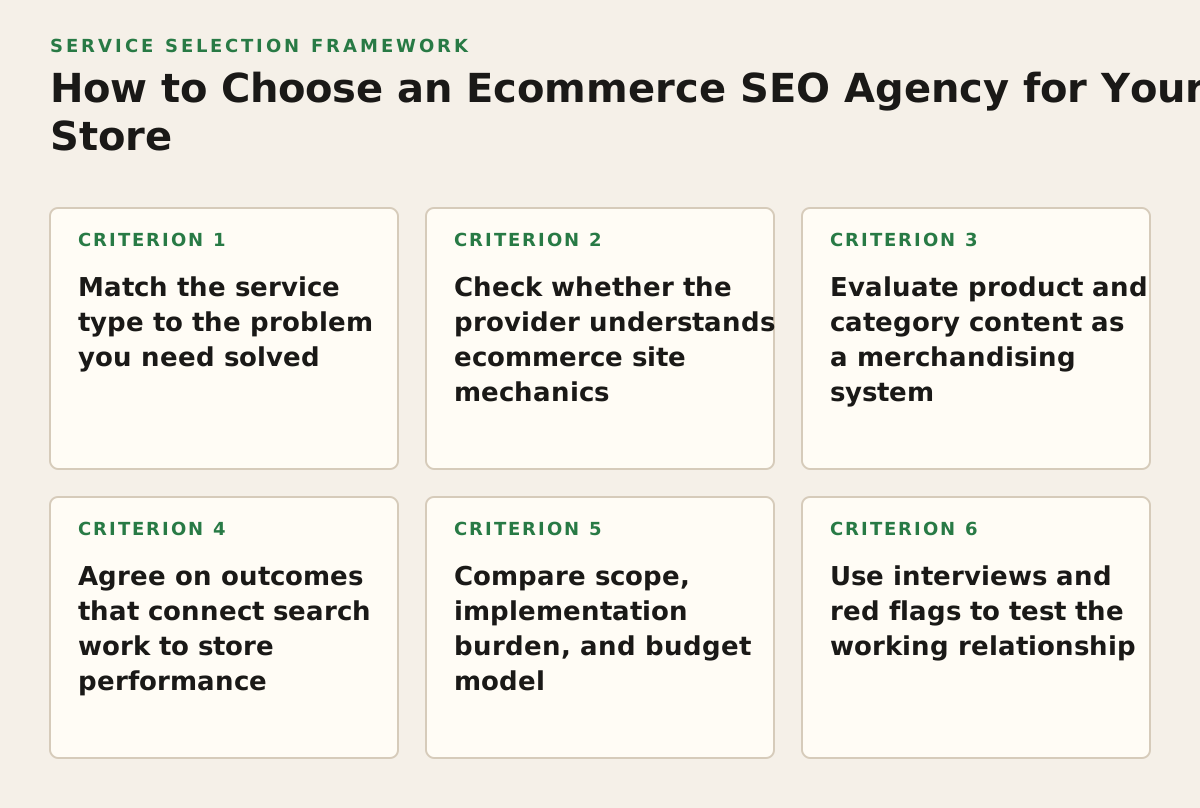
Match the service type to the problem you need solved
“Ecommerce SEO agency” can describe very different arrangements. Choose by the constraint you need removed, not by the provider’s broadest service list. A focused engagement can reduce coordination overhead, but it may leave connected work to your internal team. A full-service retainer can coordinate several disciplines, but only if ownership and implementation are clear.
| Buyer need | Service type to consider | Trade-off and implementation burden |
|---|---|---|
| Organic pages are missing, duplicated, or difficult to crawl | Technical SEO specialist or technical workstream within an agency | Findings are useful only if developers can prioritize and ship changes. Confirm who writes tickets, tests releases, and verifies results. |
| Product and category pages have weak targeting or thin information | Content-led ecommerce SEO team or SEO strategist working with merchandising | Requires product knowledge, copy review, and often catalog-system changes. Avoid treating every page as a standalone writing assignment. |
| Search visibility needs coordinated technical, content, and reporting work | Full-service SEO agency | More coordination and potentially broader fees; check whether work is delivered by specialists or subcontractors and who owns decisions. |
| Your team can execute but needs direction, prioritization, or independent review | SEO consultant or advisory engagement | Usually leaves implementation with your team. Agree on access, decision rights, and how recommendations become shipped work. |
| An agency needs extra strategy or reporting capacity for a client | White-label consultant or specialist partner | Clarify confidentiality, client-facing responsibilities, reporting format, and how urgent technical questions are handled. |
Use the table as a first filter, then ask each provider to connect its recommended service to a real constraint in your store. For example, a retailer whose category pages are indexed inconsistently may need technical investigation before commissioning a large batch of new copy.
Check whether the provider understands ecommerce site mechanics
This principle matters most for stores with large catalogs, filters, variants, frequent product changes, or several international storefronts. Product and category pages can generate many URL combinations; without a deliberate crawl and indexing approach, search engines may spend time on low-value pages while important landing pages receive less attention. Google’s guidance on managing faceted navigation explains why filter-generated URLs need careful handling.
Ask for diagnosis, not a list of technical buzzwords
A useful audit should connect a symptom to evidence, impact, and an implementation decision. Ask the provider to explain how it will distinguish a template-wide problem from an isolated URL issue. For a store with filter pages, a sound review might inspect crawlable links, URL patterns, canonical signals, indexation, and whether filtered pages have a search purpose. The recommended treatment should depend on the store’s actual architecture, not a blanket instruction to block every filter.
- Platform fit: Ask which changes require the ecommerce platform, a theme, an app, a developer, or a third-party feed.
- Release process: Find out who reviews staging changes, checks templates after deployment, and rolls back a harmful implementation.
- Catalog edge cases: Discuss out-of-stock items, discontinued products, duplicate variants, and category changes.
- International structure: If you sell across markets, ask how country, language, currency, and product availability affect page targeting.
Structured data is another area where a provider should be specific. Google documents product structured data and the information it can make eligible for search appearances; eligibility is not a promise that a particular result will show. Ask the agency to explain which product fields it will validate and how it will monitor errors, rather than promising a guaranteed rich result (Google’s product structured data documentation).
Failure mode: an audit recommends adding schema to every template but never checks whether the marked-up price, availability, or product identity matches what shoppers see. Implementation example: select a representative product template, compare its visible information with structured data and feed values, record mismatches, then validate the fix before rolling it out across the catalog.
Evaluate product and category content as a merchandising system
Use a content-led engagement when shoppers are not finding relevant categories, product pages give too little decision support, or the store’s information architecture does not reflect how customers browse. It works when SEO, merchandising, and product knowledge are combined: a useful category page helps users narrow choices, while a product page answers questions that distinguish one item from another. Google’s ecommerce guidance covers how product information and site structure can help search engines understand a store (Google Search Central’s ecommerce guidance).
Ask how the agency prioritizes pages
Do not accept a recommendation to rewrite the whole catalog without a reasoned sequence. A provider should show how it will group pages by business role and search intent, then select work based on opportunity, risk, and execution cost. For example, an illustrative first batch might focus on a small set of high-priority categories with clear demand and weak landing-page usefulness. That is a planning example, not a universal threshold.
- Request a sample brief for one category and one product page.
- Check whether recommendations include internal links, filters, page titles, and merchandising details—not just keyword insertion.
- Agree who supplies product facts, approves claims, and maintains content when stock or specifications change.
- Assess whether the provider can explain why some pages should be consolidated, improved, or left alone.
Failure mode: publishing near-identical descriptions across thousands of product variants can add maintenance work without helping shoppers choose. Implementation example: have the provider map page groups, identify shared and unique product information, and test a small template or category change with merchandising before expanding. For a site team reviewing how pages connect, Mr Haq’s internal link opportunity tool is one resource to consider; verify its current functionality and suitability before relying on it.
Agree on outcomes that connect search work to store performance
Use this principle with every provider, especially when a proposal emphasizes rankings or sessions. Search Console can show how a site appears in Google Search and report clicks, impressions, click-through rate, and average position; those measures describe search visibility, not completed orders by themselves (Google’s Search Console Performance report documentation). Connect them to your analytics and commerce data before treating SEO as a sales channel.
Separate leading indicators from business outcomes. Index coverage, relevant impressions, and non-brand clicks can help diagnose progress; organic revenue, transactions, and conversion rate help assess commercial contribution. Results can also be affected by inventory, promotions, seasonality, pricing, and site changes, so ask the provider to identify these confounders rather than claim every change as an SEO win.
Build a measurement agreement before work starts
- Record the baseline and the exact source for each metric, including the landing-page and query group being assessed.
- Separate branded from non-branded search where the data supports it, and define how international markets or store sections are segmented.
- Agree how attribution is handled and which analytics or order data the provider can access.
- Set a review cadence and require notes on shipped work, unresolved blockers, and next decisions—not just a chart of traffic.
Failure mode: a report celebrates higher impressions while the pages attracting them do not match available products or convert. Implementation example: review a priority category’s search visibility alongside landing-page engagement, stock status, and organic transactions; investigate the gap before expanding the same tactic to other categories.
If shopping-feed visibility is part of the plan, define it separately from organic SEO. Google Merchant Center documents free listings as a way products may appear across Google surfaces, subject to applicable requirements; ask whether feed setup and maintenance are included or are a separate workstream (Google’s free listings guidance). A provider should not present feed work as a guaranteed substitute for organic rankings.
Compare scope, implementation burden, and budget model
Pricing cannot be compared meaningfully until you know what is included. Providers may propose a recurring retainer, a fixed-scope audit or project, an hourly advisory arrangement, or a blended model. These labels do not reveal the total cost of ownership: your team may also need developer time, copy review, analytics support, or platform changes.
Ask what the fee buys and what it excludes. A fixed project can make a defined audit easier to assess, but follow-up implementation may be outside scope. A retainer can support ongoing prioritization, but it should specify recurring work and decision-making rather than promise a vague number of “SEO tasks.” An hourly model offers flexibility, but you will want clear approval rules and an estimate of the work sequence.
Make proposals comparable
- Ask for deliverables, assumptions, dependencies, and acceptance criteria in writing.
- Identify internal hours and outside costs that the proposal does not include.
- Confirm whether developer tickets, content briefs, implementation, QA, and reporting are included or merely recommended.
- Ask what happens if access, approvals, or releases are delayed, and how the plan will be reprioritized.
For budget planning, an illustrative starting policy is to fund one clearly scoped diagnostic or pilot before committing to a longer program when the provider fit or implementation burden is uncertain. This is not a universal recommendation: a store with known urgent defects may need a different sequence. Failure mode: choosing the lowest quote when it excludes the work required to ship recommendations. Implementation example: compare proposals by total work needed to reach a verified change, including your team’s estimated effort, rather than by monthly fee alone.
Use interviews and red flags to test the working relationship
An interview should reveal how the provider thinks when information is incomplete. Share a relevant business constraint—such as limited developer capacity, a recent platform migration, or product availability changes—and ask how it would affect the first priorities. A credible answer should explain what it would inspect, what remains unknown, and what decision follows from the evidence.
Vendor interview checklist
- Which store or platform characteristics make you a good fit, and which would require another specialist?
- What would you need to inspect before recommending a technical or content roadmap?
- Who will do the analysis, communicate with our team, and verify implementation?
- Can you show an anonymized example of a deliverable and explain how a team would act on it?
- How do you report uncertainty, missed dependencies, and changes in priority?
- What access do you need, and can our team retain control of accounts and data?
Red flags include guaranteed rankings or revenue, a one-size-fits-all audit, refusal to explain implementation dependencies, and reporting that hides the difference between recommendations and shipped work. Be cautious if a provider demands broad access without explaining why, cannot describe how it will coordinate with your developers or merchandising team, or insists on a long commitment before agreeing on scope and review points.
For an ecommerce brand, ask about the actual work relevant to your catalog and platform rather than relying on a generic client list. For an agency seeking white-label support, add questions about client-facing communication, confidentiality, and how the partner handles a request that falls outside the agreed scope.
Sequence the decision into a practical implementation plan
Choose a small, verifiable first phase that can expose fit before you scale the relationship. The goal is not to force every store into a pilot; it is to make the first commitment specific enough that both sides can judge the quality of diagnosis and execution.
- Write the business constraint. State the store, market, and outcome at issue—for example, priority categories that attract little relevant non-brand traffic, or a migration that left important pages difficult to find.
- Gather the inputs. Prepare platform details, Search Console and analytics access where appropriate, product and category priorities, release constraints, and known changes such as promotions or inventory shifts.
- Request a scoped proposal. Ask each candidate to identify the initial investigation, deliverables, dependencies, team roles, measurement approach, pricing model, and exclusions.
- Score fit against execution reality. Compare platform and catalog understanding, evidence quality, communication, internal workload, and the ability to measure the change. Do not score a promised result as if it were delivered evidence.
- Approve one priority workstream. Define the page group or technical issue, owner, acceptance criteria, QA steps, and review date. Make clear what would justify expanding or changing the scope.
- Review what shipped and what changed. Compare implementation records with agreed measures, account for confounding factors, and decide whether to continue, revise, or stop.
Before hiring, check whether the provider can support your store’s actual needs, whether your team can implement the work, and whether the proposed measures reflect commercial priorities. Mr Haq’s stated consulting practice covers technical SEO, content strategy, analytics, and related SEO areas; an ecommerce business can contact Mr Haq to discuss whether a suitable project scope is available and confirm responsibilities before proceeding.
Authored with NotFair SEO