

A content strategy template is useful only when it helps a business decide what to publish, which pages deserve investment, who owns each task, and how organic visibility should contribute to revenue. This guide gives small businesses, e-commerce teams, international companies, and agencies a practical planning system rather than a list of disconnected blog topics. Use it to choose between creating a new page, improving an existing URL, building local relevance, or fixing the technical and measurement problems that make content underperform.
The central decision is not “What keywords can we target?” It is “Which customer problem should this page solve, and what business action should it support?” A strong plan connects search demand to commercial priorities while leaving room for expert judgment, product changes, seasonal demand, and evidence from Search Console.
1. Start with the business job, audience, and decision
When this applies: Start here before researching keywords, especially if the business has several services, product categories, markets, or stakeholders competing for editorial attention. A local service company may need qualified calls in Dhaka, while an e-commerce brand may need category pages that support transactions. An international company may need the same solution described differently for Bangladesh, the United Kingdom, and the United States.
Why it works: Content becomes easier to prioritize when every proposed asset has a defined business job. The job might be generating a consultation, helping a buyer compare products, reducing pre-sales questions, supporting a local location page, or demonstrating expertise after a ranking loss. This prevents the common failure mode of publishing high-volume informational articles that attract impressions but never move users toward a relevant next step.
Write a one-line strategy statement for each business unit:
- Audience: Who has the problem, and what level of knowledge do they have?
- Problem: What are they trying to accomplish, avoid, compare, or repair?
- Business outcome: Which action matters: inquiry, sale, store visit, qualified lead, renewal, or assisted conversion?
- Proof: Why should this company be trusted to answer the question?
- Next step: Which product, service, tool, case study, or contact path should follow?
For example, a Bangladesh-based accounting software company might define an audience as “growing retailers comparing inventory systems.” The business job is not simply to rank for “inventory management.” It is to help a buyer understand stock visibility, integration requirements, implementation risk, and whether a demonstration is appropriate. That job leads to a comparison guide, a product page, implementation documentation, and a demo path—not ten generic articles about business software.
Failure mode: Treating personas as decorative descriptions. “Busy decision-maker” does not tell a writer what objection to resolve or what evidence to include. Replace vague personas with a decision statement such as, “A multi-location retailer needs to choose software without losing existing stock records.”
Use digital marketing strategy to turn the editorial outline into actionable goals, channel choices, campaigns, and measurement responsibilities across the marketing team.
2. Map search intent before assigning keywords
When this applies: Use an intent map when a keyword list is large, overlapping, or supplied by multiple stakeholders. It is particularly important for e-commerce sites with near-duplicate category terms, agencies managing several client markets, and businesses recovering from a ranking loss where old assumptions may no longer match the search results.
Why it works: A query is a clue about the searcher’s desired outcome, not an instruction to repeat a phrase on a page. Intent mapping groups queries by the task behind them: learning, comparing, finding a brand or location, completing a transaction, or getting support. The group determines the page type, depth, call to action, and acceptable level of commercial pressure.
| Search situation | Likely page type | Primary goal | Evidence to include | Illustrative priority signal |
|---|---|---|---|---|
| Problem or concept research | Guide, glossary, tutorial, or explainer | Build qualified awareness | Original explanation, examples, limitations, expert review | Relevant audience and clear path to a related solution |
| Product or provider comparison | Comparison, alternatives page, or buying guide | Help shortlist options | Decision criteria, trade-offs, pricing context where verified, use cases | Strong commercial relevance and sales-team demand |
| Category or service demand | Category, service, or location page | Generate leads or sales | Scope, process, specifications, trust signals, FAQs | Direct connection to revenue and available differentiation |
| Brand, location, or known item | Official brand, contact, store, or product page | Enable a visit, inquiry, or transaction | Accurate business details, availability, access, and next action | High likelihood of immediate action |
| Existing customer support | Documentation, troubleshooting, or account help | Resolve friction and retain users | Steps, prerequisites, screenshots, escalation route | Support volume, product impact, and answer accuracy |
For each keyword cluster, record the current search result pattern, not just a tool’s label. If the results are dominated by product pages, an essay may be the wrong asset. If they show local packs and map results, a national article will not substitute for accurate location information and a well-maintained business profile. Google describes Search Console as a way to monitor search performance and troubleshoot issues, so use its query and page data to validate whether your intended page type matches actual discovery patterns in 2026: Google Search Console documentation.
Failure mode: Creating one page for every slight keyword variation. This produces cannibalization, thin location pages, and an editorial backlog that nobody can maintain. Consolidate close variants when the same user need and result type apply; split them only when the audience, decision, product, or location genuinely changes.
A practical intent-record format
- Primary query and close variants
- Searcher task and stage of consideration
- Recommended URL and page format
- Internal page that should receive or provide a link
- Conversion or business action
- Evidence still required before publication
3. Build a topic and URL architecture that can scale
When this applies: Use an architecture model before publishing at volume, migrating a site, launching new product lines, or expanding into new countries. It also helps after a penalty or major ranking decline, when the site may contain overlapping pages, weak archives, or large areas of low-value content.
Why it works: Search engines and users need clear relationships between overview pages, detailed resources, products, services, and supporting evidence. A useful architecture gives each important topic a logical home and allows authority, context, and navigation to flow between related URLs. It also makes maintenance possible: when a product changes, the team can locate the category, comparison, guide, FAQ, and support pages that need review.
Use a hub-and-support model, but do not apply it mechanically:
- Hub page: The main commercial or thematic page that defines the topic and directs users to meaningful subtopics.
- Supporting page: A distinct question, use case, comparison, implementation task, or audience need.
- Proof page: A case study, methodology page, author profile, technical reference, or customer evidence that reduces risk.
- Conversion page: The service, product, consultation, store, or contact URL that can satisfy the commercial need.
Imagine an SEO consultancy serving international companies entering Bangladesh. A sensible cluster might include a core Bangladesh SEO consulting page, supporting pages on local search, multilingual content planning, technical considerations for regional sites, and a market-entry checklist. Those pages should link where the relationship is useful, not because a spreadsheet demands a fixed number of links.
Before creating a new URL, ask:
- Does an existing page already satisfy this intent?
- Could updating and expanding that page produce a clearer result for users?
- Would a new page have a distinct audience, decision, or product?
- Can the new URL earn meaningful internal links from relevant pages?
- Will the owner review it when facts, prices, regulations, or products change?
Failure mode: Mistaking a large content inventory for topical authority. Dozens of loosely related posts can dilute editorial focus and create maintenance debt. A smaller set of well-connected pages with clear ownership is often easier to improve, explain to clients, and defend during a quality review.
For internal-link planning, use the internal link opportunity tool when auditing related pages and identifying possible connections. It helps turn a topic map into specific internal link opportunities rather than leaving navigation as an afterthought.
4. Turn each priority into an evidence-led brief
When this applies: Use a detailed brief for pages that affect revenue, regulated or sensitive decisions, brand trust, or competitive searches. It is also valuable when a white-label agency team, subject-matter expert, freelance writer, and client approver must collaborate without losing the original strategy.
Why it works: A brief translates strategy into an executable page specification. It gives the writer a reason for the page, a defined reader, an appropriate format, and a minimum evidence standard. Google’s guidance emphasizes creating helpful, reliable, people-first content, including clear signals about who created content and how it was produced where that information helps users: Google’s people-first content guidance. The brief should therefore specify not only phrases to consider but also the experience, sources, and review needed.
Include these fields in every important brief
- Page job: The user decision and business outcome.
- Audience and situation: What triggered the search and what may stop action?
- Primary intent: Informational, commercial investigation, transactional, navigational, local, or support.
- Recommended format: Guide, service page, comparison, category page, product page, case study, or documentation.
- Required claims: Statements that need a source, expert review, customer evidence, or internal verification.
- Unique contribution: A calculator, local knowledge, original process, examples, data, interviews, or clear trade-off analysis.
- Internal links: Pages to link to and pages that should link back.
- Conversion path: The next action and the reason it is appropriate at this stage.
- Review owner and date: Who approves accuracy and when the page must be revisited.
For an e-commerce product-category brief, “write 1,500 words” is weak guidance. A better instruction might require a concise category explanation, fit and compatibility details, shipping or availability information verified by the merchant, a comparison of relevant specifications, links to buying guides, and a clear route to product selection. The word count becomes a consequence of the information needed, not the objective.
For an expertise-led consulting page, identify the practitioner responsible for the claims, the process the firm actually follows, the types of businesses served, and the limits of the service. If the firm cannot substantiate an outcome, describe the method and decision criteria instead of promising a ranking or traffic result.
Failure mode: Over-optimizing the brief around a keyword, target density, or mandatory word count. This encourages repetitive writing and can force irrelevant sections onto a page. Give writers a search problem and evidence requirements; let the final length follow the user’s decision.
Use structured data only when the page genuinely meets the relevant requirements and the markup accurately represents visible content. Schema.org explains the purpose of structured data as a way to describe content and entities in a machine-readable form; its vocabulary is not a guarantee of a special search display: Schema.org’s getting started documentation.
5. Design a production workflow with editorial controls
When this applies: This principle matters when more than one person publishes content, when an agency provides white-label strategy, or when AI tools are part of drafting and research. It is essential for sites with legal, financial, health, employment, or product-safety implications, where an incorrect sentence can create more damage than a missed keyword.
Why it works: Strategy fails in the handoff between planning and publication. A production system assigns decisions to people who have the right context: the strategist owns intent and prioritization, the subject expert validates substance, the editor improves clarity, and the SEO or technical owner checks implementation. This creates an auditable chain from brief to published URL.
A workable content status model
- Proposed: Business need and audience are documented.
- Validated: Intent, existing URLs, competition, and evidence requirements are checked.
- Briefed: Format, outline, sources, links, owner, and conversion path are approved.
- Drafted: The content is complete enough for subject review, not merely optimized for phrases.
- Reviewed: Facts, examples, claims, accessibility, brand fit, and commercial accuracy are checked.
- Published: URL, indexability, canonical, metadata, links, structured data, and analytics are verified.
- Observed: Performance and user feedback determine whether to improve, consolidate, or retire it.
For AI-assisted work, define what the tool may and may not do. It can help organize notes, generate questions, suggest outlines, or identify missing subtopics. It should not invent customer evidence, expert credentials, product specifications, local facts, citations, or performance claims. Require a human to verify every material assertion and preserve the source or interview note behind important claims.
Agencies can make this operational with a shared content register containing the client, market, URL, intent, stage, owner, reviewer, source status, target action, publication date, and next review date. The register also makes reporting more honest: “published” is not confused with “improved,” and “impressions” is not confused with “qualified demand.”
Failure mode: Treating approval as a final grammar check. A polished page can still target the wrong intent, make unsupported claims, or send users to an irrelevant offer. Put strategic and subject review before the copy-editing stage.
6. Adapt the strategy for local, e-commerce, and international growth
When this applies: Use this category when the business has physical locations, a product catalogue, multiple countries, or different language and purchasing contexts. A single global template often fails because search intent is shaped by availability, geography, currency, regulations, logistics, and local terminology.
Why it works: Useful specificity is a competitive advantage. Local users need access, service area, opening information, proof of local work, and a frictionless contact path. E-commerce users need selection help, compatibility, availability, delivery context, and accurate product information. International users need clear market relevance rather than translated filler.
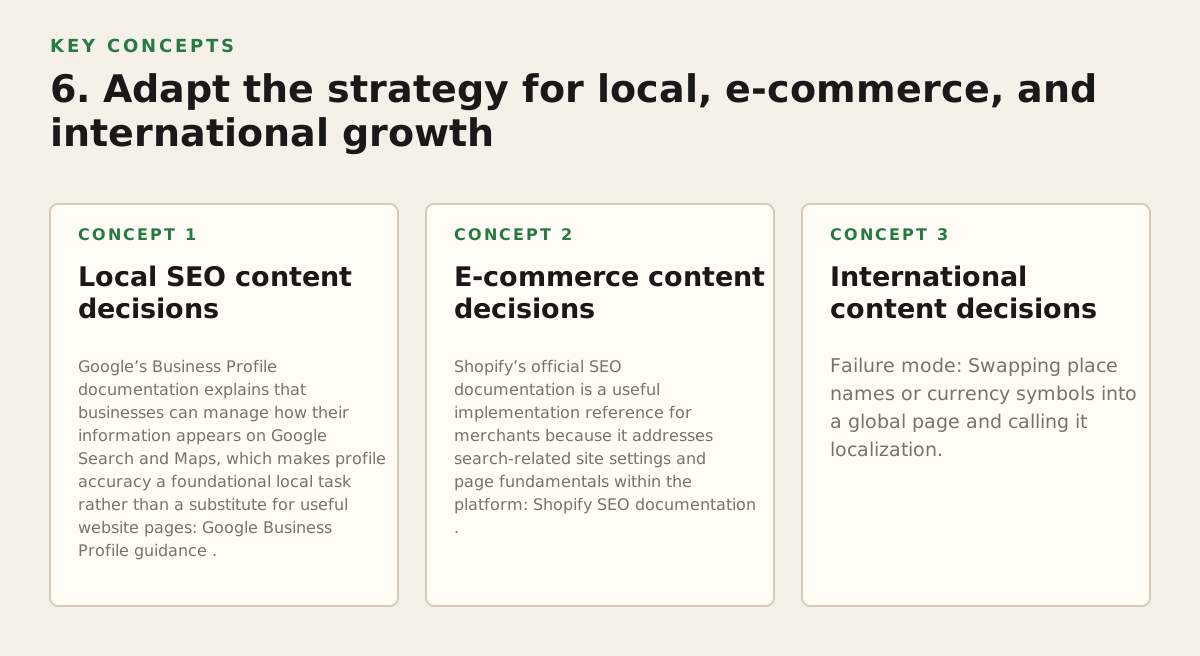
Local SEO content decisions
- Create a location page when the business genuinely serves that location and can provide distinct, accurate information.
- Describe service areas, access, staff expertise, local projects, and customer questions without manufacturing local references.
- Keep business name, address, phone, hours, and categories accurate across owned profiles and citations.
- Use locally relevant calls to action, such as booking a consultation, requesting a route, or checking service availability.
Google’s Business Profile documentation explains that businesses can manage how their information appears on Google Search and Maps, which makes profile accuracy a foundational local task rather than a substitute for useful website pages: Google Business Profile guidance. A service-area business should not create a city page for every nearby place unless it can add genuine value and serve the location.
E-commerce content decisions
- Use category pages for meaningful product groupings and buying decisions.
- Use product pages for unique specifications, variants, availability, compatibility, and purchase actions.
- Use buying guides when shoppers need criteria that category filters cannot explain.
- Use comparison pages only when the differences are accurate, current, and useful to the customer.
- Control faceted navigation so filters do not create unlimited indexable URL combinations.
Shopify’s official SEO documentation is a useful implementation reference for merchants because it addresses search-related site settings and page fundamentals within the platform: Shopify SEO documentation. The strategic decision still belongs to the business: platform defaults cannot decide which categories deserve editorial support or which products have enough differentiation for separate content.
International content decisions
- Choose whether the page needs translation, transcreation, or a market-specific rewrite.
- Verify local terminology, spelling, currency, legal context, delivery expectations, and examples.
- Use a consistent country and language URL structure that the technical team can maintain.
- Assign a local reviewer for claims that depend on market practice or customer expectations.
Failure mode: Swapping place names or currency symbols into a global page and calling it localization. That creates near-duplicates without local usefulness. If the market cannot provide distinctive evidence or a relevant offer, keep the strongest shared page and explain the market scope clearly instead of generating shallow variants.
7. Measure business contribution and establish refresh rules
When this applies: Use a measurement framework when executives ask whether content is working, when a client needs white-label reporting, or when traffic has changed and the cause is unclear. Measurement should begin in the brief, not after publication.
Why it works: Different page jobs require different success signals. A support article may reduce repeated questions; a commercial page may generate qualified inquiries; a category page may improve product discovery; an expert guide may assist later conversions. A single “organic traffic” metric hides these distinctions and can reward the wrong work.
Assign metrics by page role
- Discovery: Relevant impressions, clicks, query coverage, and engagement with the next page.
- Consideration: Product comparisons, guide-to-service clicks, assisted conversions, return visits, and qualified actions.
- Conversion: Form submissions, calls, purchases, bookings, revenue, and lead quality where tracking is reliable.
- Local: Direction requests, calls, appointment actions, location-page engagement, and verified local inquiries.
- Support: Search exits, documentation navigation, support deflection signals, and unresolved question feedback.
Set a starting policy rather than pretending that one universal benchmark applies. For example, an agency might review new commercial pages after an illustrative 90-day observation period, then decide whether to improve, consolidate, or keep monitoring based on impressions, query fit, conversions, and business feedback. The period is a planning example, not a guaranteed ranking timetable.
Use a diagnosis tree when a page disappoints:
- No impressions: Check indexability, canonical signals, sitemap discovery, technical errors, demand, and whether the page has a legitimate place in the site architecture.
- Impressions but weak clicks: Review result alignment, title and meta description clarity, brand trust, and whether the page is appearing for the wrong queries.
- Clicks but weak engagement: Compare the promise in the result with the opening content, page speed, mobile usability, navigation, and intent match.
- Engagement but few commercial actions: Check offer relevance, proof, friction, calls to action, form usability, and whether the page is too early in the buying journey.
- Traffic and conversions declining: Check seasonality, competitors, product availability, technical changes, lost links, changed search intent, and content freshness.
When editing metadata, use the meta description length checker to check how the description is likely to display and to remove avoidable truncation. Treat the description as a clear reason to choose the result, not as a place to repeat every variant of the target query.
Failure mode: Refreshing every page on a fixed calendar regardless of risk or evidence. A stable evergreen explanation may need little change, while a product page, legal guide, local profile, or statistics-heavy article may require prompt review. Base refresh priority on changing facts, business importance, search movement, user feedback, and unresolved quality issues.
8. Use the template as a decision system, not a publishing checklist
A reusable template should make weak ideas easier to reject. Before an item enters production, score it against a small set of decisions. Use a simple starting policy such as high, medium, or low rather than false precision.
| Decision factor | High-priority condition | Low-priority warning | Action |
|---|---|---|---|
| Business relevance | Directly supports a profitable service, product, or strategic market | Only loosely related to the offer | Prioritize high; reframe or reject low |
| Audience need | Clear problem, decision, or task with identifiable users | Topic exists mainly because a tool reported volume | Validate with customers, sales, support, and query data |
| Distinctiveness | Company can add experience, evidence, tools, examples, or local expertise | Likely to repeat generic competitor coverage | Define the unique contribution before briefing |
| URL fit | Existing page can be improved or new page has a distinct intent | Overlaps an established URL | Consolidate, redirect, or clarify the relationship |
| Operational readiness | Writer, reviewer, assets, and owner are available | No subject expert or approval path exists | Resolve dependencies before assigning production |
| Measurement readiness | Next action and reliable success signal are defined | Only pageviews or rankings are available | Fix tracking or choose a more realistic page job |
For a small business with limited capacity, prioritize pages that combine high business relevance, a clear customer problem, and evidence the company can supply. For an agency, add client approval risk and delivery dependencies. For a site recovering from a penalty or ranking loss, first inspect existing content quality, technical accessibility, and trust signals before adding more URLs.
Failure mode: Allowing stakeholders to bypass prioritization because a topic “sounds important.” Put the request through the same fields as every other idea. If it cannot identify an audience, business job, evidence owner, and next action, it is not ready for production.
Implementation plan: build and operate the system in sequence
Use the following sequence as a practical rollout for a new site, a major content reset, or a 2026 planning cycle. Adjust the order only when a critical technical issue prevents discovery or measurement.
- Define the commercial map. List priority services, products, locations, markets, customer types, margins or strategic importance, and the actions the business can actually handle. Separate awareness goals from lead or revenue goals.
- Inventory the existing site. Export URLs, titles, templates, indexability signals, organic queries, conversions, backlinks where relevant, internal links, and ownership. Mark pages as keep, improve, consolidate, redirect, noindex, or investigate.
- Interview the business. Ask sales which questions delay decisions, support which problems repeat, and subject experts which claims require qualification. Capture customer language instead of relying exclusively on keyword tools.
- Map intent and page roles. Cluster queries and customer questions by task. Assign each cluster a URL, format, audience, business outcome, evidence requirement, and internal-link relationship.
- Resolve architecture conflicts. Choose a canonical home for overlapping topics. Create hubs only where they improve navigation and understanding. Remove planned pages that have no distinct purpose.
- Prioritize the first production batch. Select a balanced group of commercial pages, important improvements, and a limited number of supporting resources. Include technical fixes that affect crawling, rendering, indexation, or measurement.
- Write evidence-led briefs. Specify the page job, outline, required claims, sources, expert reviewer, unique contribution, conversion path, metadata direction, structured-data suitability, and internal links.
- Run controlled production. Move each item through proposed, validated, briefed, drafted, reviewed, published, and observed stages. Do not let AI-generated text or unverified client information bypass subject review.
- Validate publication. Check the rendered page, indexability, canonical, headings, links, mobile experience, forms, analytics events, search snippets, and location or product details. Record the final URL in the register.
- Review by decision, not by vanity metric. After the agreed observation period, classify each page as scale, improve, consolidate, repair, or retire. Feed sales quality, customer questions, and Search Console evidence back into the next planning cycle.
For most small and medium-sized businesses, the best starting policy is to improve the pages closest to a real customer decision before building a large informational library. That approach exposes offer, trust, technical, and measurement weaknesses early. Once those foundations are sound, supporting content can be added where it genuinely helps users reach the right service or product.
Mr Haq can help turn this framework into a prioritized SEO content plan, technical review, local or international strategy, and measurement workflow; visit Mr Haq when you need an experienced SEO partner to connect the plan to implementation.
Authored with NotFair SEO