


Searching for local seo price usually means you are not looking for a single number. You are deciding how much work your business needs, which risks should be handled first, and whether a consultant, agency, or internal marketer can produce evidence of progress. This guide gives small businesses, e-commerce brands, international companies, and agencies a practical way to compare proposals without confusing activity with useful local visibility.
The right decision is not necessarily the cheapest monthly retainer. It is the offer that connects a defined commercial problem to a manageable scope: accurate business information, stronger local relevance, better technical access, useful content, credible mentions, and reporting tied to calls, enquiries, store visits, or sales. Treat every price as a consequence of scope rather than as a market fact.
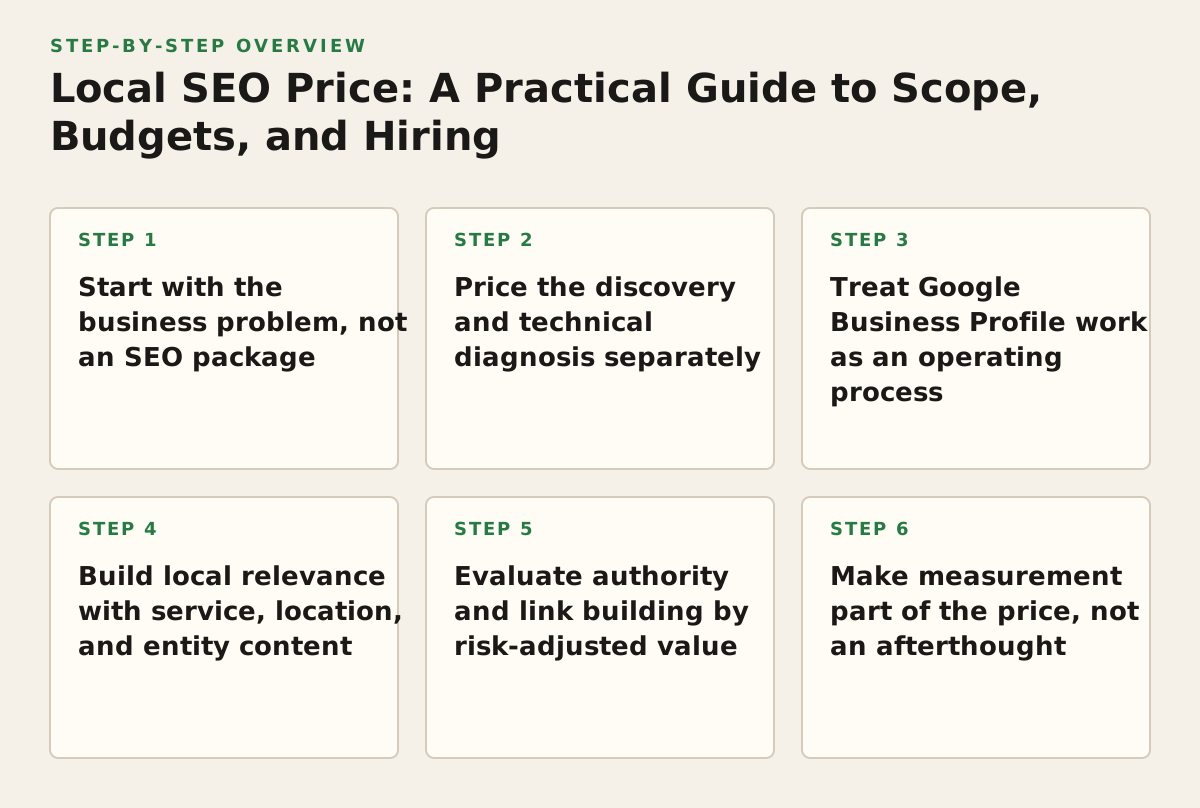
1. Start with the business problem, not an SEO package
When this applies: Use this principle whenever a provider sends a standard “local SEO” package before asking about your locations, services, customers, and conversion process. A single-location dentist, a multi-location retailer, a service-area plumber, and an international company entering Bangladesh do not have the same operating problem.
Why it works: Local search work becomes easier to price when the desired outcome is specific. “Rank higher” is too broad to govern a purchase. “Generate qualified calls for emergency plumbing in three service areas,” or “make Dhaka product searches discoverable while preserving e-commerce conversion paths,” gives the strategist a basis for deciding what to inspect and what to exclude.
Google explains that local results are primarily influenced by relevance, distance, and prominence, so a proposal should explain which of those conditions it can realistically address rather than implying that every ranking position can be bought. See Google’s explanation of how local ranking works before accepting a guarantee.
Turn the commercial goal into a brief
- Business model: storefront, service-area business, e-commerce, franchise, marketplace, or hybrid.
- Priority locations: country, city, neighbourhood, branch, or service radius.
- Priority actions: phone calls, appointment forms, directions, quote requests, purchases, or qualified leads.
- Known constraints: legal review, franchise approvals, developer capacity, CMS limitations, duplicate listings, or a previous penalty.
- Measurement reality: what can be tracked reliably from search to enquiry or sale.
Failure mode: Buying a fixed number of deliverables without identifying the bottleneck. For example, publishing ten location pages will not solve a listing-verification issue, a broken booking form, or a site that blocks important pages from being crawled.
Implementation example: A Dhaka-based home renovation company wants more quote requests in Gulshan, Banani, and Uttara. Its initial brief could prioritize service-area eligibility, accurate category and contact details, location-service page alignment, call tracking, and evidence that leads came from those areas. A proposal focused mainly on blog volume should be challenged because it does not directly address the stated job.
2. Price the discovery and technical diagnosis separately
When this applies: An audit-first engagement is most useful when rankings have fallen, a site migration has recently occurred, several agencies have made changes, or nobody can explain why important pages are absent from search. It also helps an international company determine whether the problem is country targeting, language architecture, technical accessibility, or weak local relevance.
Why it works: Diagnosis prevents the business from paying for repeated tasks that do not match the cause. A technical review should connect observations to consequences: a canonical mismatch can consolidate signals away from a desired page; blocked resources can make rendering harder; inconsistent location pages can create indexation and quality questions; and an inaccurate profile can send prospective customers to the wrong branch.
Google’s SEO documentation recommends making pages accessible to search engines, organizing site content logically, and helping search engines understand the page. Its SEO Starter Guide is a useful baseline for judging whether an audit covers discoverability, content structure, and usability rather than only title tags.
What a paid or included diagnostic should produce
- A crawl and indexation view showing important pages, exclusions, redirects, canonicals, and internal links.
- A location and service inventory identifying missing, duplicated, or conflicting pages.
- A Google Business Profile and citation consistency review, where relevant.
- A competitor and search-intent comparison based on the locations and services that matter commercially.
- A prioritized issue register with impact, confidence, effort, owner, and recommended order.
- A measurement plan explaining which actions will be reported and what remains unobservable.
Failure mode: Treating an automated audit score as a diagnosis. A site can receive warnings about minor metadata issues while its highest-value location pages are orphaned, its phone number is inconsistent, or its lead form fails on mobile.
Implementation example: After a migration, a retailer sees fewer local landing-page visits. The consultant should compare old and new URL patterns, redirects, canonicals, sitemap inclusion, internal links, structured data, and analytics annotations. If the evidence points to lost URLs, redirect and recovery work should precede a new content calendar. An audit that simply recommends more articles is not fit for the problem.
A sensible proposal will show whether discovery is a one-time project, included in the first month, or repeated after a material change. That distinction matters when comparing a low monthly quote with a higher quote that contains senior diagnosis and implementation oversight.
3. Treat Google Business Profile work as an operating process
When this applies: Profile management matters most for businesses that depend on map visibility, calls, directions, local discovery, or trust at the moment of selection. It is also a priority when a listing is suspended, duplicated, unverified, owned by a former employee, or showing the wrong category, hours, phone number, or address.
Why it works: A profile is not merely an item to “optimize” once. It is a public representation of the business that must stay accurate as hours, services, branches, products, and customer questions change. Google’s official guidance covers eligibility, representing a business, and maintaining accurate information in its Business Profile guidelines. A provider should therefore describe governance and evidence, not promise a secret ranking trick.
Price the actual workload
- Ownership and access recovery, verification, and escalation support.
- Primary and secondary category review based on the real business model.
- Business name, address, phone, hours, service areas, attributes, and landing-page alignment.
- Photo, product, service, update, and question-management responsibilities.
- Review-response workflow, approval rules, and escalation for harmful or suspicious content.
- Duplicate-profile detection and branch governance for multi-location organizations.
Failure mode: Incentivizing reviews, creating listings for ineligible locations, or changing business details without approval. Google’s contribution policies address prohibited and restricted content, while review compliance also has legal implications. The FTC Endorsement Guides explain why endorsements and reviews need to reflect honest experiences and disclose relevant relationships where applicable.
Implementation example: A Bangladesh restaurant has one verified profile, outdated holiday hours, and three unofficial duplicates. A practical scope would establish the legitimate profile as the source of truth, document access, correct hours and categories, investigate duplicates, create a review-response playbook, and assign the owner responsible for future changes. It should not promise that posting updates alone will overcome poor relevance or intense competition.
Ask whether profile work includes approval time, verification assistance, branch-level checks, and response management. Ten minutes of monthly posting is not equivalent to resolving ownership, duplicate, or suspension problems.
4. Build local relevance with service, location, and entity content
When this applies: Content investment is appropriate when search demand exists but the site does not clearly explain what the business offers, where it operates, who it serves, or why a customer should choose it. It is particularly important for professional services, healthcare, home services, education, B2B providers, and international brands that need market-specific pages.
Why it works: Useful local content reduces ambiguity for both customers and search systems. A strong page connects one service to a real market, answers practical questions, shows evidence of experience, and provides a clear next action. It should be more than a city name inserted into a national page.
For eligible businesses, structured data can help communicate entities and business details in a machine-readable format. Google’s LocalBusiness structured-data documentation explains supported properties and implementation considerations; the vocabulary itself is maintained at Schema.org’s LocalBusiness reference. Structured data does not replace accurate visible content or guarantee a search feature.
A practical content unit
- Intent: what the searcher is trying to decide, compare, solve, or buy.
- Local proof: service coverage, branch details, delivery terms, staff expertise, projects, certifications, or customer questions.
- Commercial clarity: who the service is for, what is included, what happens next, and how to contact the business.
- Technical connection: title, heading structure, canonical URL, internal links, schema where appropriate, and indexability.
- Maintenance owner: the person responsible for updating hours, pricing context, availability, regulations, and claims.
Failure mode: Producing near-identical doorway pages for every suburb. Pages that offer no distinct information, service coverage, proof, or useful next step can create a poor customer experience and dilute the site’s editorial effort.
Implementation example: An accounting firm serving Dhaka and Chattogram could create a service page for tax advisory and location pages that explain local availability, meeting options, relevant business types, and the firm’s process. The pages should not make unsupported claims about local offices or invent testimonials. If one page cannot provide genuinely distinct value for a neighbourhood, keep the stronger city or regional page instead.
Use internal links to make the relationship between service, location, evidence, and conversion pages obvious. During planning, the internal link opportunity tool can help identify relevant pages that are currently disconnected; this helps the content team prioritize internal link opportunities rather than publishing more isolated articles.
5. Evaluate authority and link building by risk-adjusted value
When this applies: Link acquisition deserves budget when the site is technically sound, its important pages satisfy the search intent, and credible local or industry references could reasonably help customers discover or trust the business. It is also relevant for competitive markets where reputable businesses and publications naturally reference comparable services.
Why it works: A relevant mention can contribute discovery, referral traffic, reputation, and context. But authority is not a quantity contest. A local chamber, trade association, respected publication, supplier, event organizer, or genuinely useful partner may be more valuable than a large batch of unrelated domains.
Failure mode: Buying packages based on a target number of links, publishing low-quality guest posts at scale, or using exact-match anchor text in a way that creates an unnatural pattern. This can waste budget and introduce reputation or policy risk, especially for regulated services, finance, healthcare, and businesses recovering from a manual action.
Implementation example: A Bangladeshi software company targeting overseas buyers could prioritize case-study partnerships, supplier or technology-partner pages, credible industry contributions, digital PR around original research, and genuinely useful expert commentary. Each prospect should be recorded with topical relevance, audience value, editorial control, commercial relationship, and risk. A link that produces no relevant audience and exists only to manipulate rankings should not pass that test.
If outsourced acquisition is being considered, link building services helps you assess whether outsourced link building should be included in a local SEO budget, including link building, guest posting, niche edits, white-label SEO, casino SEO, iGaming marketing, digital PR, and content marketing. Use that evaluation to compare the supplier’s methods, review process, and risk controls rather than simply adding a link quantity line to the proposal.

Questions for a link-building quote
- How are prospects selected, and what makes a placement relevant to the customer?
- Will the client approve targets and content before publication?
- Are paid, sponsored, affiliate, or client relationships disclosed appropriately?
- What happens if a placement is removed, changed, or later becomes unsuitable?
- Can the provider show the publication context, not only domain metrics?
- How will the work avoid conflicts with regulated claims or existing penalty-recovery advice?
For agencies, white-label delivery should include a transparent prospect list, editorial status, client-ready notes, and escalation rules. The cheapest fulfillment model is a poor bargain if the agency must later explain irrelevant placements to its client.
6. Make measurement part of the price, not an afterthought
When this applies: Measurement design is essential when several branches share a domain, calls are the main conversion, e-commerce revenue crosses channels, or stakeholders need a defensible monthly report. It is even more important after a ranking loss, when correlation can easily be mistaken for recovery.
Why it works: Local SEO produces several layers of evidence: visibility, actions, qualified leads, and revenue. A useful measurement system distinguishes them. Ranking for a location phrase may show reach, but a qualified call or completed purchase is closer to business value. Neither should be treated as a perfect proxy for the other.
Specify the reporting layer
- Visibility: priority queries, landing-page impressions, indexed pages, and local discovery trends where measurement is reliable.
- Engagement: calls, direction requests, form starts, product views, and booking actions.
- Quality: qualified leads, service-area fit, appointment completion, or sales value.
- Work delivered: fixes released, pages improved, listings managed, links earned, and tests completed.
- Decision log: what changed, why it changed, what evidence is expected, and what will happen next.
Failure mode: Reporting only average position, traffic, or a proprietary visibility score. Those metrics can move while lead quality declines, or remain flat while technical recovery work restores important pages. A report that does not identify actions, limitations, and next decisions is an activity receipt.
Implementation example: A multi-branch clinic can separate organic landing-page leads by branch, annotate opening-hour changes and campaigns, record whether calls were qualified, and show unresolved tracking gaps. Its dashboard can include a branch filter and a workstream status view. It should avoid claiming that every phone call originated from one ranking change unless the tracking setup supports that conclusion.
For page-level quality control, use the meta description length checker to check whether titles and descriptions are likely to be truncated or poorly communicated in search results. That tool supports snippet review; it cannot prove ranking improvement or replace conversion measurement.
7. Compare pricing models by scope, control, and exit risk
When this applies: Use a pricing model comparison when you are choosing between a one-time audit, project implementation, monthly consulting, managed execution, performance-based work, or a white-label arrangement. The same monthly amount can represent radically different seniority, output, and accountability.
Why it works: Price becomes comparable only after scope is normalized. Ask who performs the work, how many locations and templates are covered, what access is required, how approvals work, what is excluded, and what evidence is delivered. A lower fee may be reasonable for strategic direction only; it is not automatically comparable to a fee covering technical implementation, content, listings, outreach, and reporting.
| Model | Best fit | Confirm before signing | Main failure risk |
|---|---|---|---|
| Diagnostic audit | Unclear cause, migration, penalty, or major ranking loss | Prioritized findings, evidence, remediation order, and handoff format | A long issue list with no owner, consequence, or decision path |
| Fixed-scope project | Known implementation such as branch cleanup or site restructuring | Pages, locations, revisions, dependencies, acceptance criteria, and change control | Scope expands when hidden technical or approval work appears |
| Monthly consulting | Internal team needs senior direction and review | Meeting cadence, response limits, deliverables, access, and implementation responsibility | Advice accumulates while nobody releases the changes |
| Managed retainer | Business wants ongoing execution across multiple workstreams | Capacity, named roles, approvals, reporting, content ownership, and stopping rules | Routine activity continues after the main bottleneck changes |
| Performance-linked arrangement | Only when attribution, control, and definitions are unusually clear | Qualified action definition, baseline, exclusions, tracking, payment trigger, and disputes | Incentives encourage easy-to-measure traffic instead of profitable demand |
| White-label support | Agency needs strategy, fulfillment, or reporting behind its brand | Client confidentiality, communication ownership, QA, margins, and escalation | Opaque delivery damages the agency’s client relationship |
Failure mode: Comparing providers by hours, content count, or links alone. Ten hours of senior diagnosis may prevent months of misdirected implementation, while a larger deliverable count can conceal low editorial quality or weak prioritization.
Implementation example: A small retailer with one location and a functioning website could begin with a fixed diagnostic and a limited implementation sprint. A franchise with many branches may need an ongoing operating model with templates, local approvals, governance, and branch reporting. A marketing agency may choose white-label consulting if its team can execute but needs strategy and QA. These are different purchasing decisions even when the keyword target is the same.
Use a simple proposal scorecard
- Score whether the proposal understands the business model and priority locations.
- Mark every deliverable as strategy, implementation, monitoring, or reporting.
- Identify dependencies that sit with the client, developer, writer, or agency.
- Check whether success is connected to qualified actions and commercial goals.
- Record exclusions, approval limits, contract length, ownership of assets, and exit terms.
- Prefer the proposal with the clearest next decision, not merely the longest task list.
Any budgets, thresholds, or timelines you create should be labeled as an illustrative starting policy, not a universal benchmark. For example, a company might reserve an initial period for diagnosis and urgent fixes, then release additional content or authority budget only after measurement and technical dependencies are under control. The correct allocation depends on the market, site condition, internal capacity, and value of a qualified customer.
8. Adjust the decision for penalties, e-commerce, international targeting, and agencies
When this applies: Standard local SEO pricing becomes misleading when the engagement includes a penalty, a large product catalog, multiple countries, or delivery for another agency’s client. These cases add investigation, coordination, governance, or technical complexity that a simple local listing package does not cover.
Why it works: Different constraints change both the sequence and the risk. A penalty recovery needs evidence and restraint before new promotion. E-commerce needs category, product, faceted-navigation, stock, and conversion decisions. International targeting needs market-specific language, currency, delivery, and location signals. Agencies need repeatable workflows and clear client ownership.
Penalty or ranking-loss recovery
- Separate a documented manual action from an algorithmic decline or tracking change.
- Inventory recent technical, content, link, migration, and business changes.
- Preserve evidence before deleting or disavowing material without a reasoned diagnosis.
- Prioritize policy compliance, useful content, accessibility, and technical recovery.
- Define what evidence would support a recovery decision and what remains uncertain.
E-commerce and international expansion
- Map local intent to category, product, store, delivery, and support pages.
- Prevent filters and parameter combinations from creating uncontrolled crawl paths.
- Make availability, delivery area, returns, currency, and contact options clear.
- Use market-appropriate research rather than translating one generic page repeatedly.
- Coordinate hreflang, canonicals, internal links, and localized business information where applicable.
Failure mode: Charging a standard local retainer while quietly absorbing enterprise-style complexity. This produces rushed work, unclear ownership, and a report that hides unresolved dependencies.
Implementation example: An international company entering Bangladesh may need a Bangladesh-specific service or product path, local contact and delivery information, market-relevant content, and analytics segmentation. The work should first confirm the company’s actual presence and customer journey in that market. Creating a local address or branch page that does not represent a real operation would create trust and governance problems rather than solve a visibility gap.
Implementation plan: move from quote to controlled execution
Use the following sequence to turn a local SEO proposal into a decision and operating plan. Do not release every workstream at once; let evidence determine the next allocation.
- Write the commercial brief. Name the business model, priority locations, services or products, primary conversion, target market, and known constraints. Include whether the goal is recovery, expansion, lead generation, store discovery, or agency fulfillment.
- Request a scope-led proposal. Ask for the diagnosis, deliverables, owners, dependencies, approval process, reporting format, contract terms, exclusions, and asset ownership. Reject guarantees that are not tied to controllable work and measurable definitions.
- Run the baseline. Record current profile access and accuracy, important indexed pages, technical health, local landing pages, conversion tracking, priority-query visibility, and lead quality. Label gaps in the data instead of filling them with assumptions.
- Resolve access and urgent risks. Secure administrator ownership, correct serious business information errors, repair broken conversion paths, investigate migration losses, and address policy or penalty concerns before promotional activity.
- Prioritize by value and dependency. Use a simple score of commercial impact, confidence, effort, and risk. An illustrative starting policy is to do high-impact, high-confidence fixes first; it is not a universal benchmark for every business.
- Build the content and internal-link system. Improve the strongest service and location pages, add evidence and useful local detail, connect related pages, and establish an owner for factual updates. Avoid publishing pages merely to meet a quota.
- Start authority work selectively. Approve relevant prospects, document the reason for each placement, and use digital PR, partnerships, expert contributions, or useful resources where they serve an audience beyond search engines.
- Report decisions, not just outputs. Each reporting cycle should show what changed, what moved, what did not move, what tracking cannot establish, and which next action follows from the evidence. Reallocate effort when the original bottleneck is no longer the main constraint.
- Review the engagement at a defined checkpoint. Continue, narrow, expand, or stop based on implementation quality, qualified demand, risk, and learning. A recurring fee should earn its continuation through useful decisions and execution, not inertia.
Mr Haq can help turn this assessment into a prioritized local SEO strategy, technical plan, content system, measurement framework, or agency support engagement; start with Mr Haq when you need the scope matched to your market and operating constraints.
Authored with NotFair SEO