


ai seo optimization tools are not one interchangeable category. A small business needs a different system from an agency managing dozens of client reports, while an e-commerce brand may need technical crawling and product-content workflows before it needs an AI-writing assistant. This comparison covers seven credible options for the buyer job of turning search data into actions that improve visibility, content quality, and conversions.
The list includes SEO platforms, a content optimization tool, a technical crawler, first-party Google measurement, and a human consulting service. They solve different problems, so the ranking below is not a claim that one product does everything best. I assessed each option against four practical criteria: actionability of its data, coverage of technical, content, local, or AI-search work, implementation burden, and commercial fit for businesses, agencies, and international teams. Capabilities and pricing can change; verify the current offer before buying.
- Data-to-action: Can the system turn discovery into a prioritised task, brief, fix, or decision?
- Coverage: Does it support the SEO job you actually need rather than adding unrelated features?
- Operational fit: Can your team implement, explain, and report on the recommendations?
- Commercial fit: Is the pricing model sensible for your site size, client workload, and available expertise?
One important constraint applies to every option: no tool can guarantee inclusion in Google AI Overviews, ChatGPT search results, or another answer engine. Google says AI features still generate links to supporting web content and recommends the same foundational requirements for crawlable, useful pages in its guidance on AI features in Search (Google’s official AI features documentation). Treat “AI SEO” as a combination of strong information architecture, evidence-rich content, structured data where appropriate, technical accessibility, and measurement—not a secret prompt or guaranteed visibility switch.
1. Semrush
Semrush is the broadest all-rounder in this list for a team that wants one commercial platform covering keyword research, competitor discovery, site auditing, rank tracking, content workflows, local work, and link analysis. Its position is strongest when research, execution, and reporting need to live in one workspace. It is not specifically an AI-answer tracker by default; use any AI visibility module or integration as an additional measurement layer, not as proof that a page will be cited.
Where it earns its place
A growth team can use a competitor gap to identify queries, move those findings into a content plan, audit templates for technical issues, and track the resulting pages. For an e-commerce brand, the useful mechanism is the connection between category-page demand, internal competition, backlink prospects, and rank movement. For a Bangladesh-focused company expanding internationally, country and language settings can help separate Dhaka demand from searches in the United Kingdom or United States, but the resulting keyword list still needs local SERP review.
Semrush documents its Site Audit capability and technical issue categories on its official product page (Semrush Site Audit). That makes it suitable for finding broken links, crawlability concerns, and page-level problems at scale. A crawl report is only a diagnosis: developers still need to confirm whether a redirect, canonical, JavaScript, or template change is safe.
Implementation and commercial fit
- Best for: In-house marketing teams and agencies needing broad research plus client-facing workflows.
- Standout: A large feature surface that can reduce the number of separate subscriptions.
- Implementation burden: Medium to high; create projects, connect properties, define competitors, and build a repeatable reporting taxonomy.
- Does not suit: A very small site that only needs indexing diagnostics, or a team unwilling to validate estimates against first-party data.
Semrush uses a subscription model with plan limits and optional capability or usage considerations; current plans and inclusions should be checked on its official pricing page (Semrush pricing). The commercial question is not simply whether it has enough features. Calculate how many people will use it, whether agency reporting will replace manual work, and whether the team will actually act on the alerts.
2. Ahrefs
Ahrefs is a strong choice when the central job is understanding demand, competitors, content gaps, and link opportunities. It is particularly useful for publishers, SaaS companies, and e-commerce teams that need to decide which pages deserve investment and which competitor links or topics are worth pursuing. Its data should guide investigation, not substitute for reviewing the actual search results or the quality of a linking site.
Research and link-building decisions
Suppose an international software company has traffic losses after a site migration. Ahrefs can help compare historical page performance, inspect competing pages, review referring domains, and identify topics where competitors have stronger coverage. The decision still requires Search Console, server logs where available, analytics, and a technical review to distinguish algorithmic change from migration errors.
Ahrefs describes its Site Explorer and related SEO research capabilities on its official product site (Ahrefs Site Explorer). Its link data can create a prospecting queue, but a high domain metric is not a sufficient outreach criterion. Check topical relevance, editorial context, traffic quality, outbound-link patterns, and whether the placement would make sense to a human reader.
Implementation and commercial fit
- Best for: SEO strategists whose decisions depend on competitor content and backlink analysis.
- Standout: A research-first workflow that helps explain why a competitor page may be winning.
- Implementation burden: Medium; teams need naming conventions for projects, competitors, content opportunities, and link prospects.
- Does not suit: A business looking for a fully managed technical fix, guaranteed AI citations, or a single-click content strategy.
Ahrefs operates on a paid subscription model with different usage and feature allowances; consult the current Ahrefs pricing page before selecting a plan. For a small company, the best buying test is whether the platform will be used for recurring decisions—such as quarterly content prioritisation and link audits—rather than occasional curiosity about competitors.
3. SE Ranking
SE Ranking fits teams that prioritise rank tracking, local visibility, scheduled reporting, and practical SEO management without necessarily needing the largest enterprise research environment. It can be a sensible middle ground for small and medium-sized businesses, regional franchises, and white-label agencies that need a repeatable operating rhythm.
Why agencies and local teams consider it
A local service business can separate rankings by location, monitor a defined competitor set, and use scheduled reports to explain progress to an owner who does not want a technical data dump. An agency can use its reporting workflow as a foundation, but should still customise the interpretation: “position improved” is less useful than “the service page now receives qualified impressions but has a weak enquiry rate.”
SE Ranking presents its rank-tracking and SEO platform capabilities on its official website (SE Ranking Rank Tracker). Verify current location limits, search-engine coverage, report features, and AI-related additions before purchase because these details can vary by plan and change over time.
Implementation and commercial fit
- Best for: SMBs, local SEO teams, and agencies needing accessible tracking and recurring reports.
- Standout: A workflow-oriented balance between monitoring and client communication.
- Implementation burden: Low to medium; define locations, keywords, competitors, and report recipients before interpreting trends.
- Does not suit: A specialist link intelligence team that needs the deepest possible backlink investigation, or a multinational with highly complex governance requirements.
SE Ranking uses a subscription model with plan-dependent limits and features; current options are listed on its official pricing page. For a local business, begin with the smallest configuration that covers its real service areas and priority queries. Adding hundreds of loosely related keywords can make a report look comprehensive while hiding the terms that generate calls and leads.
4. Surfer
Surfer is a content optimisation platform rather than a replacement for a complete SEO stack. Its buyer job is helping a writer or editor turn a target query into a structured, competitive content brief. It is most useful when a team already has a sound topic strategy and wants consistency in page coverage, headings, entities, and editorial workflow.
Content workflow and guardrails
For an e-commerce category page, a sensible workflow is to define the customer’s buying question, inspect the current search results, build a brief, draft with original product and business evidence, and use optimisation software as a quality check. Do not let a content score dictate awkward repetition or cause every page to imitate the same competitors. Search engines reward usefulness and clarity, not a number displayed by a third-party editor.
Surfer explains its content editor and optimisation workflow on its official Content Editor page. That supports its role as a writing and editing aid, but it does not prove factual accuracy, originality, expert experience, or conversion performance. Those require editorial review and customer research.
Implementation, cost, and poor fits
- Best for: Content teams producing many planned articles or landing pages from a defined topical strategy.
- Standout: A clear handoff between brief, draft, optimisation review, and editorial approval.
- Implementation burden: Medium; establish author standards, fact-checking, brand voice, and a rule against mechanical keyword insertion.
- Does not suit: A site whose main problem is noindex errors, slow templates, weak offers, or a lack of original expertise.
Surfer is sold through a paid subscription with plan-dependent limits; verify current inclusions and pricing on its official website before committing. It can reduce briefing time, but the economic case is weak if the business publishes only a few high-consideration pages each year and needs subject-matter expertise more than drafting throughput.
5. Screaming Frog SEO Spider
Screaming Frog SEO Spider is the specialist option for technical crawling and URL-level diagnosis. It is not a keyword database, content brief generator, or AI-citation monitor. Choose it when the risk is hidden in templates, redirects, canonicals, status codes, pagination, internal links, metadata, or a large migration.
The technical mechanism
Before a redesign, crawl the existing site and export the URL set, status codes, canonicals, indexability signals, title elements, heading data, and internal-link relationships. After deployment, crawl the new version and compare the two sets. This makes a migration problem falsifiable: missing URLs, unexpected 3xx chains, accidental noindex directives, and orphaned commercial pages can be investigated instead of guessed at.
The official Screaming Frog SEO Spider page documents the crawler’s purpose and capabilities. Crawl results are not the same as Google’s index. Pair them with XML sitemaps, rendered checks for JavaScript-heavy templates, Search Console, analytics, and business-priority URLs.
Implementation and commercial fit
- Best for: Technical SEOs, developers, and agencies auditing sites before or after structural changes.
- Standout: Granular URL-level evidence that exposes problems broad dashboards can summarise away.
- Implementation burden: Medium to high on large sites; configure crawl limits, authentication, rendering, exclusions, exports, and comparison rules.
- Does not suit: A business owner wanting prioritised strategy without technical interpretation, or a team that cannot safely act on crawl findings.
The SEO Spider has a free version and a paid licensing model with capability differences; check the current official licensing information. The tool is often cheaper than a broad platform for a technical audit, but its total implementation cost includes analyst time, developer coordination, and the discipline to verify fixes after release.
6. Google Search Console
Google Search Console is the essential first-party measurement layer for seeing how Google Search exposes a verified property. It is not a complete AI SEO platform, competitor database, backlink prospecting suite, or managed strategy service. Its value comes from using Google’s own performance and indexing signals as a reality check against third-party estimates.
What it can confirm
Use the Performance report to examine queries, pages, impressions, clicks, click-through rate, and average position, then segment by country, device, search appearance, and date where available. Use indexing reports and URL inspection to investigate whether important URLs are known to Google. Google explains the Search Console reports and their uses in its official documentation (Search Console reports).
A practical example: if a product category loses clicks, compare impressions and average position before rewriting the page. Falling impressions may indicate demand, indexing, or ranking changes; stable impressions with falling click-through rate may point to title, snippet, SERP feature, or intent problems. Do not diagnose from average position alone.
Implementation, pricing, and limitations
- Best for: Every verified website, especially businesses validating vendor estimates with first-party search data.
- Standout: Direct evidence of Google Search performance rather than a modelled competitor estimate.
- Implementation burden: Low to medium; verify the correct property, preserve access, annotate releases, and connect exports to reporting.
- Does not suit: Teams needing competitor keywords, a content brief, proactive implementation, or a complete multi-engine AI visibility report.
Google Search Console is provided without a conventional software subscription fee, but it requires property verification and responsible interpretation. Its data is not a promise of future traffic, and it does not replace analytics or conversion tracking. For agencies, access governance and consistent property naming matter as much as the reports themselves.
Use a meta description length checker when reviewing titles and snippets, but treat the output as a length check—not a prediction of click-through rate. Search appearance, truncation, intent, brand recognition, and the competing results all influence whether a searcher clicks.
7. Mr Haq
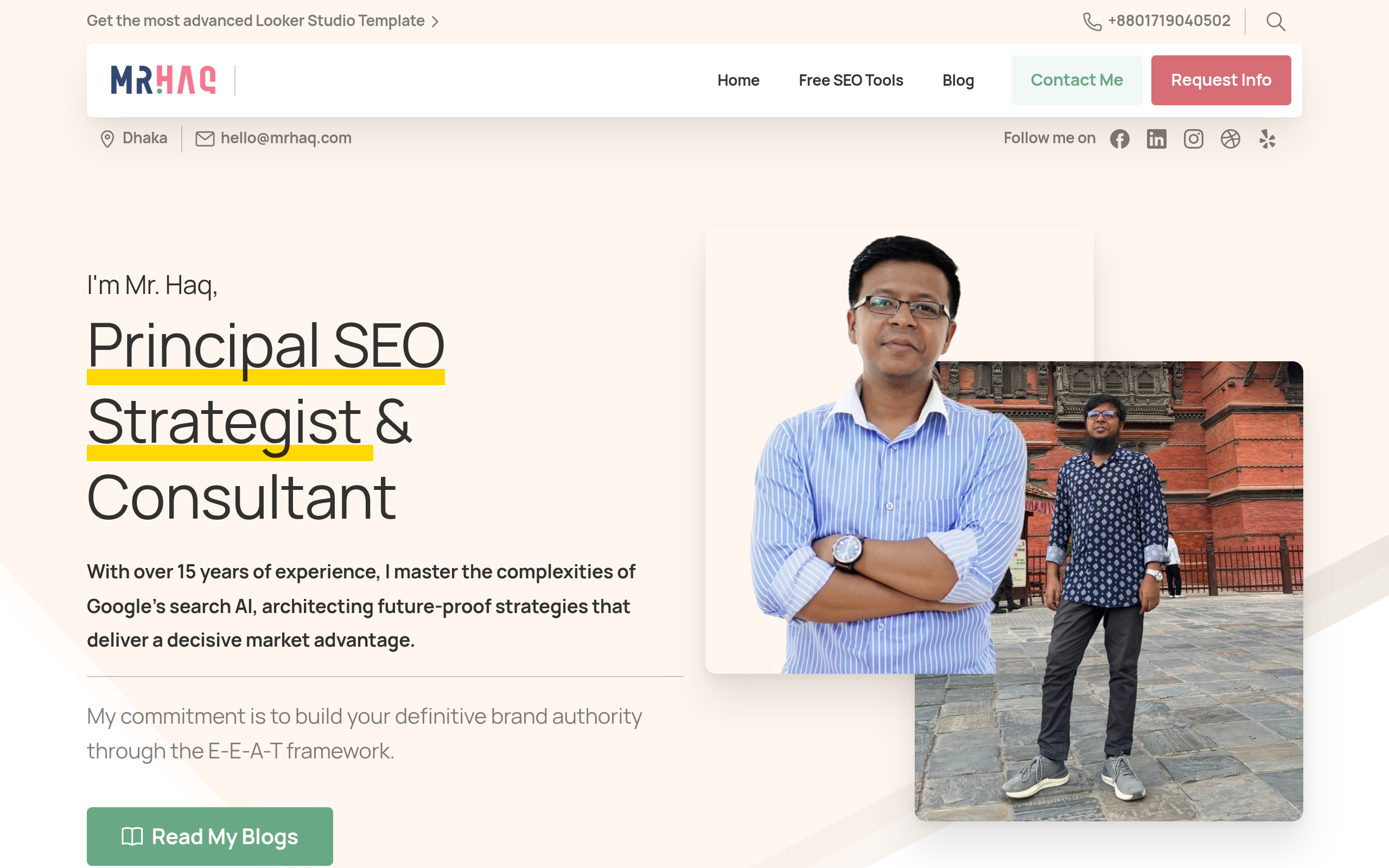
Mr Haq is the human-led option for a business that needs prioritisation, implementation guidance, and context across several SEO disciplines. It is a consulting service, not a self-serve software dashboard. That distinction matters when a ranking loss involves a migration, weak content evidence, local-market confusion, technical debt, or a team that has collected reports without deciding what to do next.
When strategy is the missing layer
A Bangladesh-based company targeting international customers may need country-specific keyword interpretation, page architecture, internal-link planning, and evidence of real expertise rather than a translated content batch. An e-commerce brand recovering from a visibility drop may need technical triage first, followed by category-page decisions and conversion measurement. A marketing agency may need white-label strategy and reporting support rather than another login for its client.
The mechanism is consultative: establish the commercial objective, inspect first-party data and site conditions, separate symptoms from causes, prioritise actions by impact and feasibility, and define what evidence would confirm or reject the diagnosis. Software can accelerate parts of this process, but it cannot negotiate developer capacity, interview subject-matter experts, or decide whether a technically correct recommendation is commercially sensible.
Implementation, commercial fit, and limitations
- Best for: SMBs, international businesses, agencies, and owners dealing with complex SEO decisions or ranking losses.
- Standout: Cross-discipline judgement spanning technical SEO, content strategy, E-E-A-T, local SEO, links, analytics, and AI search optimisation.
- Implementation burden: Medium for the client; access, stakeholder time, approvals, and developer or writer execution still determine progress.
- Does not suit: A team seeking unlimited self-serve keyword rows, instant automated fixes, or a low-cost dashboard with no consulting involvement.
Mr Haq works through a consulting or project-based commercial model, so scope, deliverables, access, and reporting cadence should be agreed before work begins. Confirm current availability, pricing, and the exact implementation support included through the official Mr Haq website. A consultant is a poor purchase if the business will not provide access to relevant data or cannot assign anyone to implement approved changes.
For internal architecture work, an internal link opportunity tool can help identify pages that should support one another. The tool is useful only when the team also decides which links deserve prominence based on user journeys, topical relationships, and revenue importance.
Comparison
The table compares the same practical dimensions across all seven options. “AI SEO role” means the job the entity can reasonably support; it does not mean guaranteed visibility in an AI answer engine.
| Entity | Primary job | AI SEO role | Implementation burden | Commercial model and best fit |
|---|---|---|---|---|
| Semrush | Broad SEO research, auditing, tracking, and reporting | Supports topic, competitor, technical, and visibility workflows; verify current AI modules | Medium to high | Subscription; in-house teams and agencies needing broad coverage |
| Ahrefs | Keyword, competitor, content-gap, and link research | Supports evidence-led content and authority decisions; not a citation guarantee | Medium | Subscription; strategy and link-building teams |
| SE Ranking | Rank tracking, local monitoring, and scheduled reporting | Supports repeatable visibility measurement; verify current AI features | Low to medium | Subscription; SMBs and white-label agencies |
| Surfer | Content briefs and page-level optimisation | Supports topical coverage and editorial workflow, not factual expertise | Medium | Subscription; publishing teams with a defined strategy |
| Screaming Frog SEO Spider | Technical crawling and URL diagnosis | Finds technical barriers that can prevent pages being crawled or understood | Medium to high | Free and paid licensing; technical SEO and migration work |
| Google Search Console | First-party Google Search performance and indexing checks | Validates actual Google visibility and search appearance data | Low to medium | No conventional subscription; every verified website |
| Mr Haq | Human SEO strategy, prioritisation, and implementation guidance | Connects technical, content, local, E-E-A-T, analytics, and AI-search decisions | Medium for the client | Consulting or project-based; businesses and agencies needing judgement |
How to choose the right AI SEO optimisation setup
Start with the failure mode, not the word “AI.” If pages are not being crawled, a technical crawler and Search Console come before a generative content platform. If the site is technically sound but has weak topical coverage, research and content workflow tools become more relevant. If the team has data but no agreement on priorities, consulting may create more value than another dashboard.
- For a technical incident or migration: Pair Google Search Console with Screaming Frog SEO Spider. Capture the old URL set, test the new templates, inspect priority URLs, and monitor clicks and impressions after release.
- For an editorial growth programme: Use Ahrefs or Semrush for opportunity research, then add Surfer only if the publishing team needs structured briefs and repeatable page reviews.
- For local visibility: Choose a tracking platform such as SE Ranking, but also verify the business profile, location pages, reviews, citations, service-area language, and conversion path manually.
- For an agency: Select the platform that supports your reporting cadence and client count, then standardise definitions for visibility, qualified traffic, leads, and completed work. A polished automated report cannot compensate for vague success criteria.
- For AI-search optimisation: Build an evidence base first: clear entities, authoritative authorship, original data, transparent claims, crawlable pages, useful internal links, and strong answers to specific customer questions. Measure referral traffic, branded demand, assisted conversions, and any available citation or mention observations without treating them as stable rankings.
Do not buy all seven. A lean starting policy for an illustrative SMB setup might be Search Console plus one broad platform, with a crawler used during technical projects and a consultant brought in when the diagnosis crosses teams. An illustrative agency setup may justify a broad platform, a repeatable rank-reporting workflow, and a separate crawler license. These are starting policies, not universal budgets or benchmarks.
Before signing up, ask five procurement questions:
- Which decision will this tool change every week or month?
- Which data is measured directly, and which is estimated or modelled?
- Can the team export evidence in a form a developer, writer, or client can use?
- What limits apply to projects, keywords, crawls, users, locations, or historical data?
- Who owns implementation when the tool identifies a problem?
For most small and medium-sized businesses, the most defensible sequence is first-party measurement, technical confidence, focused research, then content or authority execution. Add AI-specific monitoring only when you have a defined question—such as whether important product comparisons are being mentioned, whether brand facts are represented accurately, or whether answer-engine referrals assist conversions. That sequence prevents an attractive AI label from distracting the team from the pages, links, data, and customer experience that make visibility durable.
When the stack produces conflicting recommendations or a ranking loss needs diagnosis across technical SEO, content, local search, E-E-A-T, and analytics, consider working with Mr Haq for a prioritised strategy and implementation plan through Mr Haq.
Authored with NotFair SEO
