


On page seo services help improve the pages on your site through audits, content recommendations, technical review, implementation, or ongoing support. The right engagement depends on the problem you need solved and who can act on the recommendations: a team with writers and developers may need clear priorities, while a lean business may need implementation help as well. Compare providers by scope, responsibilities, budget assumptions, and how the work will be assessed—not by the length of an audit or a promise of rankings.
Understand the service categories before comparing providers
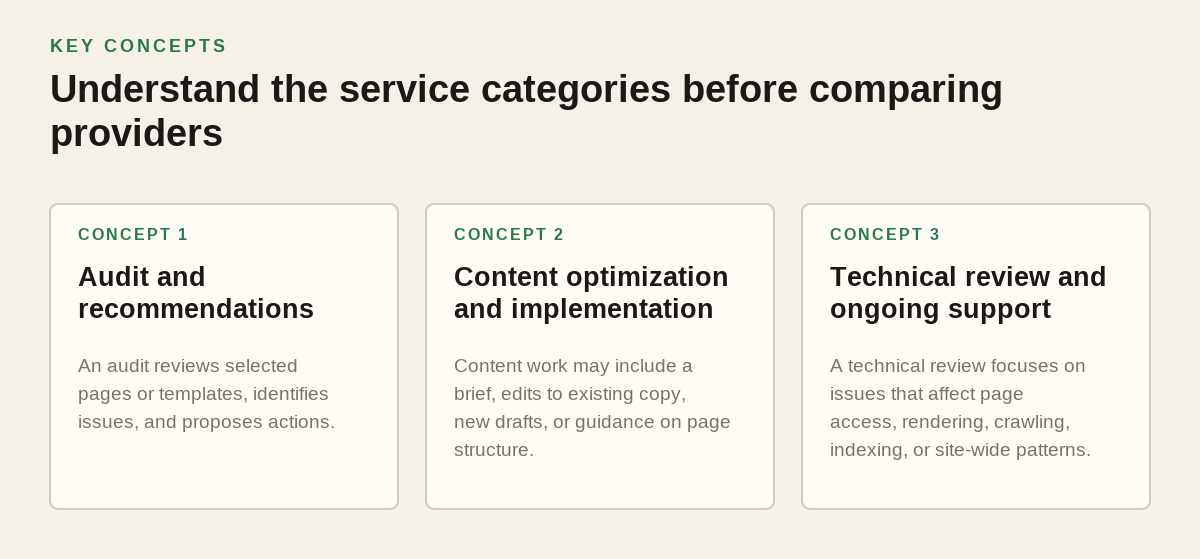
“On-page SEO” can describe several different deliverables. A proposal may focus on diagnosing pages, improving content, changing how templates work, or guiding your team through implementation. These categories overlap, but they do not carry the same workload for the buyer.
Audit and recommendations
An audit reviews selected pages or templates, identifies issues, and proposes actions. Depending on its scope, it might assess whether a page meets its intended purpose, whether its content is clear and useful, how related pages link to it, or whether a technical issue affects crawling or indexing. The deliverable is advice, not a completed change, unless implementation is explicitly included.
This can suit a marketing agency or in-house team that has people ready to do the work but needs a reasoned plan. Ask how the provider will select pages, distinguish a template-wide issue from an individual page problem, and prioritize recommendations when the team cannot do everything at once.
Content optimization and implementation
Content work may include a brief, edits to existing copy, new drafts, or guidance on page structure. Implementation may also involve changing titles, headings, internal links, or a content-management-system template. These tasks need different skills and approvals: a writer can revise a page, for example, but a developer may be needed to change a shared template.
A small business with limited SEO capacity may prefer a provider who can carry changes through publication. Before assuming that is included, ask whether the provider has CMS access, whether development work is covered, who supplies accurate product or service details, and who approves the final page. “Implementation included” needs a precise definition.
Technical review and ongoing support
A technical review focuses on issues that affect page access, rendering, crawling, indexing, or site-wide patterns. It may surface work that requires a developer rather than a content editor. Ongoing support adds a recurring process for choosing tasks, reviewing changes, and monitoring outcomes; it does not mean every requested change is automatically included.
For an e-commerce business, reviewing a product-page template may be more useful than commissioning isolated edits before understanding the shared pattern. For an agency, consulting or quality review may fit better if its own team will execute. In either case, confirm who owns each task and what dependencies could delay it.
Match the engagement to the problem you can name
Start with the constraint: unclear priorities, weak page content, a technical obstacle, or too little capacity to implement. A service should address that constraint directly. A broad package can create more recommendations than a small team can use; a narrow page edit can miss a recurring template problem.
| Buyer need | Service type to consider | Trade-off to check |
|---|---|---|
| The team has conflicting advice and needs a practical order of work. | Page or template audit with prioritized recommendations. | Your team still needs to interpret, approve, and implement changes unless execution is included. |
| Important pages do not clearly answer the questions visitors bring. | Content and on-page optimization, such as briefs, edits, or page restructuring. | Subject-matter review is needed; writing cannot supply facts the business has not verified. |
| Important URLs may not be accessible or indexed as expected. | Technical review of crawling, indexing, and relevant templates. | Fixes may require developer time; identifying an issue does not resolve it. |
| Many pages share a pattern that needs consistent treatment. | Template analysis and implementation planning. | A shared change can affect many URLs, so the scope should include appropriate review and testing. |
| The team can do the work but needs direction or quality control. | Consulting, coaching, or review alongside the existing workflow. | Your team keeps the execution burden; agree on review frequency and decision ownership. |
Consider an online retailer whose category pages and product pages use different templates. A template review could help determine whether a repeated issue needs a shared fix or whether only particular pages need new content. A local service business with a small set of important pages may instead need page-specific recommendations. These are illustrative starting points, not diagnoses: inspect the actual pages and available data before choosing a scope.
For sites affected by ranking losses or a penalty concern, do not assume that “on-page” work alone is the answer. Ask the provider to explain what evidence points to page-level changes, what other causes remain possible, and whether the proposed engagement covers the investigation needed. Define the problem before buying the remedy.
Evaluate whether the recommendations are useful
A sound recommendation links a specific page, an observed problem, and an action the team can take. “Improve content” is too vague to assign or review. A more useful instruction might ask the product team to confirm which variants a page covers, then make the verified differences easier to find. The details must come from the business; an SEO provider should not invent product claims to make a page seem more complete.
Google’s SEO Starter Guide discusses practices such as creating useful content, using words people search for in prominent locations, and making links crawlable. Treat this as a foundation for discussion, not a checklist that guarantees a ranking. A provider should explain why a proposed change helps the page serve its purpose and its audience.
Ask how the provider reasons about an individual page
Request a walkthrough of one representative page—not a free audit of your whole site. Look for a clear connection between what a visitor needs, what the page currently provides, and what change is being recommended. The provider should also be able to say what they do not know yet, such as whether a product detail is accurate or whether a template issue affects other URLs.
Titles and snippets merit review, but their display is not fully under the site owner’s control. Google may use several sources, including the page title and headings, to create a title link; it may also generate a search-result snippet from page content rather than use the meta description. See Google’s documentation on title links and snippets. A provider can recommend clearer page elements, but should not promise that Google will display specific wording.
- Purpose: Is the page meant to explain, compare, support a purchase, or help a visitor complete another task?
- Content: Is an important question unanswered, or is information repeated without helping the visitor decide?
- Page elements: Do the title, headings, and visible copy accurately describe what the page offers?
- Internal links: Can visitors and crawlers reach the page from relevant parts of the site?
- Constraints: Does the proposed change depend on verified business information, CMS access, or developer work?
When internal linking is in scope, the internal link opportunity tool may help identify candidate pages to review. A suggested link still needs a human check: it should be useful in context, not added simply to increase the number of links.
Compare delivery burden, pricing models, and budget questions
There is no meaningful price comparison until you know what each proposal includes. Providers may charge for a defined audit, a project, recurring support, or consulting time. Those models allocate effort and responsibility differently; none is automatically best for every site. Compare the work and ownership behind the fee, rather than a headline price detached from scope.
The workload can depend on how many URLs and templates are involved, how complete the existing documentation is, how much content needs review, whether implementation is included, and how many approvals are required. A fixed project needs a clear process for newly discovered work. For a recurring fee, ask what activity repeats, how priorities are selected, and what happens when the team’s implementation capacity is limited.
Remember to budget internal time as well as the provider’s fee. Someone may need to supply product facts, review drafts, create development tickets, approve releases, or check results. A long audit can be poor value if there is no owner for the resulting tasks. An implementation-ready plan may be more useful when staff time is scarce; an agency with its own delivery team may instead value independent review and clear handoffs.
- Which pages and templates are included, and how will they be selected?
- Does the scope include research, recommendations, writing, implementation, quality assurance, and follow-up—or only some of these?
- Who supplies accurate business information, reviews subject-matter claims, and approves publication?
- What work or access will be needed from our writers, developers, or agency team?
- How are additional requests, delayed approvals, and newly discovered dependencies handled?
- What documentation and work products can our team keep and use after the engagement?
Be specific about copy: does the provider edit existing material, prepare new drafts, or give your writers a brief? For technical work, clarify who makes the change, tests it, and approves release. If reporting is included, agree on the measures and data sources before work starts. A dashboard is a way to inspect information, not proof by itself that the page improved.
If a proposal mentions blocking crawlers or keeping URLs out of search, ask what action is intended. Google explains that robots.txt manages crawler access; it is not a general method for preventing a URL from being indexed. The provider should distinguish crawling from indexing and explain the limits of any recommended fix.
Agree on success measures before implementation
Decide what the work is meant to change, and record the starting context before edits go live. A completed audit, published page, or revised title is an output—not proof that the business objective was achieved. Select measures that correspond to the pages and audience in scope, and note what else may affect their performance.
Google Search Console’s Performance report includes search results data such as clicks, impressions, click-through rate, and average position. These metrics can help examine selected pages and queries, but they do not identify every cause of a movement or prove that a particular edit caused it. Where reliable analytics are available, pair search data with a relevant business outcome, such as qualified visits or completed actions.
- For discoverability work: review whether the relevant URLs are indexed and monitor their search visibility.
- For a commercial page: examine qualified organic visits and the actions those visits support, where tracking is dependable.
- For content revisions: check the published page against the agreed brief, then observe performance over time.
- For implementation work: track which changes were released and whether the intended page or template reflects them.
Keep the record practical: list the URLs changed, describe the edits, and note when they went live. If other site, market, or campaign changes happened at the same time, record those too. This makes later review more honest; it avoids treating every movement as an effect of the SEO work. A meta description length checker can help check a proposed description’s length, but that check is a drafting aid, not a performance measure or a guarantee of what Google displays.
Avoid accepting ranking guarantees as a success criterion. Search results depend on factors outside a provider’s control, and a single position does not capture whether the right people visit or take a useful action. Instead, agree on the pages, measures, data sources, review process, and limits of attribution before signing.
Screen providers with evidence and clear ownership
Be cautious of promises about a specific ranking, traffic increase, or result date made before the provider has examined your site and explained the assumptions. Other warning signs include recommendations with no page examples, a universal checklist presented as a diagnosis, unclear implementation ownership, or reporting that counts tasks without connecting them to the agreed goal.
Ask the provider to walk through a representative page and show how an observation becomes a recommendation. You are not asking for a full unpaid audit; you are checking whether the reasoning is understandable, whether assumptions are separated from facts, and whether the change is feasible for your team.
- “What specific problem is this engagement intended to solve?” Look for a bounded answer tied to your priorities, not a promise to fix every SEO issue.
- “Which pages or templates would you examine first, and why?” The explanation should connect the sample to your site’s structure and the problem under review.
- “What will we receive, and who implements each recommendation?” Ask who owns writing, technical changes, approvals, and quality checks.
- “How will we assess progress, and what data do you need?” The provider should distinguish completed deliverables from outcome measures.
- “What could prevent this work from succeeding?” Look for an honest account of dependencies such as limited staff capacity, missing subject-matter input, or technical work outside the scope.
Before choosing, confirm that the proposed scope fits the team that will deliver it. If your team can implement changes, prioritize actionable recommendations and a review process. If it cannot, make implementation ownership, access, approvals, and developer dependencies explicit in the agreement. Choose the smallest engagement that removes the constraint you have identified.
Mr Haq’s consulting covers technical SEO, content strategy, local SEO, link building, analytics, E-E-A-T, and AI search optimization. To learn more about the available consulting, visit Mr Haq.
Authored with NotFair SEO
