


SEO vs paid search is a choice between earning visibility in unpaid search results and paying to show ads for relevant searches. Paid search can put an eligible ad in front of searchers while a campaign is active; SEO works on improving the pages and site signals that help search engines understand and surface your content. Neither is automatically better: choose based on how soon you need demand, how much you can spend to acquire a customer, and whether your site can convert the resulting traffic.
What SEO and paid search do differently
Both channels can connect a business to people searching for a product, service, or answer, but they earn visibility through different mechanisms. With SEO, you improve pages and your site so search engines can discover, understand, and potentially show them in unpaid results. Google’s SEO Starter Guide describes practices that can help search engines crawl and understand content; following them does not guarantee a particular ranking.
With paid search, an advertiser sets up campaigns that may show ads for selected searches. The ad’s appearance and position depend on the ad auction and other factors, rather than on an organic ranking being purchased. Google explains how its ad auction determines which ads can show and their position. In practical terms, payment gives you a way to participate in an auction; it does not ensure every search will produce an impression or sale.
| Decision factor | SEO | Paid search |
|---|---|---|
| How visibility is pursued | Improve pages and site quality for unpaid results. | Bid to show ads for relevant searches. |
| When visibility can begin | After search engines discover and assess changes; timing and placement are uncertain. | After campaigns are eligible to serve; delivery depends on auction and campaign conditions. |
| What consumes resources | Research, content, technical work, and ongoing maintenance. | Ad spend, campaign management, landing pages, and measurement. |
| What happens when work or spend stops | Existing pages may remain visible, but rankings and traffic are not guaranteed. | Ad delivery can stop when a campaign is paused or no longer eligible to serve. |
These are not mutually exclusive channels. A retailer can use ads to test demand for a product category while improving category and product pages for organic discovery. A local business can advertise for urgent, high-intent searches while building useful service pages that answer questions and support longer-term visibility. The right comparison is therefore not “which channel wins?” but “which job should each channel do?”
Compare speed, cost, and control
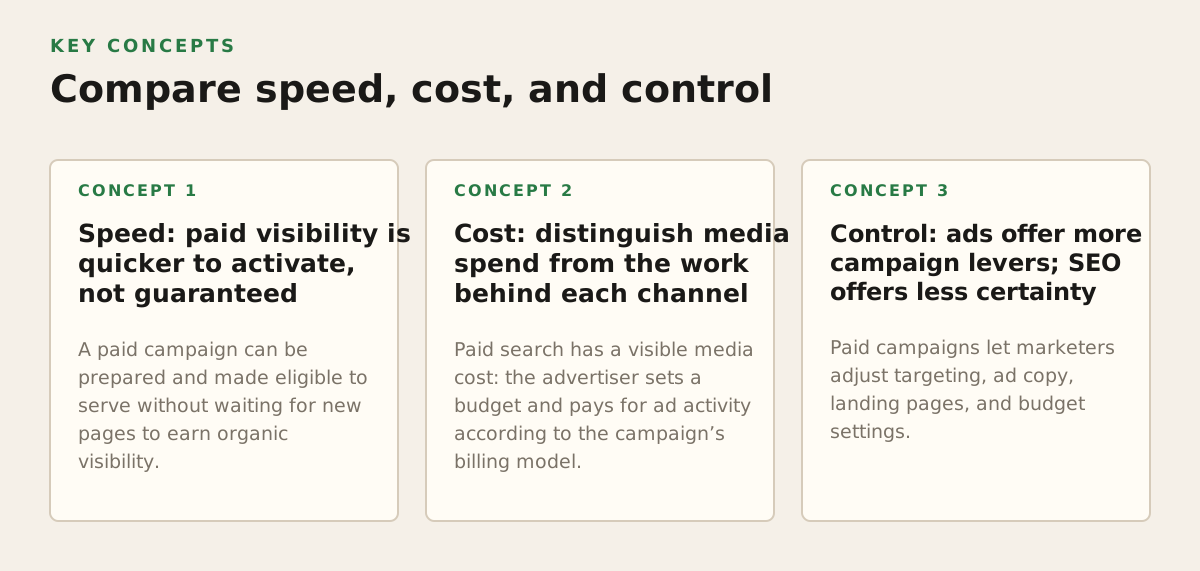
Speed: paid visibility is quicker to activate, not guaranteed
A paid campaign can be prepared and made eligible to serve without waiting for new pages to earn organic visibility. That makes it useful when a business needs to test a new offer, cover a seasonal period, or capture demand for a service with a short sales window. But an active campaign does not guarantee traffic: ads still need to be eligible and selected in auctions, and the landing page needs to make a compelling next step.
SEO usually involves a longer chain: identify a search need, create or improve a useful page, make sure it can be accessed and understood, and wait to see whether it earns visibility. Google’s documentation on how search works and SEO fundamentals is a useful reminder that search engines discover and process pages; a change to a page is not an instant placement. If an owner needs leads this month, SEO alone may not meet that immediate need. If the business can invest in building assets for future discovery, paid ads alone may leave that work undone.
Cost: distinguish media spend from the work behind each channel
Paid search has a visible media cost: the advertiser sets a budget and pays for ad activity according to the campaign’s billing model. Google’s documentation on average daily budgets explains how budgets guide campaign spending, including that actual spend can vary from the average on a given day. The budget is not the full cost of acquisition, however. Campaign setup, keyword research, ad creative, landing-page improvements, analytics, and staff or agency time also consume resources.
SEO does not mean “free traffic.” There may be no ad charge for an organic click, but the work takes resources: technical fixes, content planning and production, internal linking, and evaluation of what deserves updating. A small business often needs to decide whether it can do that work consistently or has to fund outside help. For an ecommerce brand, the effort may involve improving important category and product pages, not merely publishing more blog posts.
Compare the channels using the cost that matters to the business: total cost to produce a qualified outcome. A paid click that does not convert can still teach you something about search intent or a weak landing page, but repeated spend without a credible path to revenue is a warning. An organic visit is not automatically profitable either; if it comes from a low-intent query or lands on a page that does not support the purchase, visibility has limited business value.
Control: ads offer more campaign levers; SEO offers less certainty
Paid campaigns let marketers adjust targeting, ad copy, landing pages, and budget settings. Those controls make it easier to isolate a specific offer or market, but they do not let an advertiser dictate whether a particular search will show an ad. Campaign reach can also be constrained by competition, relevance, budget, and the advertiser’s own settings.
SEO is less direct. You can choose which pages to improve, what questions to answer, and how your site is organized, but you do not control the search results page or guarantee placement. Search engines set their own systems for evaluating and presenting results. Bing’s Webmaster Guidelines, for example, describe guidance for improving how content can be understood and indexed; they are guidance, not a promise of ranking. Treat SEO recommendations as changes to test and monitor, not levers with guaranteed outcomes.
Match the channel to the search and the business
Channel choice should follow the customer’s task and the business constraint—not a broad rule that one channel suits a particular company type. Separate searches where someone is ready to act from searches where they are still learning, then map each group to a page that can fulfil its intent.
- Urgent local need: A repair business may use paid search to pursue high-intent searches while building clear service pages that explain what it does and where it operates. Do not target locations the business cannot actually serve.
- Product discovery: An ecommerce team can use ads to test whether shoppers respond to a product category, while improving category pages with useful selection information and links to relevant products.
- Complex purchase: A B2B company may need educational pages that address evaluation questions, alongside ads for searches with stronger commercial intent. The landing page should match the promise in the ad.
- New offer: A business with little search visibility can use a small, controlled campaign to explore whether relevant searches exist, while deciding whether the opportunity justifies sustained SEO work. That is a testing approach, not proof that future organic performance will match ad results.
Use a few practical checks before assigning work or budget:
- Is there proven demand? If search terms and customer questions are well understood, prioritize pages and campaigns around those needs. If they are uncertain, use research or a limited test rather than assuming volume.
- How soon does the business need results? A deadline may make paid search a more direct route to test, but only if the landing page and follow-up process are ready. SEO is not a reliable substitute for an immediate sales plan.
- Can the business serve the traffic? Check stock, margins, lead response capacity, delivery or service area, and sales coverage before buying more clicks or attracting more organic visits.
- What is the value of a qualified conversion? Set a business-specific allowable acquisition cost using actual margins and conversion data. Do not copy a generic target or treat every lead as equally valuable.
For businesses targeting Bangladesh and other markets, keep market selection separate from language assumptions. Search behavior, product availability, service coverage, and the wording customers use can differ by market. Confirm those details with customer and sales data before building pages or setting campaigns around them.
Measure outcomes without confusing the channels
Clicks and impressions show whether a channel is generating visibility and visits; they do not establish whether it is creating profitable demand. Track actions that matter to the business—such as qualified enquiries, purchases, or completed bookings—and make sure the measurement is implemented consistently. Google’s guide to conversion tracking explains how advertisers can measure actions after an ad interaction. The setup still needs to reflect the business’s real definition of a conversion.
For organic performance, Google Search Console’s Performance report provides search-related metrics such as clicks, impressions, click-through rate, and average position. Use these to diagnose patterns, not to declare success from one metric in isolation. Rising impressions with weak engagement could indicate that a page appears for searches it does not answer well; more clicks without qualified leads could point to a mismatch between search intent, page content, and the offer.
Keep reporting useful by separating channel activity and connecting it to business outcomes. A basic monthly view might include:
- Organic: landing pages, search queries, clicks, and qualified conversions.
- Paid: campaign spend, search terms, clicks, and qualified conversions.
- Shared business context: conversion quality, sales follow-up, product availability, and any major changes to the offer or site.
Attribution has limits. A person may see an ad, return through organic search later, and convert through a direct visit. Reporting tools assign credit according to their measurement rules and available data; the credit shown is not necessarily a complete account of how the person decided to buy. Avoid concluding that one channel caused the whole outcome based only on a last-click report. Compare trends and ask whether the channel is contributing useful, qualified demand.
Build a channel mix you can actually maintain
Start with the constraint, not a fixed split
There is no universal percentage of budget or effort that belongs in SEO versus paid search. A new business with little data and a short-term sales requirement has a different problem from an established retailer with proven products and pages that already attract relevant searches. The starting mix should reflect the business’s current demand, cash-flow tolerance, site readiness, and capacity to fulfil orders or leads.
If quick demand validation is the priority, begin with a focused paid test and define what would count as a useful result before launch. Select a narrow set of relevant searches, send them to a page that matches the promise, and measure qualified outcomes rather than clicks alone. In parallel, document what customers ask and which pages are missing or weak. Do not treat the campaign’s early results as a guaranteed forecast for future campaigns or organic rankings.
If the business already receives meaningful organic visits, inspect which landing pages attract the right customers and where the experience breaks down. Improve pages that are relevant to profitable products or services before expanding into broad informational content. A useful internal link can help visitors move from a relevant answer to a product, service, or next step; when reviewing candidate connections across a site, the internal link opportunity tool may be relevant.
Use evidence to change the mix
Review results on a schedule that fits the sales cycle, rather than changing direction after a handful of clicks or a short fluctuation in rankings. Look for a specific reason to adjust:
- Pause or revise a paid search theme when it repeatedly attracts irrelevant searches or cannot meet the business’s allowable acquisition cost.
- Improve a landing page when relevant traffic arrives but visitors do not take the intended action.
- Expand SEO work when important customer needs are underserved by existing pages and the business can maintain the work.
- Reduce promotion of an offer when stock, service coverage, lead follow-up, or margins cannot support more demand.
When writing search snippets and page metadata, be accurate and useful rather than promising an offer the page does not deliver. Mr Haq’s meta description length checker is an owned resource for that task. For support with choosing and improving an SEO approach across technical SEO, content strategy, local SEO, link building, analytics, and AI search optimization, see Mr Haq’s SEO consulting information.
Authored with NotFair SEO
