


Small business advertising is the paid promotion of an offer to a defined audience, with a measurable action as its goal. To make it useful, choose one business outcome—such as a qualified enquiry or completed purchase—then match the channel, ad and destination page to that outcome. Track what happens after the click, compare results with your own business economics, and change one part of the campaign at a time. This gives a small team a practical way to test advertising without mistaking attention for sales.
Define the business outcome before choosing an ad platform
A campaign needs a narrower job than “get more customers.” That phrase does not tell you which customers matter, what they should buy, or how you will recognize a useful result. A focused brief makes those decisions explicit before campaign settings or creative start to shape them.
Choose an action that connects to revenue
For an ecommerce business, the desired action might be a completed order for a particular product or category. For a consultancy or service company, it might be an enquiry from a potential client who fits the firm’s actual offering. These actions are more informative than a page view because they are closer to a business result. A form submission can be a useful early signal, but it does not automatically mean that the enquiry is relevant or will become a customer.
Write down what counts as success in terms the person handling enquiries or orders can check. For example, a business could define a useful lead as an enquiry about a service it provides, from a market it can serve, with enough information for a follow-up. That definition helps distinguish campaign activity from the outcomes the business can act on.
Make the brief usable by the whole team
Before spending, record the offer, intended audience, action, measurement method and operating constraint. A constraint might be limited stock, a service area the company has confirmed it can cover, or a small team’s ability to respond to enquiries. These are not minor details: generating demand the business cannot fulfil can waste money and damage the customer experience.
- Offer: What product, service or next step is being promoted?
- Audience: What need or buying situation makes the offer relevant?
- Action: What should a suitable prospect do?
- Evidence: What recorded event or business record will show that it happened?
- Constraint: What limits fulfilment, follow-up or eligibility?
For an international company targeting customers in Bangladesh or another market, do not treat a location setting as proof that the business can serve everyone there. Confirm eligibility, language, payment or fulfilment arrangements where relevant, and the campaign’s actual targeting settings before launch.
Choose channels according to how customers find a solution
Channel selection is a question of customer context, not platform popularity. Search may suit a product or service that people already describe in a query. Social advertising may suit an offer that needs to be demonstrated or explained to a defined audience. Neither choice guarantees demand or a profitable result; each is a hypothesis to test against the campaign’s goal.
Use search when a need can be expressed in a query
Google describes Search campaigns as a way to show ads to people searching for products and services an advertiser offers; its Search campaign overview explains the format. The practical decision is whether a prospective customer’s query can be matched to a specific offer and a useful destination. A broad list of related phrases is not automatically a good audience: some searches may signal research, a different need, or an intent the business cannot serve.
For example, a retailer promoting a product category should send a relevant searcher to a page where that category and its purchase path are clear. A service firm should make the service and enquiry route easy to find. If the page does not answer the need implied by the query, the keyword can look relevant while the customer journey still fails.
Use social when the message can create or clarify interest
Social campaigns may be worth testing when a demonstration, image or concise explanation can help a particular audience understand why an offer matters. Decide what people should do next—a purchase, a visit to a product page, or a service enquiry—and make the destination support that action. Meta’s overview of ad objectives describes objectives in terms of the results a campaign is set up to pursue. Use that distinction to choose an objective aligned with the action you want, rather than choosing one merely because its label sounds appealing.
For local businesses, paid promotion and local organic visibility are separate considerations. Google says local results are mainly based on relevance, distance and prominence in its guidance on local ranking. Accurate business information and a suitable service area still matter; an ad should not be assumed to establish local eligibility or improve organic ranking.
- Search: Consider it when customers can describe the need in a query and you have a closely matched page.
- Social: Consider it when creative can explain or demonstrate the offer to a defined audience.
- Another channel: Add it only when you can state its distinct role and measure a meaningful outcome.
Start with the channel that has the clearest connection to the brief. If you cannot explain what a second channel adds to the customer journey, adding it may make results harder to interpret rather than making the campaign more complete.
Make the ad, offer and landing page agree
Advertising pays to bring attention to a message; it cannot make an unclear offer easy to understand. The ad should set a credible expectation, and the landing page should continue that same promise. If a page introduces a different product, unclear conditions or an unexpected next step, the visitor has to resolve the mismatch before acting.
Check the destination from the customer’s point of view
For a service company, the page should identify who the service is for, what it addresses and how to enquire. For an ecommerce brand, make the product or category and the route to purchase apparent. In either case, avoid claims about results, availability, discounts or delivery that the business cannot substantiate and honour.
- Does the ad name a specific product, need or relevant benefit?
- Does the destination repeat the same offer without an unexpected detour?
- Can a visitor find the details needed to decide whether to act?
- Can the team process the resulting order or enquiry?
There is also a distinction between paid ad copy and an organic search result description. If you are reviewing the length of a page description as part of that separate SEO task, the meta description length checker can help with that check; it does not assess whether an ad is persuasive or whether conversions are being recorded.
For a small team, the customer journey includes what happens after the form or purchase. Decide who receives an enquiry, how the team recognizes a suitable lead, and what happens when an order cannot be fulfilled. These operational checks help explain results: a campaign may produce relevant interest, while slow or inconsistent follow-up prevents that interest from becoming a sale.
Set a spending rule from your own economics
There is no responsible universal advertising budget without knowing a business’s margins, sales process, conversion rate, cash constraints and ability to serve additional customers. A platform’s suggested setting or an example budget elsewhere cannot replace those inputs. Instead, decide what a customer or qualified lead is worth to your business and what portion of that value could reasonably go toward acquiring one.
Work back from contribution, not headline revenue
For a product sale, consider the amount remaining after costs that vary with the sale, then account for the business’s other requirements before deciding how much it can allocate to acquisition. For lead generation, consider how many enquiries become customers, the value of those customers and the cost of serving them. A raw lead total can conceal poor fit: a campaign that attracts many unsuitable enquiries may be less useful than one that produces fewer appropriate prospects.
Write a campaign rule before launch: what you are willing to spend to learn, what evidence would justify continuing, and what would prompt a pause or change. Any initial limit should be labelled as an internal starting policy, not an industry benchmark. If results are sparse or tracking has not been verified, call the result inconclusive rather than declaring the channel successful or unsuccessful.
- Can the business afford the test without relying on a hoped-for return?
- Can it fulfil the advertised offer if demand arrives?
- Are the costs and customer outcomes used in the decision clearly defined?
- Is there a planned review point to continue, revise or stop?
This approach does not produce a budget figure from missing information. It gives the owner or marketing lead a decision rule tied to the business’s own capacity and economics, rather than to clicks or a borrowed benchmark.
Measure conversions and make tests interpretable
Measurement is useful only if the recorded event corresponds to an action the business values. Google’s conversion tracking overview explains that Google Ads can record actions such as purchases and sign-ups after someone interacts with an ad. The appropriate setup depends on the website, action and account configuration, so verify that the event records as intended before using campaign reports to make spending decisions.
Separate early signals from business outcomes
A page visit or button click may help diagnose where people leave the journey, but it is not the same as a purchase or a qualified enquiry. For a service company, a form completion can be an initial signal; a lead that fits the service and progresses through follow-up is more informative. For ecommerce, a completed purchase is more meaningful than a product-page view. Keep those stages distinct in reporting so an increase in activity is not mistaken for an increase in revenue.
When results disappoint, identify the point where the journey breaks before changing the whole campaign. If the audience is mismatched, review targeting or search terms. If people respond to the ad but do not act on the page, inspect the offer and destination. If enquiries arrive but do not become customers, check lead quality, follow-up and the sales process. Change one plausible cause at a time where possible; otherwise, it becomes difficult to learn what made a difference.
- Reach: Did the intended audience have an opportunity to see the campaign?
- Relevance: Do searches, placements and enquiries fit the offer?
- Action: Are recorded events real outcomes or just early signals?
- Economics: Do the resulting customers or qualified leads fit the spending rule?
- Operations: Can the team fulfil orders and follow up consistently?
Google’s Smart Bidding documentation describes automated bidding strategies that use conversion-related signals. Automation does not make a poorly defined conversion valuable or correct a mismatch between the ad and offer. First confirm that the campaign is measuring the intended business action; then assess whether automated bidding fits the campaign and the data available in the account.
If you are also improving organic pathways between related pages, the internal link opportunity tool is relevant to that internal-linking task. It is separate from measuring paid conversions and should not be treated as evidence of what caused an ad result.
Use AI assistance only with clear approval boundaries
AI-assisted campaign workflows can make account access and change control important parts of the evaluation. Before using any tool, establish what access it requires, which changes need human approval, how changes can be reversed and who checks the outcome. Those questions matter particularly when a campaign has limited stock, a constrained test budget or an offer with conditions that need careful review.
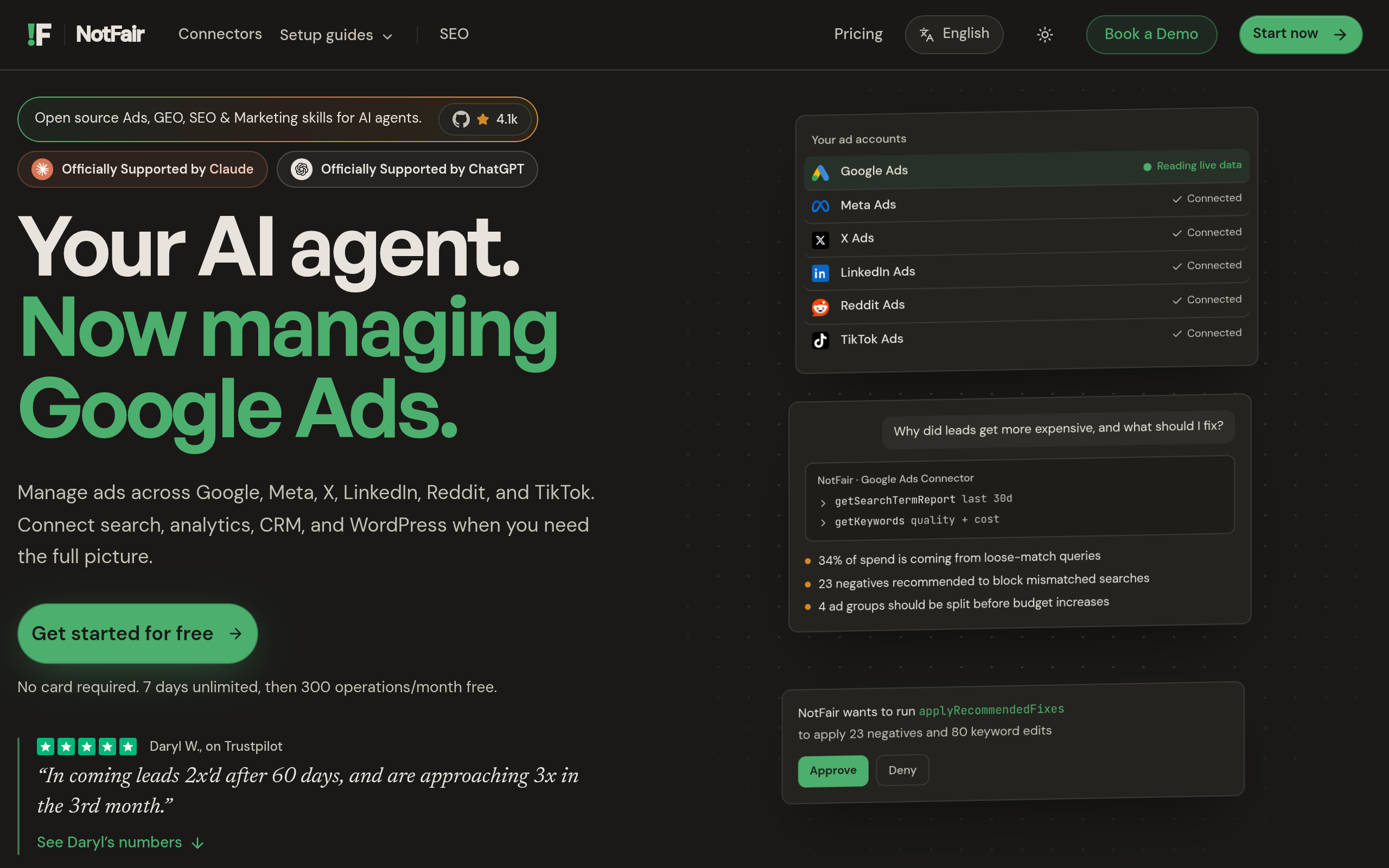
For evaluating AI-assisted options for managing and optimizing small business advertising campaigns, Google Ads connector points to NotFair’s page describing a Google Ads connection for AI clients and approval-gated campaign actions. Treat those details as the provider’s description, then verify the access, approval process and reversibility directly before relying on the tool.
Start with one focused campaign, one business action and one spending rule. Review whether the audience, page, recorded outcome and customer follow-up all support the same goal before adding channels or automation. Mr Haq offers SEO strategy and consulting across technical SEO, content strategy, local SEO, link building, analytics and AI search optimization; explore Mr Haq if organic visibility is part of your wider marketing plan.
Authored with NotFair SEO
