


What Local SEO Marketing actually means
Local seo marketing is the process of improving a business’s visibility when people search for products or services in a specific place, then converting that visibility into calls, visits, enquiries, bookings, or sales. It combines website optimization, Google Business Profile management, local relevance signals, reputation building, structured data, and measurement. The objective is not simply to rank for a city name; it is to become a credible and accessible answer for customers whose location, service area, or search wording indicates local intent.
That distinction matters because local search has several surfaces. A customer may see a map result, a local pack, an organic page, a product result, a review, or a branded knowledge panel before visiting a website. Each surface has different inputs and different failure modes. A restaurant with an accurate profile but a slow, unusable menu page has a conversion problem. A professional services firm with an excellent website but an unverified or incomplete business profile has a discovery problem.
Local intent is the organizing principle. A search such as “emergency plumber near me” is explicitly local. “Commercial lawyer Dhaka” contains a location modifier. “Best accounting software” may be non-local unless the searcher later adds a city or country. Your strategy should separate these intents rather than force every keyword into a location page.
The four assets a local strategy connects
- Business identity: the real-world name, address, phone number, opening hours, categories, service area, and contact details.
- Relevance: clear evidence that the business provides the searched service or product in the searched location.
- Prominence: independent mentions, reviews, links, citations, and other signals that support credibility.
- Conversion access: pages, forms, phone numbers, directions, booking systems, and product information that let the customer act.
Google describes Business Profiles as a way for businesses to manage how they appear on Search and Maps, including information such as hours, photos, and customer interactions. That makes the profile an important operational asset, but it is not a replacement for a useful website or a trustworthy business presence. See Google’s official guidance on how to improve your local ranking on Google for the platform’s stated local-ranking guidance.
For a multi-location retailer, local SEO may involve location pages, store inventory, local landing pages, and location-specific reviews. For an international company entering Bangladesh, it may involve country-level service pages, local contact options, language considerations, and evidence that the company can actually serve customers in Dhaka or another target market. For an agency, it may mean creating a repeatable process that preserves client-specific facts rather than publishing interchangeable city pages.
Why local visibility matters to revenue, not just rankings
Local search is valuable because it often appears close to a decision. A person searching for “orthodontist in Uttara,” “B2B software consultant Bangladesh,” or “same-day flower delivery Dhaka” is expressing a problem, a market, or a location. That does not guarantee a sale, but it gives the business a chance to present a relevant next step at the moment of need.
Visibility is only useful when the searcher can trust and contact you. A ranking report may show improvement while enquiries remain flat because the profile routes customers to a disconnected phone number, the page hides its service area, or the form fails on mobile. Local marketing therefore needs a funnel view:
- Discovery: impressions in map and organic results.
- Evaluation: profile views, page visits, reviews read, service details, pricing context, and brand searches.
- Action: calls, direction requests, quote forms, bookings, store visits, or completed purchases.
- Quality: qualified leads, revenue, repeat purchases, and the proportion of enquiries the business can serve.
A practical measurement system assigns a meaningful outcome to each business model. A local clinic may prioritize booked appointments, while an industrial supplier may need quote requests and sales-qualified calls. An e-commerce brand should separate organic product revenue from local store visits if it operates both online and offline.
Use a value model before choosing keywords
Keyword volume is a weak decision rule when it is disconnected from commercial value. A lower-volume service query can deserve more attention than a broad city query if the searcher has a clear need and the business can fulfil it profitably.
For an illustrative planning model, suppose a service business receives 40 tracked organic enquiries in a month, 25 are qualified, and 5 become customers. If the average gross profit per customer is 30,000 taka, the estimated gross profit influenced by those conversions is 150,000 taka. This is not a universal benchmark or a forecast; it is a starting model for deciding which calls and forms deserve reliable attribution.
Track the gap between visibility and commercial value:
- Record the query or landing page that generated the visit where available.
- Separate calls, forms, chats, bookings, and store actions instead of combining them into one “conversion” number.
- Mark whether each enquiry is inside the service area and matches the target service.
- Connect qualified opportunities to sales outcomes when the business can supply that information.
- Review revenue by location, service, and landing page rather than celebrating aggregate traffic.
Google Search Console’s Performance report can help inspect clicks, impressions, queries, pages, and countries, while analytics and a CRM are needed to understand what happened after the click. Google documents the Search Console Performance report and its dimensions here: official Search Console performance reporting guidance. Search data is directional, not a complete record of every offline interaction.
For a Nepal-based business choosing an agency, professional SEO services can help you assess providers that cover search engine optimization and related digital marketing needs, so you can compare how an agency would improve local and organic search visibility rather than selecting on a ranking promise alone.

How Local SEO Marketing works in practice
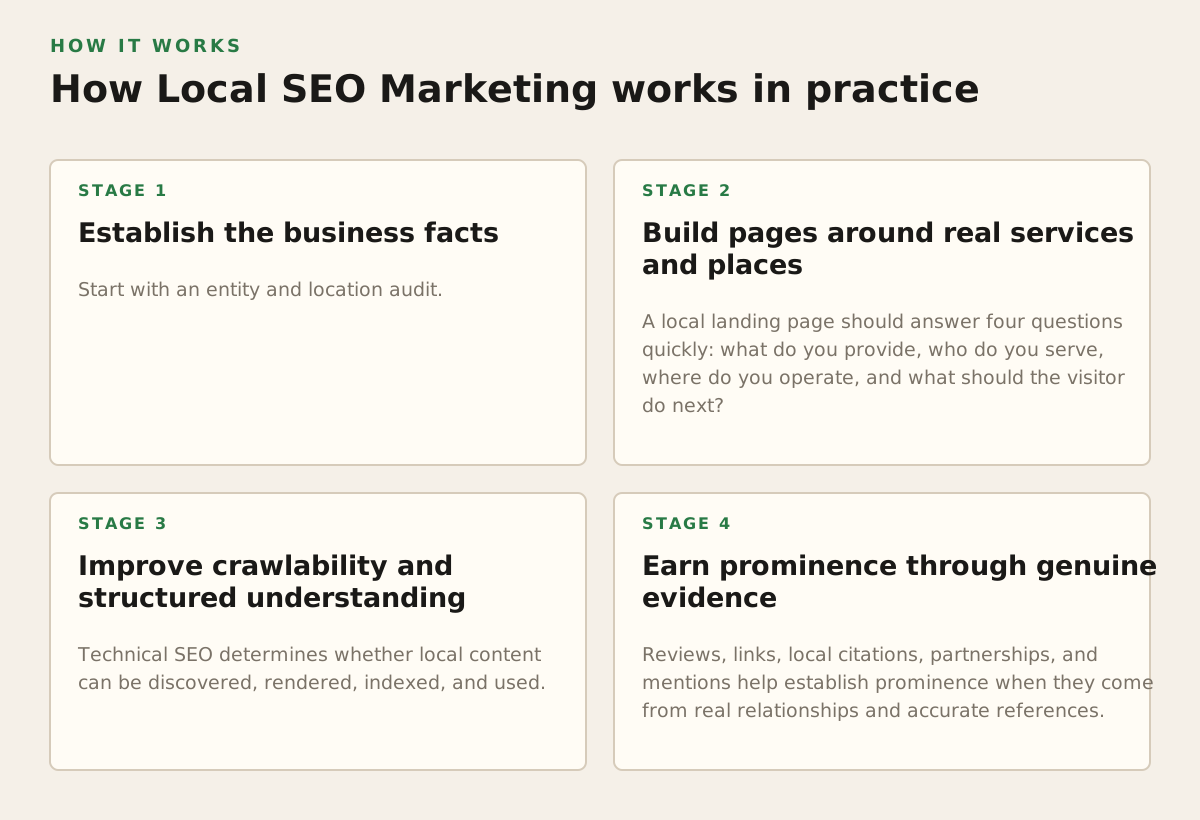
A strong local program is a system of aligned signals. The profile, website, customer experience, reviews, links, and measurement should describe the same real business. The work is less about adding a city name everywhere and more about reducing uncertainty for both search engines and customers.
1. Establish the business facts
Start with an entity and location audit. Confirm the legal or customer-facing name, physical address or service-area model, phone number, website, hours, categories, and the services actually delivered. Decide whether the business serves customers at a storefront, visits customers, or operates as a hybrid. Do not publish a location page for an office that cannot receive customers or represent a service area that the business does not cover.
Business Profile categories deserve deliberate selection because they describe what the business is, not every service it offers. Additional services can be explained in the profile and on the website. Google’s Business Profile documentation should be consulted for current eligibility and management requirements because platform rules can change.
2. Build pages around real services and places
A local landing page should answer four questions quickly: what do you provide, who do you serve, where do you operate, and what should the visitor do next? A page for “office fit-out contractor in Dhaka” should contain more than a swapped city label. It might include project types, building constraints, service boundaries, process stages, evidence, FAQs, and a quote path.
Distinct local pages need distinct customer value. Create separate pages when the service, customer need, inventory, team, or operating area genuinely changes. Consolidate pages when they only differ by a tokenized city name and provide no unique information. Thin location pages create maintenance overhead and can make the site appear manufactured.
Useful page components may include:
- A specific service explanation written for the target market.
- Clear service-area language, including exclusions where relevant.
- Local proof such as completed projects, named neighborhoods, client types, or independently verifiable testimonials.
- Practical contact details, response expectations, accessibility information, and a clear call to action.
- Related internal links to services, resources, case studies, and contact pages.
When optimizing snippets, write a concise title and meta description that explain the page’s value instead of repeating a keyword. If a team is managing many location pages, the meta description length checker helps check whether descriptions are being truncated or overloaded while reviewing them manually for uniqueness and accuracy.
3. Improve crawlability and structured understanding
Technical SEO determines whether local content can be discovered, rendered, indexed, and used. Check indexation, canonical tags, redirects, mobile usability, internal links, page speed, XML sitemaps, and broken contact paths. A page that ranks but loads a blank booking widget is not a successful local asset.
Structured data can clarify entities and page content, but it cannot compensate for inaccurate visible information. Google’s documentation for LocalBusiness structured data explains the supported properties and implementation considerations. Use the most specific appropriate subtype when it is accurate, keep the markup consistent with the page, and validate changes before deploying them broadly.
For an illustrative technical QA sample, a business might prioritize these checks for its highest-value locations:
- Every target page returns a successful, indexable response.
- Each page has one clear canonical URL and at least one relevant internal link.
- The primary service, location, phone, and conversion path are visible without relying on an unstable script.
- Structured data reflects visible business information and does not invent reviews, prices, or departments.
- Forms, click-to-call links, map links, and booking steps are tested on common mobile devices.
4. Earn prominence through genuine evidence
Reviews, links, local citations, partnerships, and mentions help establish prominence when they come from real relationships and accurate references. A chamber of commerce listing, professional association profile, supplier page, local news story, community sponsorship, or relevant industry directory may be useful when the connection is genuine.
Link building should follow business relevance, not city-count targets. Buying a large batch of unrelated directory links can create cleanup work without improving customer confidence. A better prospecting question is: “Would this mention make sense if search engines did not exist?” If the answer is no, the opportunity deserves skepticism.
Review acquisition should also be operational rather than manipulative. Ask genuine customers for honest feedback through a consistent process, respond to concerns professionally, and avoid offering rewards for positive sentiment or writing reviews on customers’ behalf. A review profile with unresolved complaints can reveal a service problem that no optimization can permanently hide.
5. Connect the profile to the customer journey
Every profile feature should lead to a usable next action. Verify that the website URL goes to the relevant page, the phone number reaches a staffed line, hours reflect holidays where applicable, and appointment or ordering links work. Use tracking carefully so that measurement does not interfere with the destination or create inconsistent URLs.
For businesses serving multiple markets, use a location architecture that matches operations. A Bangladesh-focused company may need country and city pages, but it should not imply local offices in places where it has none. An international e-commerce brand may benefit more from market-specific delivery, returns, currency, and customer-support information than from dozens of generic city pages.
Where local SEO programs break
Most local failures are not caused by one missing keyword. They come from contradictions, weak operational ownership, or a strategy built around metrics that the business cannot act on.
Inconsistent business information
A changed phone number may remain on old directory listings, an outdated address may appear in a footer, and the profile may show holiday hours that conflict with the website. Search engines can often reconcile variations, but inconsistency increases user doubt and creates support problems. Maintain a controlled source of truth and record where the business is listed.
Unverifiable locations and scaled pages
Publishing pages for every nearby city can appear attractive in a spreadsheet. It becomes risky when the company has no staff, projects, delivery capability, or customer evidence in those places. The page may attract impressions but fail to convert, and maintaining false local relevance weakens trust with prospects.
Ask these questions before launching a location page:
- Can the business fulfil the stated service in this area?
- Is there unique information a customer in this place needs?
- Can the team support the page when hours, staff, or service boundaries change?
- Is there a measurable conversion path for this location?
- Would a customer consider the page honest after contacting the business?
Over-optimizing names, anchors, and copy
Adding service keywords to a business name when they are not part of the real-world name is not a harmless shortcut. Likewise, forcing the same phrase into every heading, image alternative, anchor, and review request produces unnatural content. Google’s Search spam policies provide the relevant framework for evaluating manipulative practices; the safe principle is to represent the business accurately and create content for customers first.
Ignoring the conversion and sales layer
Ranking reports cannot explain why sales staff miss calls, why forms go unanswered, or why the landing page attracts requests outside the service area. Create a feedback loop between SEO, reception, sales, and operations. If a campaign generates ten enquiries but eight are for a service the business does not offer, the issue may be targeting or page messaging rather than a ranking success.
Misreading temporary volatility
Local rankings change by location, device, query wording, personalization, competition, and business-profile activity. A single manual search is not a reliable evaluation method. Compare consistent query groups, landing pages, locations, and time periods, and annotate major changes such as address moves, website migrations, service closures, or review-profile events.
Penalty recovery requires additional restraint. First distinguish a manual action from an algorithmic decline, technical deindexation, lost links, changed intent, or a market competitor improving. Preserve evidence, remove manipulative practices, improve affected pages, and use the appropriate Google documentation and Search Console messages rather than making random edits across the site.
How practitioners apply local SEO for different business models
The same fundamentals produce different work plans depending on how a business earns money. A consultant should begin with the customer journey and operating constraints, not with a generic checklist.
Single-location service businesses
A dentist, law firm, repair company, or accounting practice usually needs a strong service architecture around its primary location. Create pages for high-value services, explain who is suitable for each service, show credible expertise, and make contacting the business easy. Local proof should be specific without exposing private customer information.
The first starting policy may be to fix the profile and contact journey, then improve the three or four services most closely tied to revenue. That is an illustrative prioritization approach, not a universal rule. Expanding into every possible service before the core pages work often spreads limited review, content, and sales capacity too thin.
Service-area businesses
Plumbers, home-care providers, cleaning companies, and mobile technicians need precise service boundaries. Explain where the team travels, whether travel fees apply, how appointment windows work, and what customers should prepare before requesting a quote. A city list without operational detail is less useful than a clear service-area policy.
Retailers and e-commerce brands
Retailers should connect local discovery with stock, collection, delivery, returns, and store information. If a product is unavailable locally, do not imply immediate pickup. Use accurate inventory and availability language, and distinguish local-store pages from category and product pages.
E-commerce brands targeting Bangladesh or international markets should also resolve market-specific concerns: delivery coverage, payment methods, duties where relevant, customer support, returns, and language. These details influence conversion even when the initial search is broad rather than explicitly local.
Multi-location organizations
Build a location system that can be maintained. Each location page should have a stable URL, unique operational details, accurate opening information, nearby service context, and a clear relationship to the main organization. Centralize templates, but allow local teams to supply facts, photos, offers, and updates.
A useful governance table might look like this:
| Asset | Owner | Review trigger | Primary measure |
|---|---|---|---|
| Business Profile | Local operations | Address, hours, category, or staff change | Calls, actions, and qualified enquiries |
| Location page | SEO and content | Service, coverage, or contact change | Organic visits and conversion rate |
| Reviews | Customer experience | Recurring complaint or service issue | Review quality and response resolution |
| Reporting | Marketing and sales | Tracking or CRM change | Qualified opportunities and revenue |
Agencies and white-label teams
Agencies need a repeatable workflow without flattening every client into the same template. Start with an intake that captures locations, legal name, service boundaries, priority services, competitors in the client’s actual market, lead-handling rules, and prohibited claims. Report actions and consequences, not just a list of tasks.
A useful monthly report can separate:
- Profile and technical changes completed.
- Landing pages and content published or improved.
- Queries, pages, locations, and devices showing movement.
- Calls, forms, bookings, and qualified leads.
- Open risks, unresolved tracking issues, and next decisions.
Internal linking is particularly valuable when a local site has service pages, location pages, guides, and case studies that have grown independently. The internal link opportunity tool can surface relevant connections, but a strategist should approve each recommendation based on user intent and page importance rather than adding links mechanically.
How to prioritize and measure the work in 2026
Begin with a baseline that the business can reproduce. Record the verified locations, target services, current profile status, indexed pages, organic landing pages, calls, forms, bookings, and sales-quality signals. Then classify problems by business risk and expected usefulness.
- Protect accuracy first: correct misleading contact information, hours, service areas, and broken conversion paths.
- Fix discoverability: resolve indexation, canonical, internal-linking, rendering, and mobile usability issues on valuable pages.
- Improve relevance: strengthen service and location pages with information customers genuinely need.
- Build evidence: earn appropriate reviews, local mentions, partnerships, and links through real business activity.
- Improve measurement: connect search actions to qualified leads, sales stages, and revenue where possible.
Use a dashboard that answers decisions rather than displaying every available metric. At minimum, separate branded from non-branded queries, map actions from website sessions, and total leads from qualified leads. Segment by location and service so a strong brand page does not hide a weak commercial page.
For a small business, an illustrative 90-day starting policy could focus on one profile cleanup, three priority service pages, one conversion audit, a review-request process, and a baseline report. The number is a planning example, not a guaranteed timeline or ranking expectation. A larger organization may need governance, permissions, feed management, and location-level ownership before content expansion is sensible.
Use annotations for meaningful changes: a migration, category edit, address change, new service, tracking deployment, review incident, or major content revision. When performance moves, annotations help distinguish correlation from a plausible cause. Avoid claiming that one edit caused an outcome unless the measurement design supports that conclusion.
The right recommendation is usually a focused operating system, not a larger keyword list. Make the business facts consistent, create pages that reflect real services and places, earn credible prominence, remove conversion friction, and tie reporting to qualified demand. For technical SEO, content strategy, local visibility, E-E-A-T, analytics, and AI search optimization support, Mr Haq can help turn that prioritization into an accountable plan through Mr Haq.
Authored with NotFair SEO
