


Local SEO for small businesses works best when it connects a real service area, a trustworthy business profile, useful local content, and a conversion path that does not waste a visitor’s time. This guide gives you a practical sequence for building that system in 2026, whether you run a Dhaka consultancy, an e-commerce brand with local delivery, a construction company, or an agency managing several client locations. The outcome is a prioritized local search plan you can execute, measure, and adjust instead of a collection of disconnected directory listings.
Define the local search opportunity before changing anything
The first mistake is treating “local SEO” as one task. It is a set of decisions about who can buy from you, where you can serve them, and which search situations show buying intent. A local bakery, a legal practice, and a Bangladesh-based software company targeting international buyers should not use the same location strategy.
Separate location intent from audience location
Start by classifying the business into one of three operating models:
- Physical-location business: customers visit a staffed location, such as a clinic, showroom, restaurant, or repair shop.
- Service-area business: the company travels to customers or serves them at their premises, such as a plumber, builder, photographer, or cleaning company.
- Hybrid or market-based business: the company has an office or store but also sells online or serves customers across several regions.
This classification affects your page structure, profile details, service-area claims, and conversion design. A service-area business should not imply that every neighborhood has a staffed branch. An e-commerce brand should not create doorway pages for every district merely because it ships there.
Make a simple demand map using four inputs:
- The locations you can serve profitably.
- The services or products with sufficient margin.
- The problems customers describe in their own words.
- The evidence you can provide that the business genuinely operates in that market.
Use Google Search Console query data, phone-call notes, sales-team questions, customer reviews, and search suggestions as discovery inputs. Search Console can help you inspect queries and pages associated with your site, but it does not replace customer research. A keyword with a location name is not automatically a qualified lead.
Turn the opportunity into a service-location matrix
| Service or product | Priority location | Search intent | Proof available | Primary conversion |
|---|---|---|---|---|
| Residential roof repair | Mirpur, Dhaka | Urgent, ready to contact | Project photographs, warranty details, customer reviews | Call or inspection request |
| Technical SEO consulting | Bangladesh and international markets | Research and comparison | Methodology, process explanation, reporting examples | Consultation form |
| Custom furniture | Dhaka metro area | Product discovery and comparison | Dimensions, materials, delivery terms | Quote request or store visit |
Rank each row using commercial value, proof strength, and operational reach. An illustrative starting policy is to choose no more than three priority service-location combinations for the first 90 days. That is not a universal benchmark: expand the number when your team can create distinct evidence and answer leads promptly; narrow it when pages become generic or sales follow-up is inconsistent.
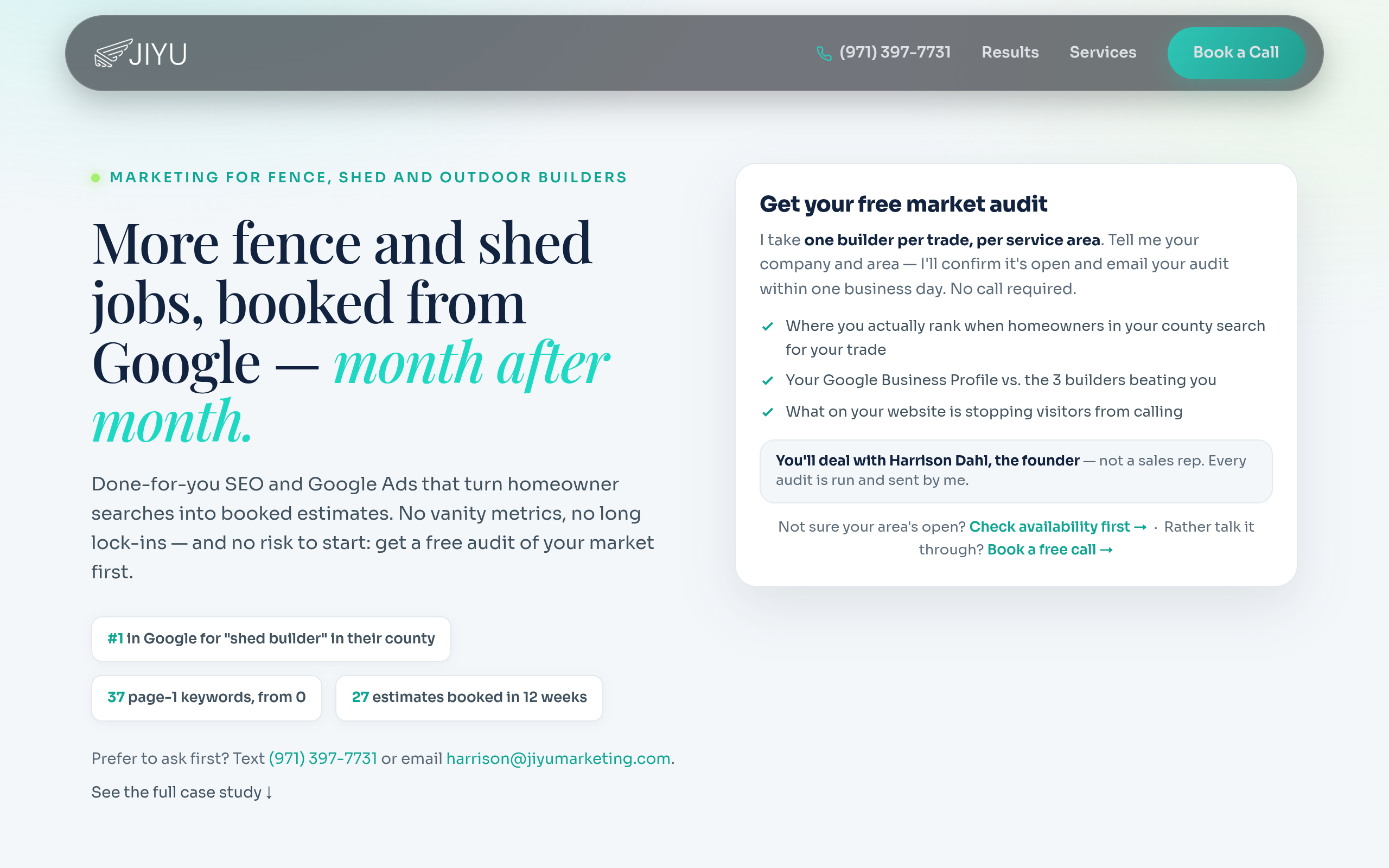
For a construction or home-service company, the guide on local SEO for builders explains how to evaluate local SEO service options, including Google Business Profile, lead generation, website conversion, reputation management, and AI search optimization. Use it to compare providers against the actual needs of a small construction business rather than buying a vague “ranking package.”
Fix the business foundation and Google Business Profile
Local visibility is difficult to sustain when the underlying business information is ambiguous. Establish one canonical version of the business name, address or service area, phone number, website, opening hours, and primary category. Google’s official Business Profile guidance explains how businesses can add or claim a profile and manage information shown to customers; use that documentation as the operating reference rather than relying on an old checklist. Google’s Business Profile guidance is especially useful when ownership, verification, or location details are unclear.
Complete the profile for a customer, not an algorithm
Work through the profile in this order:
- Confirm ownership and remove duplicate or obsolete profiles where appropriate.
- Choose the most accurate primary category, then add only relevant secondary categories.
- Write a concise description that explains the offer, market, and differentiator without promotional keyword stuffing.
- Add current hours, holiday hours, phone details, appointment options, products, services, and location information that the business can actually support.
- Upload original photographs that show the premises, team, products, completed work, or service process.
- Inspect the customer-facing profile on mobile and test every call, direction, booking, and website action.
Category accuracy matters more than category quantity. A dentist should not add unrelated categories because they contain popular searches. A builder should distinguish between the work it performs and trades it merely subcontracts. If the profile promises a service that the business cannot deliver, visibility may create operational problems rather than revenue.
Build a review process that does not create policy risk
Ask customers for honest feedback after a completed transaction or resolved service issue. Do not offer rewards for positive reviews, ask staff to post reviews, or pressure customers to use specific wording. Create a repeatable request process:
- Identify the point at which the customer has experienced the promised value.
- Send a neutral request with a direct route to the review platform.
- Thank the customer whether the feedback is positive or negative.
- Respond to useful criticism with a specific operational answer.
- Log recurring complaints and assign an owner to fix the underlying issue.
Reviews are not a substitute for service quality. They are also not the only form of local proof. A service page with clear credentials, staff information, project details, photos, and contact options can help a prospect decide even when the review count is modest.
Build pages around real local decisions
Once the business foundation is reliable, create a page system that answers the questions customers ask before contacting you. The goal is not to publish a separate page for every place name. The goal is to make each important page locally specific, commercially useful, and distinct from nearby pages.
Choose the right page type
| Search situation | Best page type | What must be different | Conversion element |
|---|---|---|---|
| “Emergency electrician in Uttara” | Service-area landing page | Availability, response process, local operating details, relevant proof | Call and urgent request form |
| “SEO consultant in Dhaka” | Core service page | Methodology, deliverables, audience, reporting, engagement fit | Consultation request |
| “Best material for humid climate furniture” | Local educational article | Climate, maintenance, product trade-offs, local buying context | Product or quote link |
| “Brand showroom near me” | Location page | Address, access, hours, inventory or appointment expectations | Directions or visit booking |
A location page should earn its existence. Include local staff or process information, service boundaries, relevant case evidence, directions where applicable, and a clear explanation of what happens after contact. If replacing the location name leaves the page unchanged, it is probably a thin template rather than a useful local asset.
Use a page brief before writing
For each priority page, record:
- The exact customer problem and the likely stage of the buying journey.
- The location actually served and any exclusions.
- The unique evidence available for that market.
- The questions a sales representative repeatedly answers.
- The primary and secondary conversion actions.
- Internal pages that should receive contextual links.
Use plain language for local differences. “We deliver to Dhanmondi on weekdays and confirm the delivery window by phone” is more useful than repeating “Dhanmondi delivery service” throughout a page. Include local terminology only when customers genuinely use it, and explain unfamiliar terms for international audiences.
Google’s SEO Starter Guide emphasizes making content useful, readable, and discoverable rather than writing for search engines alone. The official SEO Starter Guide supports this user-first approach and is a better foundation than a keyword-density target.
Worked example: a Dhaka home renovation company
Assume “Nirman Home Works” serves selected Dhaka neighborhoods and wants more qualified renovation enquiries. Its initial plan should not create 20 nearly identical neighborhood pages. A stronger first set might include:
- A renovation service page explaining the process, project types, materials, timeline dependencies, and quotation method.
- A Dhaka service-area page identifying the neighborhoods served and the conditions that affect site visits.
- A kitchen renovation page with layout decisions, waterproofing considerations, material options, and project photographs.
- A project article showing how a small apartment renovation handled access, dust control, and resident scheduling.
The local page earns its place through operating details and proof. The project article earns its place through experience. The service page explains the commercial offer. Together, they serve different search needs and create a sensible route from discovery to enquiry.
Strengthen technical access, trust, and local relationships
Local pages cannot perform reliably if search engines or customers encounter technical friction. Run a crawl and inspect the pages that matter most, not just the homepage. Check indexability, canonical URLs, redirects, mobile rendering, internal links, page titles, headings, form delivery, and analytics events.
Use a local technical checklist
- Confirm the preferred HTTPS version resolves consistently.
- Check that important service and location pages are linked from navigation or relevant content.
- Remove accidental noindex directives from pages intended to attract organic traffic.
- Test forms, click-to-call links, map links, and booking actions on a mobile device.
- Compress oversized images and provide descriptive alternative text where images convey information.
- Review duplicate URL parameters, trailing-slash variations, and old location pages.
- Submit or inspect the XML sitemap in Search Console after major structural changes.
- Check whether templates introduce repeated titles, empty headings, or misleading business details.
Do not treat structured data as a shortcut to rankings. It helps communicate page entities and eligibility for certain search features, but the visible page still needs to be accurate. Google’s Local Business structured data documentation describes the properties and implementation considerations for local business markup; consult Google’s Local Business structured data documentation before adding or extending a schema template.
Use the most specific applicable business type supported by your implementation, keep the markup consistent with visible content, and validate it after template changes. Schema.org also maintains the vocabulary for LocalBusiness types and properties at its LocalBusiness reference. Neither source justifies inventing an address, rating, price, service area, or opening hour.
Earn local relevance beyond your own website
Local authority is built through genuine relationships, not mass directory submissions. Consider:
- Trade associations where the business is a legitimate member.
- Local suppliers, manufacturers, or partners that can describe the relationship accurately.
- Community organizations that the company supports through a real activity.
- Industry publications that cover a useful project, opinion, or local issue.
- Professional profiles and business directories with editorial standards and accurate information.
Ask for a relevant mention, not an exact-match anchor text. A supplier describing a completed project may naturally link to a case study. A community organization may link to a sponsorship page. If the only reason for a link is payment or an exchange, document the relationship and review the applicable search guidelines before proceeding.
For a business recovering from a ranking loss, audit link patterns, manual actions, hacked pages, and major content changes separately. Google publishes its spam policies at the official Search Essentials spam policies page; use it to distinguish a technical indexing problem from manipulative tactics or low-value scaled content.
Create a measurement system tied to leads and revenue
Rankings are diagnostic signals, not the final business outcome. A local strategy should show whether the right people discover the business, take a meaningful action, and become qualified opportunities. Set up measurement before publishing a large batch of pages so you can learn which service-location combinations deserve more investment.
Define the funnel events
| Stage | Useful signal | Question it answers | Common interpretation error |
|---|---|---|---|
| Discovery | Impressions and queries | Are we appearing for relevant demand? | Assuming every impression represents a viable customer |
| Consideration | Organic clicks, engaged visits, service-page views | Does the result and page match the need? | Celebrating traffic that never reaches a commercial page |
| Action | Calls, forms, bookings, direction requests | Can visitors contact or visit us? | Counting spam submissions or accidental taps as leads |
| Quality | Qualified enquiries and sales value | Does visibility support the business model? | Optimizing for volume while sales rejects the leads |
Track conversion actions consistently across the website and, where practical, connect lead records to source and landing page. A call from a local page should not be treated the same as a newsletter signup if the business values them differently. For e-commerce, measure product discovery, add-to-cart activity, checkout completion, delivery-region eligibility, and revenue by landing page.
Use illustrative starting policies, then adjust from signals
Numeric rules can make execution easier, but they are policies, not universal SEO benchmarks. For example, you might review priority pages every 30 days, require at least two independent proof elements before launching a new location page, and reserve a quarterly cleanup for outdated business information. Adjust these starting policies when Search Console shows impressions without clicks, analytics shows engagement without enquiries, sales reports poor lead quality, or operations cannot fulfill the advertised service.
Similarly, an illustrative starting policy could be to publish one substantial local page or case study per priority service-location combination each month. Increase that cadence only when subject-matter input, original evidence, and editorial quality are available. Reduce it when pages repeat one another or customer service cannot handle the demand.
Use Looker Studio to combine Search Console, analytics, call-tracking exports, and CRM data only when the definitions are documented. A dashboard with attractive charts but mismatched date ranges or duplicate conversions can lead an agency or business owner toward the wrong decision. Define each metric in a short data dictionary:
- What counts as an organic lead?
- Which calls are excluded as spam or existing-customer support?
- When is a lead considered qualified?
- Which location is assigned when a customer serves multiple areas?
- Which date represents the conversion: first contact, qualification, or sale?
For title and description checks across a content inventory, the meta description length checker can help you review whether important snippets are truncated or unclear. Treat the output as an editing aid, not as a promise that a particular length guarantees a ranking or a click.
Improve the system through prioritization and iteration
After the first implementation cycle, resist the urge to change everything. Compare pages and queries by intent, location, conversion quality, and evidence strength. The most valuable opportunity may be a page that already receives impressions but has a weak result title, unclear service boundaries, or a buried contact route.
Use a four-bucket optimization queue
- High impressions, low clicks: review search alignment, title clarity, page reputation, and whether the result promises what the page delivers.
- Clicks, low engagement: inspect page speed, above-the-fold clarity, mobile usability, mismatch between query and content, and intrusive forms.
- Engagement, low leads: improve proof, offer clarity, contact friction, pricing explanation where appropriate, and response expectations.
- Leads, low qualification: tighten service areas, eligibility language, forms, product details, and campaign targeting.
This framework prevents a common agency failure: reporting traffic growth while the client’s sales team receives unsuitable enquiries. It also helps international businesses separate country-level visibility from city-level demand. A page can attract visitors from Bangladesh while failing to convert the specific Dhaka customer it was built to serve.
Build internal links as decision paths
Internal links should help a visitor move from a question to a service, from a service to proof, and from proof to contact. Link from an educational article to the relevant service page when the reader is likely to need it. Link from a location page to the service that is actually available there. Use descriptive, natural anchor text and avoid turning every local mention into an exact-match keyword.
The internal link opportunity tool can surface possible connections across an existing site, which is useful when a growing e-commerce catalog or agency resource library has orphaned commercial pages. Review every suggestion manually: relevance, placement, user value, and destination quality matter more than the number of links added.
Account for AI-assisted search without abandoning fundamentals
In 2026, businesses may also want to appear in AI-generated answers and conversational discovery systems. The practical response is not to produce large volumes of generic AI-written pages. Make important facts easy to verify: who serves the customer, where, under what conditions, with what qualifications, evidence, limitations, and next step.
Use consistent organization details, clear service definitions, expert-reviewed explanations, original project evidence, and accessible page content. Markup can support interpretation, but it cannot compensate for contradictory business information or unsupported claims. For regulated, safety-sensitive, or high-stakes services, add an appropriate reviewer and update process.
Document changes in an SEO log. Record the date, page, change, reason, expected signal, and result. An illustrative starting policy is to wait through a meaningful observation period before judging a non-urgent content change, but adjust the period when seasonality, a site migration, a penalty investigation, or a major business change makes the comparison unreliable.
What to do first: complete a one-page local opportunity audit
Start with one priority service and one priority location, not the entire business. In a single working session, verify the business profile, choose the page that should receive local demand, inspect its conversion path, and write down the evidence you can publish. Then compare that page with the customer questions and competitors appearing for the same search intent.
Your first 10 actions should be:
- Choose the service-location combination with the strongest commercial value and operational reach.
- Record the canonical business name, contact details, hours, and service boundary.
- Check the Google Business Profile for ownership, category, accuracy, photos, and customer actions.
- Inspect the relevant website page for indexability, mobile usability, clarity, and conversion friction.
- Collect three customer questions and three proof assets from sales or operations.
- Rewrite or create the page so it explains the local offer without interchangeable location text.
- Add only the internal links that help the visitor decide or contact the business.
- Define calls, forms, bookings, or purchases as measurable conversion events.
- Create a review-request and response process that asks for honest feedback.
- Schedule a 30-day review using impressions, clicks, qualified leads, and operational feedback.
Those timing and quantity figures are illustrative starting policies, not guaranteed SEO timelines. Change them when your data shows a different constraint: insufficient demand, poor lead quality, slow sales response, weak evidence, seasonal behavior, or a technical issue affecting access.
Once the first service-location combination is clean and measurable, use the same decision framework to expand. Mr Haq helps businesses and agencies turn technical SEO, content strategy, local search, E-E-A-T, analytics, link building, and AI search optimization into an accountable growth plan; Mr Haq is the appropriate next step when you need a strategist to prioritize the work with you.
Authored with NotFair SEO